ADVERTISEMENT
ADVERTISEMENT



How the Protests in PoJK Expose the Great Myth of “Azad” Kashmir
-
 Omer Ghazi
 - Sun, 14, Jun 2026
- 15:31 EDT
- 390
 Representative Image / Unsplash
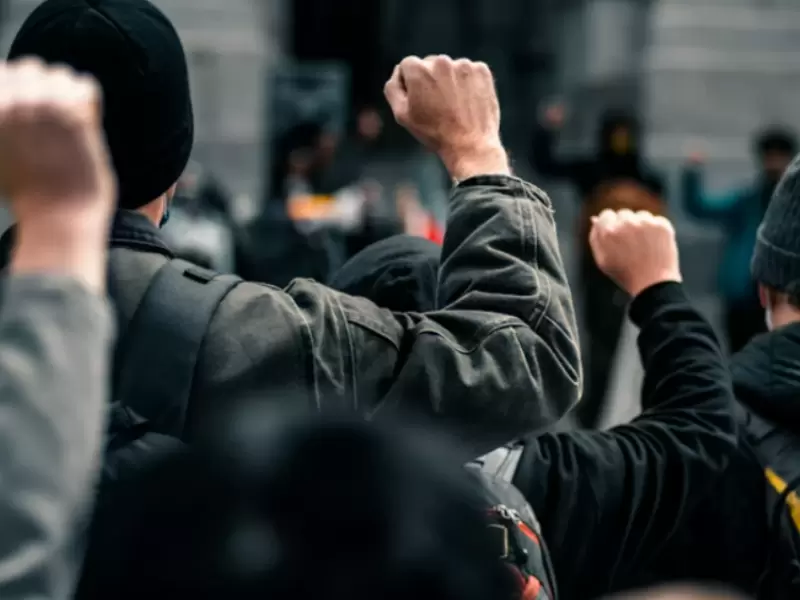
The current unrest in Pakistan-occupied Jammu and Kashmir (PoJK) is about far more than a protest movement or a dispute over political representation; rather, it strikes at the very foundation of what Pakistan has long claimed PoJK to be. Referred to by Pakistani state as "Azad Jammu and Kashmir" or "Free Kashmir", the name is intended to serve as a political statement about Pakistan's supposed commitment to Kashmiri aspirations.
But names alone cannot conceal reality. An "Azad" region where internet access can be curtailed during political unrest, where protesters can be labelled extremists, and where demands for accountability are met with coercion rather than dialogue begins to raise an obvious question: free from whom, and free to do what? If the measure of freedom is the ability of citizens to criticise those who govern them, organise politically, and peacefully express dissent without fear of repression, then the events unfolding in PoJK have exposed a gap between the rhetoric of "Azad Kashmir" and the reality currently experienced by many of its residents.
That, in fact, is the central contradiction at the heart of Pakistan's Kashmir policy. For years, Islamabad has argued that political dissent in Kashmir must be heard, that grievances cannot be suppressed through force, and that the aspirations of ordinary Kashmiris deserve international attention. These principles have formed the moral foundation of Pakistan's case on Kashmir. Yet the moment similar arguments are directed towards Pakistan itself, the vocabulary changes. Protesters become troublemakers. Activists become foreign-backed agents.
Demands for representation become threats to national security. The Kashmiri, it seems, enjoys an unquestionable right to self-determination only when that right is exercised against India. When it is exercised against Pakistan, it suddenly acquires limits. This is not merely a question of political inconsistency. It is a question of credibility. A state cannot indefinitely champion a principle abroad while suppressing its expression at home without eventually exposing the hollowness of its own narrative.
What makes the current protests particularly uncomfortable for Islamabad is that they cannot be dismissed as an extension of the India-Pakistan dispute. The demonstrators are not marching under the Indian flag; instead, their grievances are rooted in questions of governance, representation, accountability and the relationship between PoJK and the Pakistani state. In other words, it is a story about Pakistan's own conduct in a territory it has governed for decades. That is precisely why the usual playbook appears to be struggling. It is far easier to rally public opinion against an external adversary than to answer difficult questions from within the territory you claim to control.
Yet if Pakistan's reaction has been revealing, the response from parts of the international community has been equally instructive. For years, developments in Kashmir have attracted intense scrutiny from Western governments, international advocacy groups, major newspapers and human rights organisations. Statements have been issued, reports published, hearings convened and editorials written. Kashmir has frequently been presented not merely as a territorial dispute, but as a test of democratic values and human rights.
The events in PoJK should, by that logic, have generated comparable concern. Instead, the response has been remarkably subdued. There has been no sustained international campaign, no relentless media spotlight, and no chorus of political outrage comparable to what one would expect. The contrast is difficult to ignore. If the principles at stake are universal, then the standards by which they are judged should be universal as well.
The relative silence from Washington should not come as a surprise. Pakistan has once again become strategically useful to the United States. As conflict and instability spread across the Middle East, Washington needs partners willing to support its diplomatic messaging, facilitate regional engagement, and align themselves with broader American objectives without asking many questions. Therefore, the same country that spent years facing criticism over terrorism, extremist networks, and the discovery of Osama bin Laden in Abbottabad, is once again being described in the language of friendship and partnership. Strategic necessity has a curious ability to erase institutional memory.
None of Pakistan's past controversies have disappeared. They have simply become less important. This is why strong American condemnation of the events in PoJK was always unlikely. When geopolitical interests are at stake, the language of human rights often becomes more flexible. Principles that are presented as universal suddenly acquire exceptions, caveats and qualifiers. Washington may continue to speak the language of values, but as so often in international politics, interests determine when those values are vigorously defended and when they are quietly set aside.
Reports emerging from PoJK speak of internet shutdowns, mass arrests, sweeping restrictions on movement, and the deployment of security forces against protesters. Political activists have been detained. Protest leaders have been branded extremists and foreign agents. As per a report, more than 30 people have been killed and around 200 others have been injured in clashes between protesters and the security force. Entire communities have found themselves cut off from communication with the outside world.
The exact number of total casualties remains disputed, a consequence of the very information restrictions imposed by the authorities, but there is little dispute about the broader picture. A population raising political grievances has been met with the language of coercion. It is certainly not what a territory advertised to the world as "Azad" should look like. India’s Ministry of External Affairs has taken note of the situation and said that India hopes the international community will hold Pakistan accountable for its misdeeds and abuses.
None of this is to suggest that India's own Jammu and Kashmir has been free of challenges. It has not. The region has endured decades of terrorism, separatist violence, political upheaval and intense security pressures. Governments in New Delhi have faced legitimate criticism at various points, and the road to peace and stability has been neither smooth nor linear. Yet to pretend that the two situations are comparable today requires ignoring the direction in which they are moving. In recent years, Jammu and Kashmir has witnessed record tourist arrivals, expanding infrastructure, improved connectivity, growing investment, and a gradual return of democratic processes at the grassroots level. Elections have been conducted.
Development projects have multiplied. Roads, railways, educational institutions and healthcare facilities have expanded. Challenges remain, but there is at least a visible effort to move the region towards greater integration, opportunity and economic growth.
PoJK, by contrast, finds itself trapped in a cycle that has become all too familiar in Pakistan itself. A state struggling with economic crises, recurring political instability, terrorism, sectarian violence, insurgencies in multiple regions, and persistent civil-military tensions can scarcely provide a model of governance for others. Nations rarely export what they do not possess themselves. Stability cannot be exported by instability. Prosperity cannot be exported by economic distress. Democratic accountability cannot be exported by systems that struggle to sustain it at home. The tragedy of PoJK is that its people are paying the price for these contradictions.
The author is a research analyst and columnist focusing on geopolitics, foreign policy, strategic affairs, and civilisational studies. He is currently pursuing a Master's degree in International Relations, Security and Strategy at O.P. Jindal Global University.
(The views and opinions expressed in this article are those of the author and do not necessarily reflect the official policy or position of New India Abroad.)
Leave A Comment
Related






ADVERTISEMENT

ADVERTISEMENT
E Paper
Video

Comments
Start the conversation
Become a member of New India Abroad to start commenting.
Sign Up Now
Already have an account? Login