ADVERTISEMENT
ADVERTISEMENT



India–Russia $100 Billion Vision and the New Geometry of BRICS
India currently holds the 2026 BRICS presidency, hosting a series of ministerial meetings leading up to the leaders’ summit later this year.
-
 Amit Deshmukh
 - Thu, 14, May 2026
- 15:27 EDT
- 122
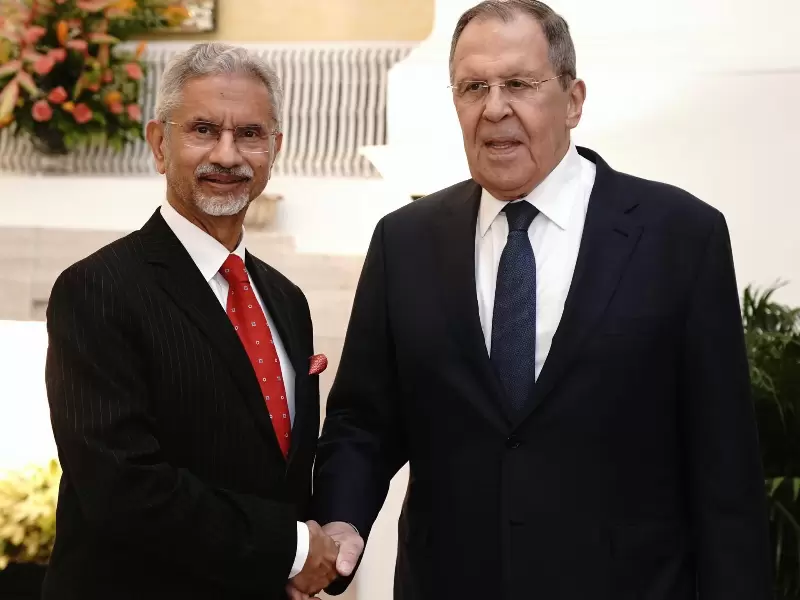 India’s External Affairs Minister Subrahmanyam Jaishankar and Russia’s Foreign Minister Sergey Lavrov / PIB
As the world navigates an increasingly fractured geopolitical landscape, the meeting between India’s External Affairs Minister Subrahmanyam Jaishankar and Russia’s Foreign Minister Sergey Lavrov in New Delhi carries significance far beyond bilateral diplomacy. The two countries reaffirmed their ambition to expand bilateral trade to $100 billion by 2030, a goal that reflects not merely economic cooperation but the emergence of a new geopolitical alignment within BRICS.
The timing of this commitment is important. India currently holds the 2026 BRICS presidency, hosting a series of ministerial meetings leading up to the leaders’ summit later this year. In a world shaped by supply-chain disruptions, sanctions regimes and rising strategic competition, the India–Russia partnership is increasingly becoming a cornerstone of the Global South’s economic architecture.
The $100 Billion Trade Vision
India–Russia trade has expanded rapidly in recent years, particularly due to energy cooperation and alternative payment mechanisms that emerged after Western sanctions on Moscow. Bilateral trade has already approached nearly $60–70 billion, largely driven by Indian imports of Russian oil and fertilizers.
The new $100 billion target aims to diversify this relationship beyond hydrocarbons. Discussions between New Delhi and Moscow include:
- Long-term energy partnerships including LNG and nuclear power
- Cooperation in civil nuclear energy and strategic technologies
- Expansion of logistics corridors and the International North–South Transport Corridor
- Negotiations toward a Free Trade Agreement between India and the Eurasian Economic Union (EAEU)
India and Russia have also discussed joint manufacturing, innovation partnerships, and cooperation in sectors such as electric mobility and advanced industrial technologies.
This transformation signals a shift from a traditional defense-centric relationship to a broad economic and technological partnership.
BRICS: A Platform for Strategic Autonomy
The India–Russia economic push is unfolding alongside the BRICS Foreign Ministers’ meeting in New Delhi, which has drawn attention due to rising global tensions.
Today’s BRICS is no longer the original five-nation grouping. With new members including Egypt, Ethiopia, Iran, the UAE and Indonesia, the bloc now represents a far larger share of the Global South.
However, the expanded BRICS also faces internal challenges. Conflicts in West Asia, disagreements over global sanctions regimes, and competing geopolitical interests have complicated consensus-building within the grouping.
India’s diplomatic approach has therefore emphasized stability, dialogue and open maritime trade routes, recognizing that global supply chains and energy flows remain vulnerable to geopolitical shocks.
India’s Balancing Act
For India, the India–Russia partnership is part of a broader strategy of strategic autonomy. New Delhi maintains close ties with Western partners while simultaneously strengthening relations with Russia and the Global South.
This multi-vector diplomacy reflects three realities:
- Energy security: Russian oil supplies have helped stabilize India’s energy market during global volatility.
- Multipolar diplomacy: India seeks a world order where no single bloc dominates global governance.
- Global South leadership: As the world’s largest democracy and one of its fastest-growing economies, India is positioning itself as a bridge between developed and developing nations.
The Road Ahead
The $100 billion trade target is ambitious but achievable if both countries overcome regulatory barriers and logistical constraints. Simplifying customs processes, enabling banking channels and building stronger connectivity corridors will be critical.
More importantly, the India–Russia partnership will likely shape the trajectory of BRICS in the coming decade. If the grouping succeeds in fostering economic cooperation, financial innovation and development financing, it could become a powerful counterweight in the evolving global order.
As India hosts the BRICS process in 2026, the message from New Delhi is clear: the future of global diplomacy will not be dictated solely by traditional power centers. Instead, it will be shaped by a network of partnerships among emerging economies—with India and Russia playing a central role in that transformation.
Discover more at New India Abroad.
Leave A Comment
Related


ADVERTISEMENT

ADVERTISEMENT
E Paper
Video

Comments
Start the conversation
Become a member of New India Abroad to start commenting.
Sign Up Now
Already have an account? Login