ADVERTISEMENT
ADVERTISEMENT



Physics-based model warns of market shock
At the centre of the warning is Peptomist’s proprietary quantitative framework, which Gupta says applies physics-style principles to market behaviour.
-
1759953093.png) Staff Reporter
Staff Reporter - Thu, 14, May 2026
- 11:08 EDT
- 88
 Representative Image / Canva
Jayesh Chandra Gupta, founder of US- and UAE-based investment firm Peptomist LLC, has issued a fresh warning of possible turbulence in global financial markets, saying his firm’s internal physics-based quantitative model is signalling a major market stress window around beginning May 15.
Speaking to India Abroad in an interview, Gupta said the firm expected a potential 20-25 per cent correction in US equities amid rising geopolitical tensions, elevated market valuations and growing instability in energy and credit markets.
“We are entering towards a phase where we will see a major market correction coming in,” Gupta said. “We might see a good correction, 20-25 per cent happening in the couple of months.”
At the centre of the warning is Peptomist’s proprietary quantitative framework, which Gupta says applies physics-style principles to market behaviour.
This framework has emerged from his earlier research published in the Journal of Technical Analysis by the CMT Association, where Dubai-based Gupta explored the application of physics-based concepts to stock price prediction.
Unlike conventional trading models based purely on charts and price action, Peptomist says its framework interprets financial markets as dynamic force systems shaped by liquidity, volatility, momentum and investor psychology.
According to the firm, the model studies capital flows “like mass”, price momentum “like acceleration” and investor behaviour through “gravitational pull around major market levels and time windows”.
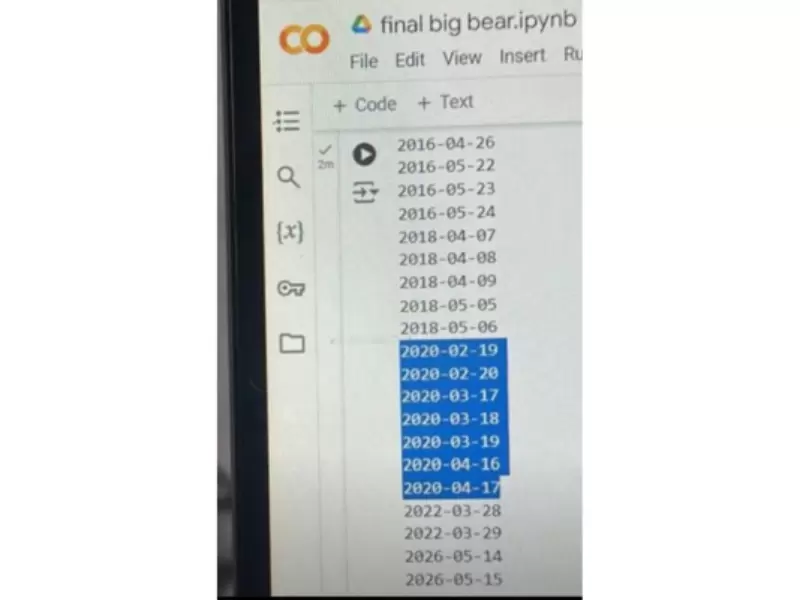 The output of the Peptomist Quant System predicting major market turning/ turbulence points. / Courtesy Photo
Peptomist claims the internal model previously aligned with several major market stress periods, including the 2016 correction cycle, the 2018 market decline, the Covid-led crash in 2020 and the 2022 downturn. The same engine is now reportedly indicating a fresh turbulence phase beginning this week.
Gupta argued that current market conditions were increasingly detached from underlying economic fundamentals.
“This rally is driven by call option buying, not a fundamental change in the rally,” he said. “It’s time to be cautious and time to be protecting the money that you have earned. Hard earned money.”
According to Gupta, aggressive call-option buying by retail investors has created a “gamma squeeze”, forcing market makers to buy underlying stocks and further push indexes higher.
“It’s a two-way coin that we are dealing with at the moment,” he said, warning that the same derivatives-driven momentum could accelerate losses if sentiment reverses.
Gupta said Peptomist had positioned itself defensively through government bonds, volatility-linked trades and long-dated hedging strategies.
“We think the safe haven at the moment is bonds because yields are very high,” he said.
A major concern, Gupta added, was the widening impact of the Middle East conflict on energy markets and inflation.
“The blockage of Strait of Hormuz is a critical risk, especially for emerging markets,” he said. “Countries importing oil, specifically Asian countries including India, they will face the biggest concern.”
He said shortages in crude oil, LNG, diesel and fertilisers could eventually intensify food inflation and currency pressures across emerging economies.
Global markets have remained volatile amid the wars in Ukraine and the Middle East, persistent inflation concerns and uncertainty surrounding interest rates and economic growth. India, one of the world’s largest crude oil importers, remains particularly vulnerable to sustained increases in energy prices.
India Abroad has not independently verified Peptomist’s proprietary models, forecasts or predictive methodologies. Peptomist said its market views and predictions remain solely its own and should not be treated as investment advice.
Discover more at New India Abroad
Related










ADVERTISEMENT

ADVERTISEMENT
E Paper
Video

Comments
Start the conversation
Become a member of New India Abroad to start commenting.
Sign Up Now
Already have an account? Login