ADVERTISEMENT

ADVERTISEMENT



Hormuz control central to Iran conflict dynamics: Terror financing expert
Ella Rosenberg described the Strait of Hormuz as central to an “energy war,” noting that control over the narrow passage determines access to global oil trade routes.
-
1759163132.png) Anushka Pathak
Anushka Pathak - Fri, 27, Mar 2026
- 16:47 EDT
- 19
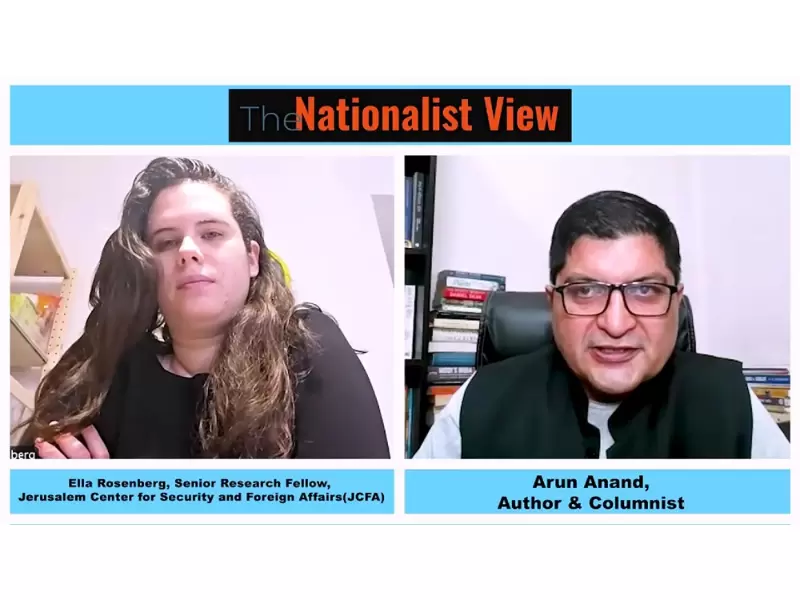 Ella Rosenberg, senior research fellow at JCFA and member of Dvorah Forum on The National View podcast / Courtesy: YouTube/India Abroad
Control over the Strait of Hormuz has emerged as a decisive factor in the ongoing U.S.-Israel conflict with Iran, according to Ella Rosenberg, a senior research fellow at the Jerusalem Center for Security and Foreign Affairs (JCFA) and a member of the Dvorah Forum.
She said competing global blocs are positioning for influence over energy routes and trade flows, with control over the strait determining access to maritime oil routes from the Middle East and GCC countries to the rest of the world.
ALSO READ: “We are defining the rules, not Iran”: Retd. IDF Colonel
Speaking on The Nationalist View podcast with journalist Arun Anand, Rosenberg described the Strait of Hormuz as central to what she termed an “energy war,” noting that control over the narrow passage determines access to global oil trade routes.
“Whoever controls that strait will control the maritime trade routes, specifically for oil, from the Middle East and the GCC countries towards the rest of the world,” she said.
She emphasized the strategic nature of the passage, saying, “It’s not a very long strait. It’s a four-kilometer strait. And it’s a very difficult strait in itself because the majority of the areas surrounding the strait itself is part of Iran.”
She said two competing blocs have emerged: one led by Iran alongside China and Russia, and the other comprising the United States, Gulf states, Israel, and the European Union, each seeking dominance over energy flows.
At the operational level, Rosenberg pointed to potential U.S. military activity near Iranian territory, including Kharg Island, as a near-term escalation point. “It’s going to be a very interesting week,” she said.
Nuclear Concerns
On Iran’s nuclear program, Rosenberg said there is no clear assessment of Tehran’s current position following recent strikes, cautioning against definitive claims. “I don’t think there’s anyone who knows. I think the only person who has some sort of indication whether they’re closer or not to a nuclear bomb is either President Trump or the Iranians themselves,” she said.
She added that nuclear weaponization remains a complex, multi-stage process. “Even if you create a nuclear bomb, it’s a very long process. So first of all, you need to create a nuclear warhead; you need to create the specific materials that should be sent. It’s a process in itself,” she said.
Rosenberg also highlighted a divergence in strategic priorities between Washington and Tel Aviv. “We’re as concerned of the missile program as we are of the nuclear problem,” she said.
War Financing
Addressing Iran’s financial networks, Rosenberg distinguished between the Iranian economy and the Islamic Revolutionary Guard Corps (IRGC)-linked system, describing them as parallel structures operating under sanctions pressure.
She said the IRGC has adapted by leveraging shadow banking and alternative financial channels. “Once you are sanctioned as an entity, you’re not allowed to trade with the usual banking or the classical banking system. So this is where the IRGC is acting as a money launderer."
"And as a good money launderer, they’re trying to find ways or methods to transfer their funds from one point to another. And this is where the shadow banking comes into place,” she added.
According to Rosenberg, these mechanisms include forex trading, cryptocurrency, and illicit financial routes spanning multiple countries, enabling continued funding despite restrictions.
Proxy War
She noted that while some Iran-backed groups, including Hezbollah and the Houthis, have weakened during the conflict, Tehran’s broader strategy may shift rather than collapse.
Rosenberg warned that such shifts could have wider regional implications, particularly for countries aligned with Israel. “If they would like to increase their credibility and increase their power as a regional power, because this is what the IRGC wants, if I were them, my best bet were terror groups in India funded by Pakistan,” she said.
On sanctions, she argued that targeting the broader economy has had limited impact on elite networks linked to the IRGC, which continue to operate globally with access to significant financial resources.
Looking ahead, Rosenberg said endgame scenarios differ across stakeholders. “The endgame here is different for Israel and the United States,” she said.
She added that European actors remain focused on regional stabilization, though she suggested that such an approach may not align with realities on the ground.
Rosenberg said the outcome will depend on whether Iran’s regime adapts or weakens, noting that if it remains in power, it is likely to restructure its proxy strategy rather than abandon it.
Discover more at New India Abroad.
Related





ADVERTISEMENT

ADVERTISEMENT
E Paper
Video

Comments
Start the conversation
Become a member of New India Abroad to start commenting.
Sign Up Now
Already have an account? Login