ADVERTISEMENT

ADVERTISEMENT


U.S. House Republicans reject Senate deal to restore airport security funding
Instead of considering the Senate bill, which passed unanimously in the early morning hours, the House will vote on a temporary bill that would restore funding for the Department of Homeland Security for two months, Republican House Speaker Mike Johnson said.
-
 Reuters
 - Fri, 27, Mar 2026
- 17:56 EDT
- 18
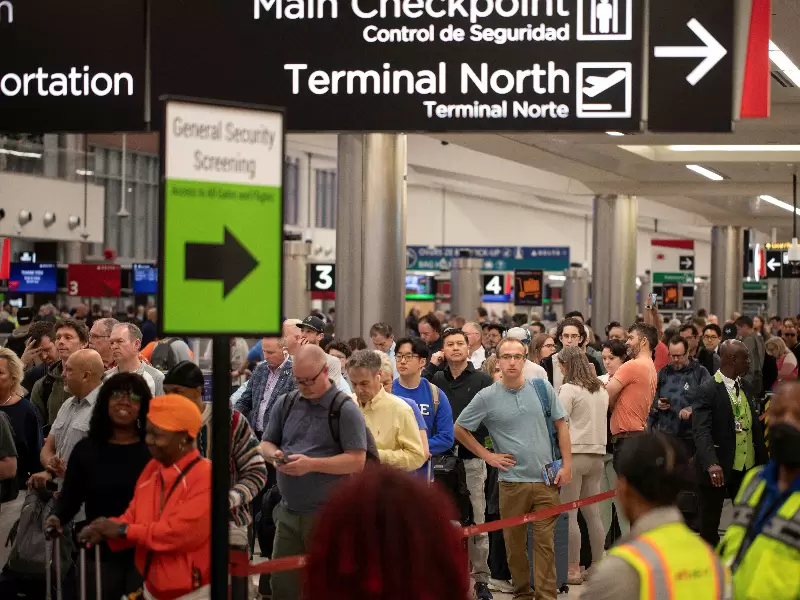 Passengers wait in line to access a Transportation Security Administration (TSA) security checkpoint inside the domestic terminal at Hartsfield-Jackson Atlanta International Airport in Atlanta, Georgia, U.S. March 27, 2026. / REUTERS/Alyssa Pointer
Republicans in the U.S. House of Representatives on March 27 rejected a bipartisan Senate compromise to end a six-week partial government shutdown, prolonging an impasse that has caused long security lines at U.S. airports during the busy spring-break season.
With Congress again deadlocked, the White House said on March 27 that President Donald Trump had declared an emergency and directed the Transportation Security Administration to begin paying its airport-screening officers. The agency said its officers would start receiving paychecks as soon as March 22.
Also Read: U.S. airports implore Congress to end TSA funding standoff
Instead of considering the Senate bill, which passed unanimously in the early morning hours, the House will vote on a temporary bill that would restore funding for the Department of Homeland Security for two months, Republican House Speaker Mike Johnson said.
"This gambit that was done last night is a joke," Johnson told reporters on March 27 afternoon.
Unlike the version passed by the Senate, the House bill includes funding for immigration enforcement - a nonstarter for Democrats who insist any money for that activity must also curb Trump's aggressive approach.
Senate Democratic Leader Chuck Schumer said Johnson's proposal was "dead on arrival" in the Senate, which has already adjourned for a two-week recess.
"We've been clear from day one: Democrats will fund critical homeland security functions — but we will not give a blank check to Trump's lawless and deadly immigration militia without reforms," Schumer said in a statement.
The Senate measure would have restored funding for most of the Department of Homeland Security, including airport security screeners, disaster-response workers and members of the U.S. Coast Guard, who have worked without pay since mid-February.
But the Senate bill does not address the underlying standoff over immigration. The bill specifically omitted funding for Immigration and Customs Enforcement and the Border Patrol, while also containing none of Democrats' proposed restraints, such as barring agents from wearing masks.
The shutdown has led to long lines at U.S. airports, and many of the 50,000 security officers who have gone without pay have called in sick or resigned. Nearly 12 percent of TSA officers did not show up to work on Thursday, including more than a third of officers at New York's JFK, Baltimore, Houston's two airports and Atlanta.
Major disruptions and security wait times of several hours or more were reported on March 27. Airline officials told Reuters the problem could worsen this weekend if there were no concrete details on how TSA officers would be paid. The agency's acting chief, Ha McNeill, said this week that agents have been sleeping in their cars at airports to save gas money and selling blood and taking on second jobs to make ends meet.
Johnson said Republicans would not vote for any measure that would hurt immigration enforcement. House Democratic leaders called on Republicans to take up the Senate bill, asserting that they were preventing an end to "airport chaos."
DEMOCRATS BLOCK DHS FUNDS AFTER US CITIZENS KILLED
Democrats, the minority party in both houses of the U.S. Congress, used what little leverage they have to block DHS funding after federal agents shot and killed two U.S. citizens in Minneapolis. They are seeking to curb Trump's immigration-enforcement push, which has resulted in more than half a million deportations and created chaos on the streets of U.S. cities.
Despite the shutdown, both ICE and Border Patrol are able to draw on separate funding from the sweeping tax and spending bill Republicans passed last year.
Republicans have suggested they will try to secure additional funding for those agencies own through a cumbersome procedure that would allow them to bypass Democratic opposition, though it is unclear whether the party can maintain enough unity in an election year to do so.
Locked out of power in Washington, Democrats have forced two government shutdowns in the past six months. Neither delivered the results they sought, as they failed to secure expiring health subsidies last November and came out of the latest standoff without a deal on immigration enforcement.
Still, Trump's administration has backed off, at least for now, from the confrontational and at times violent tactics that sparked mass protests in Minneapolis, Chicago and other cities.
Trump fired Homeland Security Secretary Kristi Noem this month. Her successor, former Republican Senator Markwayne Mullin, has signaled support for some Democratic proposals, such as limiting the ability of agents to forcibly enter homes without a judicial warrant.
Other Democratic proposals are likely dead in the water. Trump's border czar, Tom Homan, said their call for agents to operate without masks was a "nonstarter."
"It's not about reforming," Homan said at the Conservative Political Action Conference in Texas. "It's about crippling ICE. It's about taking away their authorities."
Republican Senator Susan Collins of Maine said Democrats had damaged Congress' annual funding process, weakened national security, and set a precedent that they may come to regret.
"Democrats remained intransigent and unreasonable with their list of demands," she said in a statement.
Discover more at New India Abroad.
Related






ADVERTISEMENT

ADVERTISEMENT
E Paper
Video

Comments
Start the conversation
Become a member of New India Abroad to start commenting.
Sign Up Now
Already have an account? Login