ADVERTISEMENT

ADVERTISEMENT



Rubio says Iran war to last 'weeks not months,' no US ground troops needed
Washington has dispatched two contingents of thousands of Marines to the region, the first of which is due to arrive around the end of March aboard a huge amphibious assault ship.
-
 Reuters
 - Fri, 27, Mar 2026
- 18:10 EDT
- 19
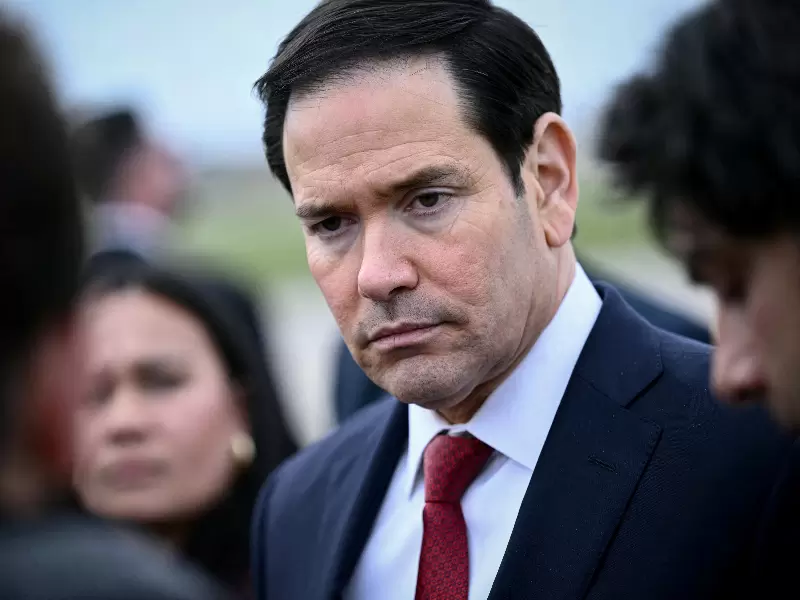 U.S. Secretary of State Marco Rubio looks on as he speaks to the press before his departure following a G7 Foreign Ministers' meeting with Partner Countries before his departure at the Bourget airport in Le Bourget, outside Paris, France, March 27, 2026. / Brendan Smialowski/Pool via REUTERS
The U.S. expects its military operations against Iran to conclude within weeks, not months, and Washington can meet all its objectives without using ground troops, U.S. Secretary of State Marco Rubio said on March 27.
Rubio told reporters after meeting G7 counterparts in France that Washington was "on or ahead of schedule in that operation, and expect to conclude it at the appropriate time here - a matter of weeks, not months."
Also Read: Iran-linked hackers breach FBI director's personal email, publish excerpts online
While he said Washington could achieve its aims without ground troops, he acknowledged it was deploying some to the region "to give the president maximum optionality and maximum opportunity to adjust the contingencies, should they emerge."
Rubio discussed with G7 foreign ministers the possibility that Iran, even after the conflict ends, could try to impose shipping tolls through the Strait of Hormuz. Rubio said European and Asian countries that benefit from trade through the waterway should contribute to efforts to secure free passage, downplaying U.S. dependence on the trade.
MARINES EN ROUTE
Washington has dispatched two contingents of thousands of Marines to the region, the first of which is due to arrive around the end of March aboard a huge amphibious assault ship. The Pentagon is also expected to deploy thousands of elite airborne soldiers.
The deployments have raised concerns that the war, which the U.S. and Israel launched on Feb. 28 with airstrikes that killed Iran's supreme leader and other top officials, could turn into a prolonged ground battle. Iran's response, striking U.S. and Israeli targets in the region as well as civilian targets in Gulf Arab nations and shipping, has disrupted global trade in energy and other commodities, raising fears of rising prices and recession.
U.S. President Donald Trump has appeared anxious to wind down the unpopular war, and emphasized this week what he has described as productive negotiations aimed at a diplomatic solution, despite repeated assertions from Tehran that no such talks have begun. On March 26, Trump extended a deadline by 10 days for Iran to reopen the blockaded Strait of Hormuz or face attacks against its civilian energy grid.
Trump's special envoy Steve Witkoff said the U.S. was hopeful of meetings with Iran within a week and that he expects an Iranian response soon to Trump’s 15-point proposal to end the war. Witkoff said there were clear red lines for the U.S., including no uranium enrichment by Iran and the country giving up what he said was 10,000 kilograms of enriched stockpiled material.
NEW STRIKES ON IRAN, ISRAEL, SAUDI ARABIA
Iranian media reported strikes on Iran's decommissioned heavy-water nuclear research reactor and a factory producing yellowcake uranium late on Friday, and said there were no radiation leaks or danger arising from either attack. Iran informed the International Atomic Energy Agency there was no increase in off-site radiation levels at the yellowcake facility, the IAEA said on X, adding that it would look into the report.
There were also reports of an attack on the Bushehr nuclear power plant, which Iranian media said left no casualties or extensive damage.
Iranian Foreign Minister Abbas Araqchi said on X that Israel, in coordination with the U.S., had also hit two steel factories and a power plant. "Attack contradicts POTUS extended deadline for diplomacy. Iran will exact HEAVY price for Israeli crimes," Araqchi said, using an acronym for the president.
A senior Iranian told Reuters that Tehran had not decided whether to respond to the proposal the U.S. sent this week after attacks on industrial and nuclear infrastructure on Friday. The official said Iran had expected its response to be delivered on Friday or Saturday, but said the continuing strikes while the U.S. was seeking talks were "intolerable."
The U.S. proposal, sent via Pakistan two days ago, is reported to include demands ranging from dismantling Iran's nuclear and missile programmes to relinquishing control of the world's most important trade route for energy supplies.
The war has spread across the Middle East, killing thousands of people and causing the biggest disruption ever to energy supplies, hitting the global economy with soaring oil, gas and fertiliser prices that have fuelled inflation fears.
In Iran, more than 1,900 people have been killed and at least 20,000 injured, said Maria Martinez of the International Federation of Red Cross and Red Crescent Societies.
Attacks on Israel by Iran's Lebanese ally Hezbollah have also prompted an Israeli onslaught that has displaced a fifth of Lebanon's population.
The Israeli military said late March 27 Iran had launched missiles towards Israel. A 60-year-old man was killed in the Tel Aviv area, the ambulance service said.
The Wall Street Journal, citing U.S. and Saudi sources, reported that an Iranian missile and drones wounded several American military members and damaged several American refuelling aircraft at the Prince Sultan airbase in Saudi Arabia. The Pentagon did not immediately respond to a request for comment.
Yemen's Iran-aligned Houthis said they were ready to intervene militarily under certain conditions, including if new allies join the United States and Israel in their war against Iran or if the Red Sea is used to launch attacks on Iran.
IRAN STILL POSSESSES MISSILES
The U.S., which has set out to neutralise Iran's long-range strike capabilities, can only confirm that about a third of the country's missile arsenal has been destroyed, five people familiar with the U.S. intelligence told Reuters.
As the damage mounts and with no end in sight, Gulf Arab states are telling the U.S. that any deal must not merely end the war but also permanently curb Iran's missile and drone capabilities and ensure global energy supplies are never again weaponised, four Gulf sources said.
Stock markets continued their slide on March 27, while the Brent crude oil benchmark topped $112, having risen more than 50 percent since the war began.
In the U.S., where Trump is politically vulnerable to rising fuel prices, diesel in California hit an all-time high at an average $7.17 a gallon, the American Automobile Association said.
Discover more at New India Abroad.
Related








ADVERTISEMENT

ADVERTISEMENT
E Paper
Video

Comments
Start the conversation
Become a member of New India Abroad to start commenting.
Sign Up Now
Already have an account? Login