ADVERTISEMENT
ADVERTISEMENT



A WIN: Indian American lawmakers hail SCOTUS tariffs ruling
The U.S. Supreme Court ruled that President Trump's use of the IEEPA to impose sweeping tariffs exceeded his authority and was not authorized by the law.
-
1759163132.png) Anushka Pathak
Anushka Pathak -
 Malvika Choudhary
 - Fri, 20, Feb 2026
- 13:10 EST
- 126
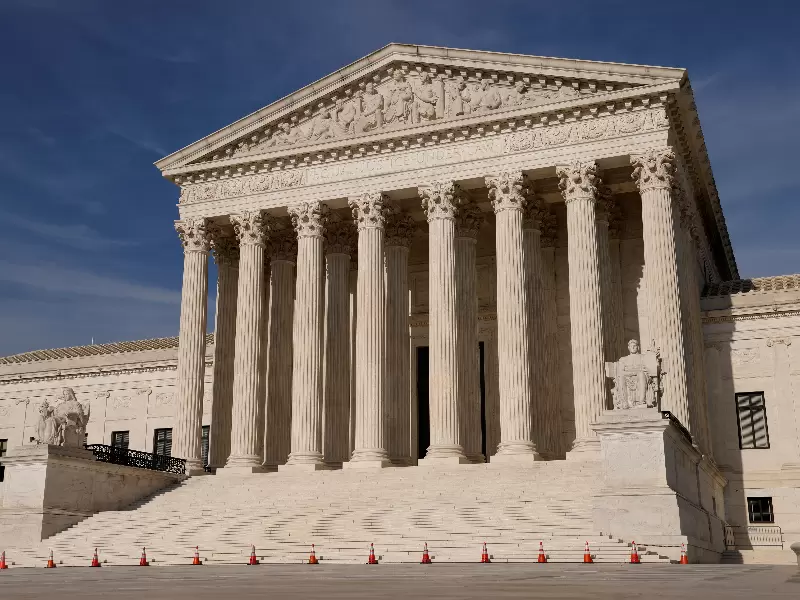 The U.S. Supreme Court building in Washington, U.S. May 17, 2021. / REUTERS/Jonathan Ernst
Indian American lawmakers have welcomed the U.S. Supreme Court’s Feb. 20 decision striking down President Donald Trump’s tariffs imposed under the International Emergency Economic Powers Act (IEEPA), calling the ruling a reaffirmation of constitutional limits on executive power.
In a 6-3 decision, the Court held that the 1977 law does not authorize a president to levy sweeping import taxes without Congressional consent.
ALSO READ: U.S. Supreme Court rejects Trump's global tariffs
The Supreme Court made it clear today: no president is above the Constitution and no president gets to abuse emergency powers like IEEPA to slap hidden taxes on working Americans.
— Rep. Ro Khanna (@RepRoKhanna) February 20, 2026
Those tariffs weren’t about security — they were a tax on families and small businesses to…
Rep. Ro Khanna said, “The Supreme Court made it clear today: no president is above the Constitution,” and accused Trump of abusing IEEPA to impose “hidden taxes on working Americans.”
Rep. Raja Krishnamoorthi said the ruling confirmed that “Donald Trump’s use of emergency powers to impose blanket tariffs was illegal,” noting that he joined an amicus brief challenging the policy.
In a statement, he said the decision “makes clear that he illegally abused his emergency powers to drive up costs for American families, small businesses, and manufacturers.”
Today’s Supreme Court ruling confirms Donald Trump’s use of emergency powers to impose blanket tariffs was illegal. I joined an amicus brief to end this abuse of power and protect American families from higher costs. My full statement: pic.twitter.com/nSEGAY4ygr
— Congressman Raja Krishnamoorthi (@CongressmanRaja) February 20, 2026
He also called the ruling “a WIN,” stating that “Donald Trump's reckless tariffs raised prices on everything from everywhere on everyone,” and that the Court “struck down his illegal blanket tariffs, finally paving the way for economic relief for farmers, manufactures, and families across Illinois.”
GOOD NEWS: The Supreme Court just ruled that Trump’s tariffs imposed under his “emergency authorities” are unlawful.
— Rep. Pramila Jayapal (@RepJayapal) February 20, 2026
They affirmed what we’ve been saying this whole time: Only Congress has the power to impose taxes, which includes Trump's reckless tariffs.
Rep. Pramila Jayapal said the court’s decision confirmed long-standing concerns about executive overreach. “Only Congress has the power to impose taxes, which includes Trump’s reckless tariffs,” Jayapal wrote, adding that the ruling declared the measures unlawful.
I'm relieved that the Supreme Court has ruled that Trump's tariffs are illegal and glad that they will be rolled back.
— Congressman Shri Thanedar (@RepShriThanedar) February 20, 2026
Unfortunately, so much harm has already done.
Prices have skyrocketed and job growth has plummeted by 88%.
Congress needs to get to work undoing that damage. https://t.co/JQlRutn9B7
Rep. Shri Thanedar also welcomed the ruling, saying he was relieved the tariffs would be rolled back. However, Thanedar said significant damage had already been done, citing sharp price increases and a steep slowdown in job growth. He urged Congress to act to reverse the economic impact, stating that lawmakers “need to get to work undoing that damage.”
The Supreme Court got it right today.
— Ami Bera, M.D. (@RepBera) February 20, 2026
President Trump never had the power to impose these sweeping tariffs that raised costs for working families, hurt small businesses, and strained our alliances around the world.
This ruling does not put an end to President Trump’s chaotic…
Rep. Ami Bera applauded the decision, saying, “The Supreme Court got it right today," and asserting Trump “never had the power to impose these sweeping tariffs.” He called for Congress to “clearly reassert” its authority over tariffs to restore stability for consumers and businesses.
President Trump’s tariffs raised costs and hurt small businesses in our country, and they aren’t even legal. pic.twitter.com/JAH80Az9ly
— Rep. Suhas Subramanyam (VA-10) (@RepSuhas) February 20, 2026
Rep. Suhas Subramanyam said he had “said from the very beginning” that the tariffs “did not follow the law,” adding they “raised costs on every single American” and hurt small businesses. He pledged to “continue to fight policies like this that break the law and raise costs.”
Excellent news. Tariffs are a self-inflicted regressive tax, inflationary, and, as imposed by @POTUS, blatantly unconstitutional. We need relief. Let’s get back to economic policy that reduces costs and fosters job & economic growth. pic.twitter.com/oWvM2HJ957
— Rep. Arvind Venkat, MD (@RepVenkat) February 20, 2026
Echoing that view, Pennsylvania State Representative Arvind Venkat described the tariffs as economically damaging and unconstitutional. He said tariffs function as “a self-inflicted regressive tax,” warning that they are inflationary and increase costs for consumers. He called for a return to economic policies that “reduce costs and foster job & economic growth.”
Virginia Delegate JJ Singh called the decision “a breath of fresh air from the Supreme Court,” adding that the president “exceeded his authority.” He said, "The impacts of these tariffs has hurt businesses and consumers,” and that the effects “will take time to unwind.”
A breath of fresh air from
— Delegate JJ Singh (@SinghforVA) February 20, 2026
the Supreme Court. Not only has the President exceeded his authority, but the impacts of these tariffs has hurt businesses and consumers. The impacts will take time to unwind. https://t.co/p6Hgo198Jd
The tariffs had been imposed on nearly all trading partners after Trump invoked national emergency powers under IEEPA, citing trade deficits and fentanyl trafficking. More than US $175 billion had been collected under the authority, and the measures were projected to generate trillions over a decade.
The majority opinion included Justices Neil Gorsuch, Amy Coney Barrett, Sonia Sotomayor, Elena Kagan, and Ketanji Brown Jackson, while Justices Clarence Thomas, Samuel Alito, and Brett Kavanaugh dissented.
IEEPA, enacted during the administration of President Jimmy Carter, had historically been used for sanctions rather than tariffs.
The White House did not immediately comment on the ruling.
Discover more at New India Abroad.
Leave A Comment
Related

 (1).jpg)





ADVERTISEMENT

ADVERTISEMENT
E Paper
Video

Comments
Start the conversation
Become a member of New India Abroad to start commenting.
Sign Up Now
Already have an account? Login