ADVERTISEMENT
ADVERTISEMENT



Swadesh Chatterjee recalls turning point in U.S.-India ties
He described the 2008 U.S.-India civil nuclear agreement as the defining success of Indian American advocacy in Washington.
-
1759953093.png) Staff Reporter
Staff Reporter - Tue, 19, May 2026
- 07:48 EDT
- 190
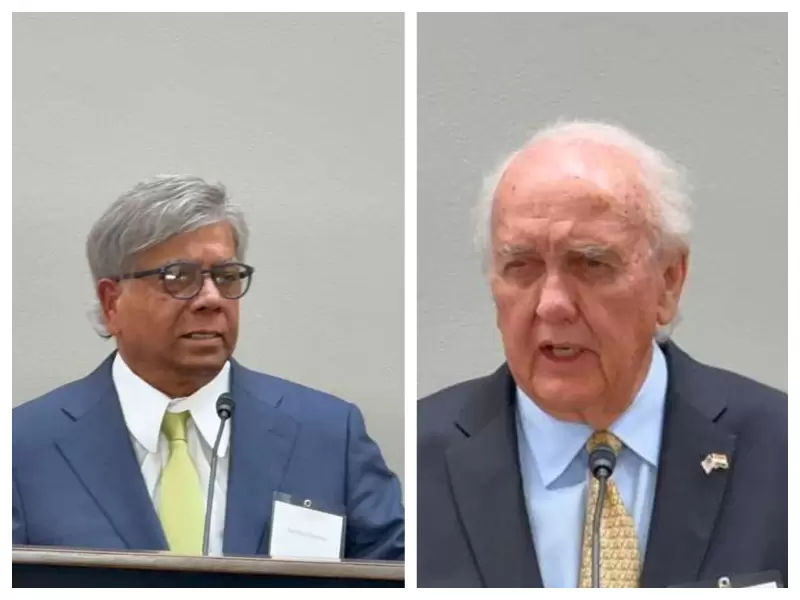 Veteran Indian American community leader Swadesh Chatterjee and Former U.S. Assistant Secretary of Commerce Ray Vickery / Courtesy photo
Veteran Indian American community leader Swadesh Chatterjee on May 18 recalled the dramatic transformation of U.S.-India relations from a period of sanctions and mistrust in the 1990s to what he described as one of Washington’s most important strategic partnerships.
Speaking at the Capitol Hill Summit 2026 organized by the U.S.-India Friendship Council, Chatterjee said the Indian American community had played a central role in reshaping perceptions of India in the United States.
“In my early days of political activism, India was viewed with suspicion,” Chatterjee said. “It was a country to manage, not partner with.”
ALSO READ: Ambassador Kwatra says India-U.S. ties remain strong
Chatterjee, chairman of the U.S.-India Friendship Council, recalled how India faced American sanctions after its 1998 nuclear tests because New Delhi had refused to sign the Nuclear Non-Proliferation Treaty.
“So we worked hard to lift the sanctions against India,” he said.
He described the 2008 U.S.-India civil nuclear agreement as the defining success of Indian American advocacy in Washington.
“Our most prominent success of Indian American community is the U.S.-India civil nuclear deal, which was signed in 2008,” Chatterjee said. “It ended India’scapit 34 years of nuclear isolation.”
Chatterjee said the deal had once appeared impossible to pass through Congress.
“When I talked to my friends in Washington about the civil nuclear deal, they said, ‘Don’t waste your time. It is dead on arrival,’” he recalled.
He said he made 77 trips from North Carolina to Washington between 2005 and 2008 to lobby lawmakers and build support for the agreement.
“That put India in a different stage of the world, in the global power,” Chatterjee said.
At the same time, Chatterjee acknowledged that the relationship was currently facing tensions over trade, immigration and energy policies.
“U.S.-India relations cannot be on autopilot,” he warned.
He also urged Indian Americans to become more politically active and develop stronger ties with lawmakers across party lines.
“Know your congressman. Know your senator. Know your governor. That makes the difference,” Chatterjee said at the close of the summit.
Former U.S. Assistant Secretary of Commerce Ray Vickery said the U.S.-India relationship had once appeared unstoppable but now required renewed political and strategic focus.
“We thought we’d gotten it to a point where basically it had its own momentum,” Vickery said. “Unfortunately, I don’t think that is the situation.”
Vickery said the summit was organized to “refocus” attention on the relationship between the world’s two largest democracies.
“There really is absolutely no issue facing the world today, whether it be economic, commercial, strategic, which can’t benefit from closer cooperation between the United States and India,” he said.
The former Commerce Department official also praised Chatterjee’s decades-long efforts to strengthen bilateral ties and mobilize the Indian American community politically.
“It’s hard to really envisage what it was like when Swadesh was the pioneer,” Vickery said.
Vickery noted that Indian Americans, now among the most successful immigrant communities in the United States, were once largely absent from American political life.
“People would say ‘India’ and they’d say ‘where?’ You’d say ‘Indian Americans’ and they’d say ‘who?’” he recalled.
Discover more at New India Abroad.
Leave A Comment
Related

ADVERTISEMENT

ADVERTISEMENT
E Paper
Video

Comments
Start the conversation
Become a member of New India Abroad to start commenting.
Sign Up Now
Already have an account? Login