ADVERTISEMENT
ADVERTISEMENT



Indian-origin student wins Henry Ford II Scholar Award at MIT
The award recognizes a senior engineering student for academic excellence and leadership potential.
-
 Malvika Choudhary
 - Wed, 03, Jun 2026
- 17:52 EDT
- 19
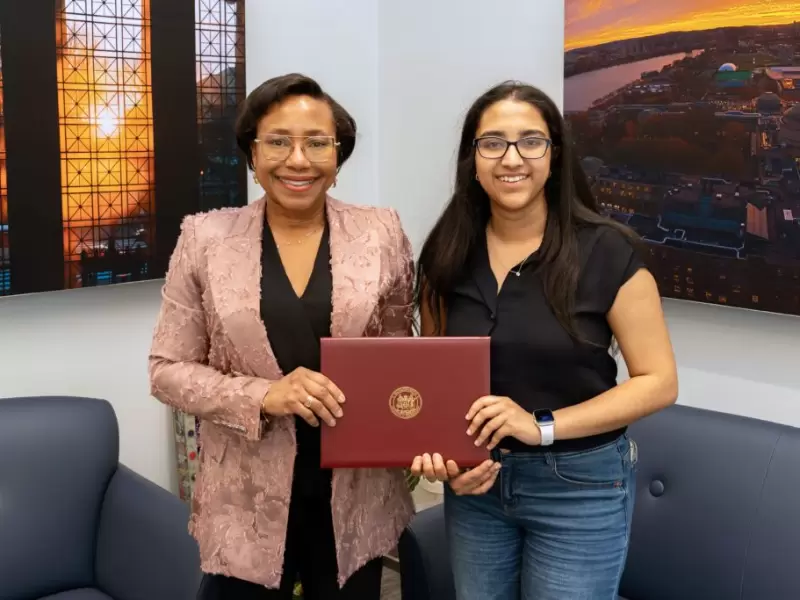 Avani Ahuja receives the Henry Ford II Scholarship. / Credit: Conor McArdle/ MIT
The Massachusetts Institute of Technology School of Engineering awarded Indian-origin student Avani Ahuja the Henry Ford II Scholar Award, one of MIT's top honors for undergraduate students.
The award is presented annually to a senior undergraduate engineering student who is in high academic standing and demonstrates exceptional potential for leadership in the engineering profession and society.
Also Read: Manikandan Pandiyan bags Global Biofuel Champion fellowship
Ahuja, a 2026 graduate from MIT's Departments of Electrical Engineering and Computer Science and Mechanical Engineering was recognized for building a multidisciplinary research portfolio spanning power electronics, robotics and women's health technologies.
As part of the Coday Research Group, Ahuja focused on capacitive wireless power transfer, a technology with potential applications in charging electric vehicles and implantable medical devices. Her work included designing and developing a converter for wireless power transfer systems that could help reduce the cost of EV charging infrastructure.
According to a university release, Ahuja also conducted women's health research at the MIT Media Lab under professor Canan Dagdeviren, contributing to the development of a conformable ultrasound breast patch aimed at making breast ultrasound screening more accessible and helping detect breast cancer earlier.
In addition, she participated in robotics research under professor Sangbae Kim and worked on projects involving humanoid robotic systems.
“My most significant experiences at MIT have included engaging in research, whether it was women’s health research under Professor Canan Dagdeviren in the MIT Media Lab, robotics research under Professor Sangbae Kim, or power electronics research under Professor Samantha Coday,” Ahuja told the University press.
“I’ve also really enjoyed engaging in the extracurricular opportunities on campus, whether it was through participating in the MIT Ohms, through MIT LIVE, or the line dancing lessons in the student center,” she added.
Beyond MIT, Ahuja gained industry experience as a fabrication process intern at Intel, where she worked on automation and manufacturing processes related to semiconductor technology.
This fall, Ahuja will remain at MIT to pursue a Ph.D. in power electronics in the Department of Electrical Engineering and Computer Science, continuing her research in the Coday Research Group.
Ahuja credited several mentors and faculty members for supporting her academic and professional development, including Samantha Coday, Maria Yang, Canan Dagdeviren, graduate students Colin Marcus and Sara Fernandez, and associate dean Kimberly Benard.
Discover more at New India Abroad.
Related







ADVERTISEMENT

ADVERTISEMENT
E Paper
Video

Comments
Start the conversation
Become a member of New India Abroad to start commenting.
Sign Up Now
Already have an account? Login