ADVERTISEMENT
ADVERTISEMENT


Indian-origin climate scientist wins prestigious Crafoord prize
The award honors the Chennai-born researcher for his work on non-CO2 climate pollutants.
-
1759163132.png) Anushka Pathak
Anushka Pathak - Fri, 30, Jan 2026
- 14:12 EST
- 305
 Scripps scientist Veerabhadran Ramanathan / Courtesy: Erik Jepsen/UC San Diego
Indian-origin climate scientist Veerabhadran Ramanathan has been named the 2026 recipient of the Crafoord Prize in Geosciences by the Royal Swedish Academy of Sciences.
The award recognizes his discoveries on how aerosol particles, short-lived climate pollutants, and non-carbon dioxide gases influence global warming and Earth’s climate system.
ALSO READ: Indian Americans to lead Institute of Medicine of Chicago
In its announcement, the academy said the award honors work that “laid the foundation for our understanding of how small particles and gases that accumulate in the atmosphere contribute to climate change.”
A climate scientist at the Scripps Institution of Oceanography at the University of California, San Diego, Ramanathan serves as a distinguished professor emeritus of atmospheric and climate sciences. He said he was “speechless and humbled” by the honor, noting the significance of recognition from the same academy that awards the Nobel Prize.
“This prize, since it is given by the same science academy that gives the Nobel Prize, is an overwhelming confirmation that climate science is based on fundamental scientific principles backed by impeccable observations,” he said.
Born in 1944 in Chennai, India, Ramanathan earned his doctorate from the State University of New York in 1974. In 1975, he made the landmark discovery that chlorofluorocarbons act as “super greenhouse gases,” trapping heat about 10,000 times more effectively per molecule than carbon dioxide. That finding established atmospheric chemistry as a central component of the climate system and led to the identification of other powerful climate pollutants.
During the 1980s, Ramanathan played a key role in NASA satellite missions measuring Earth’s energy budget, demonstrating how human-produced greenhouse gases trap increasing amounts of outgoing heat. He joined Scripps Institution of Oceanography in 1990, where his research expanded to include the climate and ozone impacts of hydrofluorocarbons and the role of atmospheric aerosols.
ALSO READ: Indian-origin student wins Duke University graduate student award
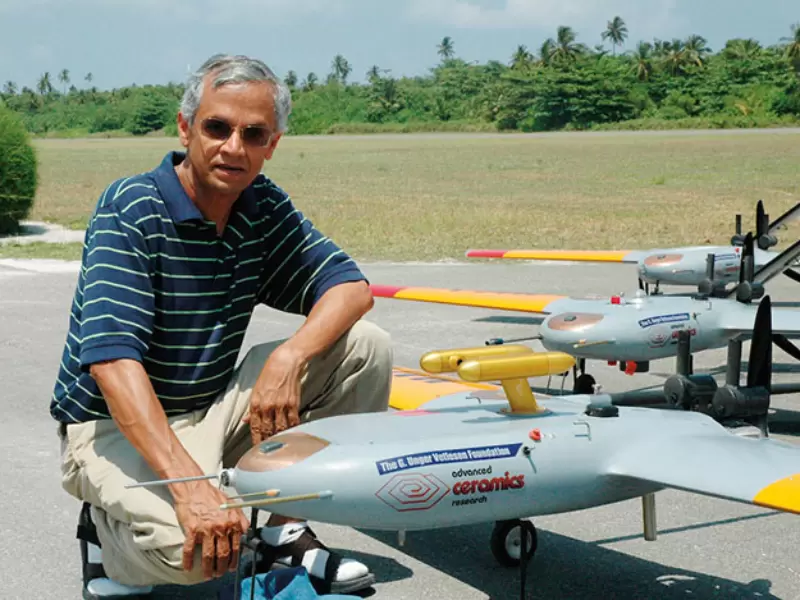 Professor Ramanathan in the Maldives with an autonomous uncrewed aerial vehicle, used in a 2006 study to measure the atmospheric brown cloud over South Asia / Courtesy: UC San Diego
Large-scale field experiments in the Indian Ocean led by Ramanathan documented widespread air pollution far from land, including soot particles that absorb sunlight, heat the atmosphere, disrupt the hydrological cycle, and accelerate Himalayan glacier melt. This work informed international efforts to reduce short-lived climate pollutants, including initiatives under the United Nations Environment Programme’s Climate and Clean Air Coalition.
Pradeep K. Khosla, chancellor of UC San Diego, said, “UC San Diego is extremely pleased to see Distinguished Professor Emeritus Ramanathan honored with this prestigious award. This honor not only acknowledges Ramanathan’s pioneering contributions to the advancement of modern atmospheric research, but underscores how strategic investments in world-class research fuel discoveries that help us understand and protect the planet and change our world for the better.”
Ilona Riipinen, professor of atmospheric sciences at Stockholm University and a member of the Crafoord Prize Committee, said, “He has expanded our view of how humankind is affecting the atmosphere’s composition, the climate and air quality, and how these three interact.”
Meenakshi Wadhwa, director of Scripps Institution of Oceanography, said, “Professor Ramanathan’s selection for the Crafoord Prize honors his extraordinary scientific contributions that have fundamentally shaped how the world understands and responds to climate change, as well as his lifelong commitment to translating that science into meaningful action.”
Ramanathan is the second researcher from Scripps to receive the Crafoord Prize, valued at eight million Swedish kronor (roughly US$900,000). The award will be presented during Crafoord Days in Lund and Stockholm from May 18 to 20, 2026.
Discover more at New India Abroad.
Leave A Comment
Related












ADVERTISEMENT

ADVERTISEMENT
E Paper
Video

Comments
Start the conversation
Become a member of New India Abroad to start commenting.
Sign Up Now
Already have an account? Login