ADVERTISEMENT
ADVERTISEMENT



Indian satellite internet concept wins NASA Space Apps Challenge
Photonics Odyssey, a six-member Indian team, took on the challenge of commercializing Low Earth Orbit (LEO) at the hackathon.
-
 Rwittika Chakraborty
 - Mon, 22, Dec 2025
- 03:08 EST
- 141
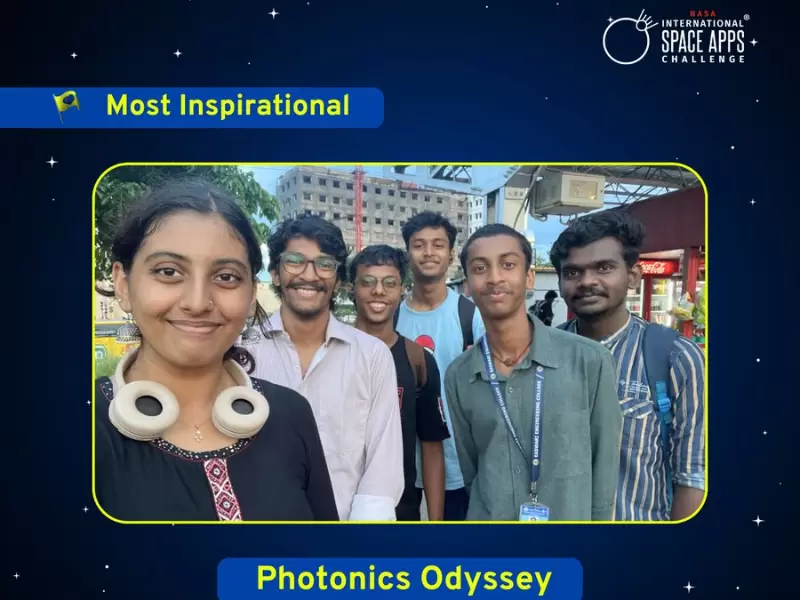 Indian team, Photonics Odyssey, wins NASA Space Apps Challenge / X/@SpaceApps
India’s Chennai-based team, Photonics Odyssey, has been honored with the Most Inspirational Award at the 2025 NASA Space Apps Challenge, a two-day hackathon, in which participants gathered at 551 local events across 167 countries and territories to showcase their STEM skills and proposed ways to transform the agency’s open data into actionable tools.
Photonics Odyssey comprises six members, Prasanth Gopalakrishnan, who is the team owner, Sakthi Sanjeev Kumar R, Rajalingam N, Rashi Menon, M Deeraj Kumar, and Manish Varma D, who took on the challenge of commercializing Low Earth Orbit (LEO) at the hackathon.
Photonics Odyssey proposed transforming satellite internet into a sovereign national infrastructure over a private service, using phased-array antennas to minimize ground dependency and expand broadband access across remote areas of India.
The concept by Photonics Odyssey aims to help connect over 700 million people who lack access to broadband internet.
Other award-winning teams that involved Indian-origin participation include Resonant Exoplanets, a US-based team, which received the Best Use of Data Award for developing an AI-powered system for automatically analysing large volumes of telescope and satellite data to identify exoplanets and detect possible biosignatures.
The team includes Adhvaidh S., Gabriel S., Jack A., and Sahil S., who worked on the challenge “A World Away: Hunting for Exoplanets with AI.”
Another winning project with Indian-origin participation was Astro Sweepers, comprising of Harshiv T., Pragathy S., Pratik J., Sherlin D., Yousra H., and Zienab E, who earned the Galactic Impact Award.
Also, with the challenge of commercializing LEO, they developed an end-to-end orbital debris compliance and risk intelligence platform that automatically ingests public orbital data to generate debris assessment reports and compute a risk index for resident space objects.
The project considers the operational, regulatory, and environmental challenges of commercialized space travel.
The winners of the 2025 NASA Space Apps Challenge were selected from over 11,500 project submissions and evaluated by judges from NASA and its partner organisations.
Leave A Comment
Related










.png)
ADVERTISEMENT

ADVERTISEMENT
E Paper
Video

Comments
Start the conversation
Become a member of New India Abroad to start commenting.
Sign Up Now
Already have an account? Login