ADVERTISEMENT
ADVERTISEMENT



Two Indian-origin Cambridge scholars elected Royal Society fellows
Anuj Dawar and Srinivasan Keshav were among seven Cambridge researchers elected to the fellowship.
-
 Pranavi Sharma
 - Thu, 28, May 2026
- 01:14 EDT
- 41
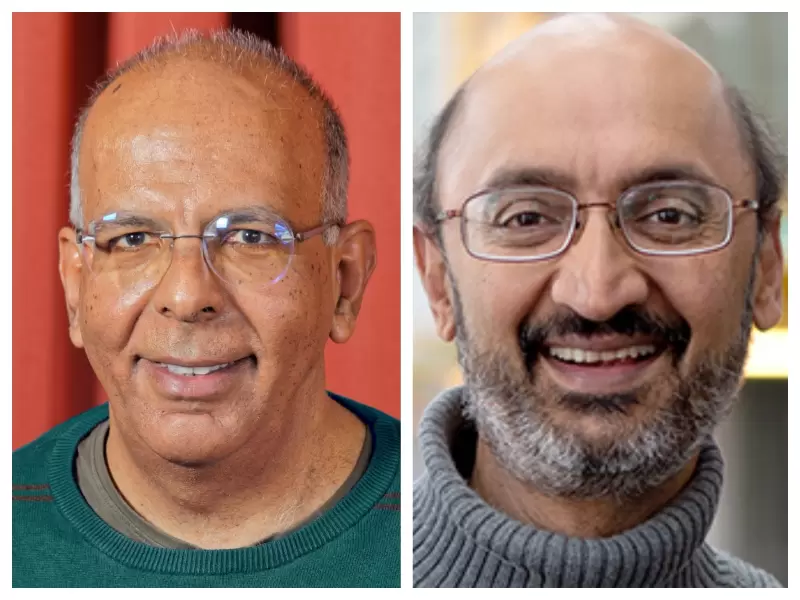 Anuj Dawar and Srinivasan Keshav / University of Cambridge
Two Indian-origin academics at the University of Cambridge, Anuj Dawar and Srinivasan Keshav, have been elected Fellows of the Royal Society in 2026, joining seven Cambridge researchers recognized this year by the UK’s national academy of sciences.
Dawar and Keshav are among the latest scientists elected to the fellowship, whose members have included Stephen Hawking, Isaac Newton, Charles Darwin, Albert Einstein, Lise Meitner, Subrahmanyan Chandrasekhar and Dorothy Hodgkin.
“I am delighted to welcome this newest group of exceptional scientists to the Fellowship of the Royal Society,” Royal Society President Sir Paul Nurse said.
“Their contributions reflect the highest standards of scientific endeavour. Whether advancing our understanding of vaccines or exploring the transformative potential of mathematics and computation, their work exemplifies the enduring value of curiosity, creativity and rigorous inquiry,” he said.
Nurse said the fellowship was strengthened by “the diversity of perspectives and experiences its members bring.”
“This incoming cohort highlights the truly international character of contemporary science and underscores the vital role that plays in achieving breakthroughs that benefits us all,” he added.
Dawar is a professor of logic and algorithms in Cambridge’s Department of Computer Science and Technology and a fellow of Robinson College. An IIT alumnus, he is known for his work in theoretical computer science and for developing methods rooted in mathematical logic to study computational complexity.
According to Cambridge, Dawar played a key role in the development of symmetric complexity and proved unconditional hardness results for forms of computation used in combinatorial optimization algorithms.
Keshav is the Robert Sansom Professor of Computer Science in the Department of Computer Science and Technology and a fellow of Fitzwilliam College. His work over four decades has spanned computer networking, energy informatics and Earth system science.
His current research focuses on the intersection of computer science and sustainability. He co-leads the TESSERA project, which applies self-supervised learning to global Earth observation data for use by ecologists, plant scientists and policymakers.
Keshav has also authored two graduate textbooks on networking. His honors include the Sakrison Prize, the inaugural Achievement Award from the ACM Special Interest Group in Energy Systems and Informatics, and fellowships of the Royal Society of Canada, the IEEE and the ACM.
Discover more at New India Abroad.
Related

.jpg)




ADVERTISEMENT

ADVERTISEMENT
E Paper
Video

Comments
Start the conversation
Become a member of New India Abroad to start commenting.
Sign Up Now
Already have an account? Login