ADVERTISEMENT
ADVERTISEMENT



Sunita Chandrasekaran to help test U.S. supercomputer
The University of Delaware team is among nine selected to prepare the Discovery system for scientific use.
-
 Malvika Choudhary
 - Thu, 09, Jul 2026
- 18:09 EDT
- 43
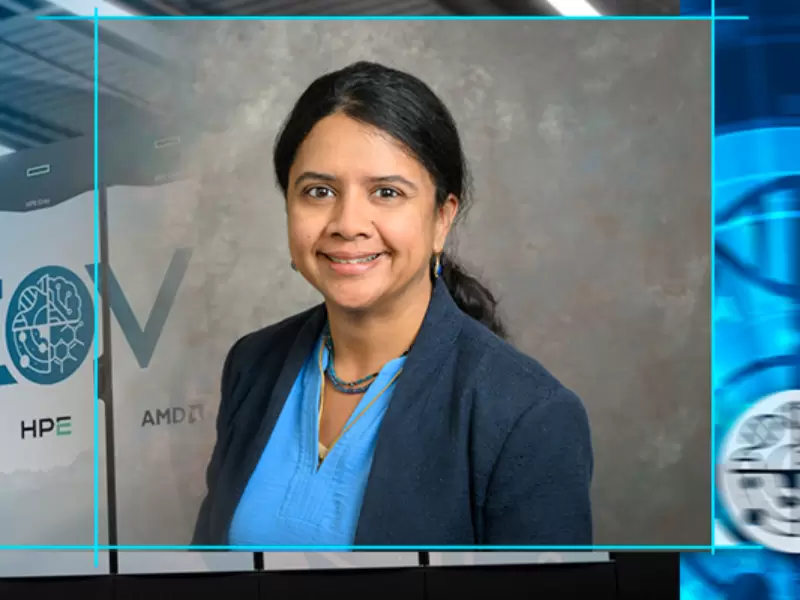 Sunita Chandrasekaran / University of Delaware
Sunita Chandrasekaran, an Indian American computer scientist, has been chosen to head a team that will assist in getting one of the most powerful supercomputers in the world ready for use in scientific research.
Under Chandrasekaran's leadership, the University of Delaware team is one of nine research groups selected nationwide to stress-test Discovery, the next-generation supercomputer being developed at Oak Ridge National Laboratory.
Also Read: Illinois Tech names Shyamal Gupta chief of Mumbai operations
Discovery is being developed to support advances in energy, national security, manufacturing, human health, and other scientific fields by combining artificial intelligence, high-performance computing, and emerging quantum technologies. The system is expected to become the fastest in the United States when it launches in 2029.
Chandrasekaran, associate professor of computer and information sciences, the David L. and Beverly J.C. Mills Career development chair, and director of the First State AI Institute at the University of Delaware, said the team's role is to uncover software bugs, performance bottlenecks, and hardware limitations before the system enters scientific service.
"Our goal is to run thousands of experiments across many different physics scenarios and see what breaks – whether it's software bugs, performance bottlenecks or system issues under stress. That's where we learn, and where our team can help fix problems in real time, working directly with the system's builders," Chandrasekaran said.
Discovery is expected to surpass today's exascale computers by sustaining demanding AI-driven scientific workloads. Researchers will test processors, memory, networking, and data movement to ensure the system can reliably support large-scale scientific applications.
Testing will begin after Discovery's initial computing cluster is installed later this year. According to the university press, Chandrasekaran's team will use Particle-in-Cell on GPU (PIConGPU), a software package that models interactions between charged particles and electromagnetic fields, to conduct thousands of plasma simulations.
The researchers will also combine the simulations with artificial intelligence to identify improved materials and designs for fusion targets, with potential applications in fusion energy, spacecraft propulsion, astrophysics, and laser-based medical technologies.
The project also provides graduate students with hands-on experience in next-generation computing. Doctoral student Nikhil Rao is developing workflows that enable machine learning models to process massive simulation data directly in memory, eliminating the need to store enormous datasets generated during computation.
The initiative brings together researchers from the University of Delaware, Oak Ridge National Laboratory, AMD, Hewlett Packard Enterprise, and Germany's Helmholtz-Zentrum Dresden-Rossendorf (HZDR), which previously collaborated with Chandrasekaran's team on Frontier, Oak Ridge's current exascale supercomputer.
"We're preparing for a machine that doesn't fully exist yet. That's what makes this work so fascinating and rewarding. We're not just preparing for what's next — we're helping make it possible," Chandrasekaran said.
Born in India, Chandrasekaran earned a bachelor's degree in electrical and electronics engineering from Anna University, Chennai, before completing her Ph.D. in computer engineering at Nanyang Technological University in Singapore.
Her research focuses on high-performance computing, artificial intelligence, and applied machine learning. She also serves on Oak Ridge National Laboratory's Computing and Computational Sciences Directorate Advisory Committee and is vice chair of the State of Delaware AI Commission.
Discover more stories on NewIndiaAbroad
Leave A Comment
Related







ADVERTISEMENT

ADVERTISEMENT
E Paper
Video

Comments
Start the conversation
Become a member of New India Abroad to start commenting.
Sign Up Now
Already have an account? Login