ADVERTISEMENT

ADVERTISEMENT



Political Tsunami in Nepal
Balendra Shah's inauguration as PM would represent an important step in the broader process of political inclusion within the national power structure.
-
 Dr. Hari Bansh Jha
 - Fri, 20, Mar 2026
- 16:20 EDT
- 21
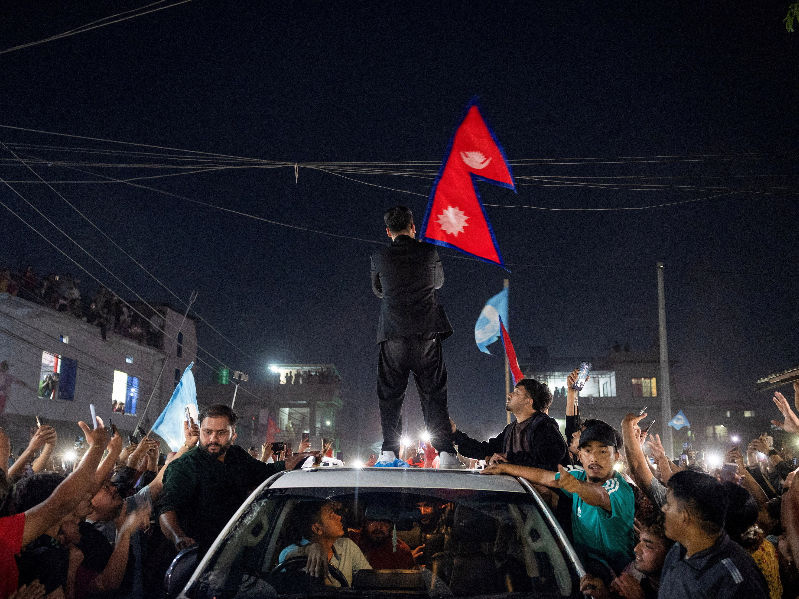 Balendra Shah, a rapper-turned-politician waves national flag after winning the election, in Damak, Jhapa district, Nepal, March 7, 2026. / REUTERS/Adnan Abidi
Nepal appears to be passing through an unusual phase in its democratic journey. The sudden rise of a young political figure, Balendra Shah—popularly known as Balen—has generated a remarkable wave of public enthusiasm across the country.
At the age of thirty-five, he has come to national prominence by leading the Rastriya Swatantra Party (RSP) to a sweeping victory in the elections to the 275-member House of Representatives. His party has secured nearly two-thirds majority in parliament, a result that many observers are already describing as a political tsunami.
In the 275-member parliament, comprising 165 members elected through the first-past-the-post system and 110 through proportional representation, the RSP led by Balendra Shah secured 182 seats.
The Nepali Congress obtained 37 seats, followed by the CPN-UML with 26 seats, the Nepal Communist Party with 16 seats, the Shram Sanskriti Party with 7 seats, the Rastriya Prajatantra Party with 5 seats, and one independent member. Such a decisive outcome reflects a significant shift in the political mood of the electorate.
An overwhelming mandate of this magnitude is rare in Nepal’s parliamentary history. The last comparable moment occurred in 1959, when the Nepali Congress under the leadership of B.P. Koirala secured a two-thirds majority in the then 109-member parliament. That election marked Nepal’s first democratic experiment after the end of the Rana oligarchy.
Although the democratic process was soon interrupted, the election remained a landmark in the country’s political history. Almost 67 years later, the scale of the popular mandate received by Balendra Shah has once again revived discussions about political renewal and democratic transformation in Nepal.
Historically, Nepal was unified geographically by Prithvi Narayan Shah, the eighteenth-century ruler who laid the foundation of the modern Nepali state. What appears to be unfolding today, however, reflects another form of unification—an emotional and psychological integration of the nation. In this election, many of the conventional divisions of Nepali politics—based on region, caste, ethnicity, religion or party affiliation—appear to have receded, at least temporarily.
The rise of Balendra Shah is particularly striking because only a few years ago he was hardly known in national political circles.
His entry into public life came from outside the traditional political establishment. He comes from a modest family background. His father, Ram Narayan Sah, served as an Ayurvedic practitioner in Kathmandu. Balendra pursued higher studies in structural engineering at an institution in Bangalore, India. During his early years in Kathmandu he also gained recognition among sections of the urban youth as a rapper, a background that later helped him connect with the younger generation.
Also Read: The Sovereign correction: Logic behind America’s war with Iran
His political breakthrough came in 2022 when he contested the election for the Mayor of Kathmandu Metropolitan City as an independent candidate. At that time, most observers believed that his chances were minimal. Kathmandu’s political landscape had long been dominated by established parties and influential elites, particularly from the Newar community and other prominent groups drawn from across the country.
In such a setting, the possibility that a candidate of Madheshi origin could contest and win the mayoral election in the capital city was widely regarded as unlikely.
Yet the results proved otherwise. Balendra Shah secured a convincing victory over candidates representing major political parties. Among them was the Nepali Congress nominee who belonged to the distinguished political family of Ganesh Man Singh, a leader remembered for his role in Nepal’s democratic movement against the Rana regime. Balendra’s victory therefore symbolized not merely an electoral upset but also the growing frustration of voters with the established political order.
During his tenure as mayor of Kathmandu, he attempted to project the image of a leader who believed more in performance than in rhetoric. His administration initiated measures to improve urban infrastructure, repair roads, remove illegal encroachments and strengthen sanitation and city management.
On several occasions he openly confronted bureaucratic inertia and political resistance. His willingness to challenge entrenched interests earned him both criticism and admiration. For many citizens he came to represent a new style of governance marked by decisiveness and administrative activism.
Encouraged by his growing popularity, Balendra Shah eventually moved into national politics.
Shortly before the parliamentary elections were announced by the interim government led by Sushila Karki, he joined the Rastriya Swatantra Party, a relatively new political formation headed by Ravi Lamichhane, a well-known media personality and former home minister. Soon after joining the party, Balendra was projected as its prime ministerial candidate. He resigned from the post of mayor and devoted himself fully to the national electoral campaign.
His electoral strategy was bold. Rather than choosing a politically comfortable constituency, he decided to challenge K.P. Sharma Oli in Jhapa-5, a constituency widely regarded as Oli’s stronghold. The contest soon attracted national attention. When the results were announced, Balendra Shah emerged victorious, while Oli suffered an unexpected defeat in his own political bastion.
Also Read: IIT’s California conference signals global shift
The wider electoral outcome also reflected a shift in public sentiment. Voters from diverse regions—the Himalayan districts, the hill regions and the Terai—extended strong support to the Rastriya Swatantra Party. Many observers therefore see this development as transcending the long-standing divide between Pahade and Madheshi identities.
It suggests that a growing segment of the population is willing to support leaders who promise effective governance and institutional reform rather than relying exclusively on identity-based politics.
If Balendra Shah eventually assumes the office of prime minister, another historic milestone will be reached. In Nepal’s political history, no leader of Madheshi origin has yet occupied the highest executive office. His elevation would therefore represent an important step in the broader process of political inclusion within the national power structure.
At the same time, the extraordinary mandate that Balendra Shah has received carries enormous responsibilities. Nepal today faces several serious structural challenges. Unemployment remains widespread and corruption continues to affect many political and administrative institutions.
Out of a population of roughly thirty million, more than six million young Nepalis are believed to be working abroad, particularly in the Gulf countries and Malaysia. Another six to eight million are estimated to be employed in India. Every day thousands of young people leave the country in search of better opportunities.
This large-scale migration has significant social consequences. Many villages, particularly in the Himalayan and hill regions, are gradually losing their working-age population. Some settlements have already begun to resemble ghost villages. At the same time, Nepal’s education sector faces its own difficulties. Each year hundreds of thousands of students leave the country to pursue higher studies abroad, reflecting declining confidence in domestic educational institutions.
Nepal must also navigate a delicate geopolitical environment. Situated between India and China, the country has traditionally followed a policy of maintaining a careful balance in its foreign relations. Any perception that the government is tilting excessively towards one side could create political sensitivities at home and strategic concerns abroad.
In such circumstances, public expectations from Balendra Shah are understandably very high. Many citizens believe that his leadership could help improve governance, curb corruption, generate employment opportunities and stimulate economic development. However, only the coming years will reveal whether this political tsunami results in a lasting transformation of Nepal’s political landscape or remains simply a moment of extraordinary public expectation.
The writer is the author or editor of thirty-three books on economics, governance, and regional affairs in South Asia.
Discover more stories on New India Abroad
Related






.jpg)


ADVERTISEMENT

ADVERTISEMENT
E Paper
Video

Comments
Start the conversation
Become a member of New India Abroad to start commenting.
Sign Up Now
Already have an account? Login