ADVERTISEMENT

ADVERTISEMENT



Myanmar conflict revives concerns over cross-border insurgent networks in northeast, expert warns
Arrests of foreign nationals and rise of drone warfare highlight evolving threats linking Myanmar’s instability to India’s Northeast.
-
1759953093.png) Staff Reporter
Staff Reporter - Thu, 09, Apr 2026
- 17:23 EDT
- 17
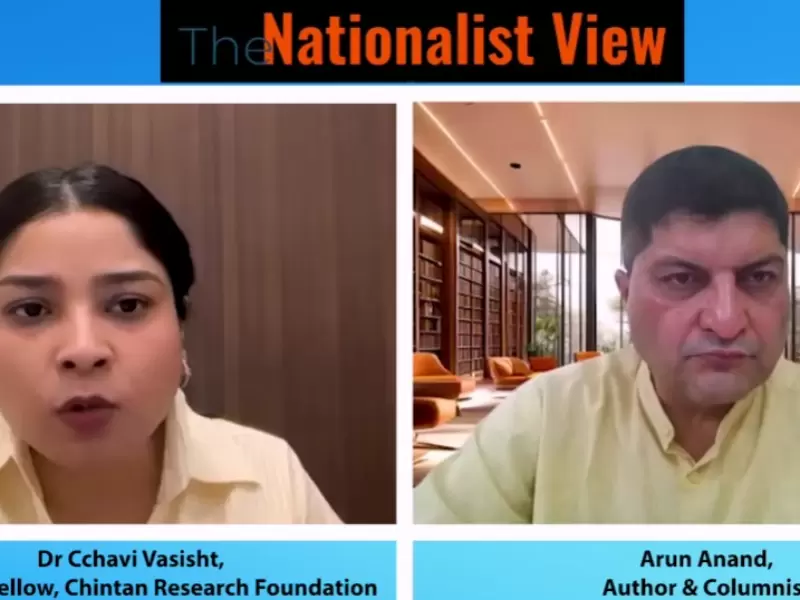 A still from the Nationalist view podcast / Screengrab
Fresh concerns over national security in India’s Northeast have intensified following the arrest of foreign nationals allegedly linked to covert training operations tied to Myanmar’s conflict.
Indian authorities recently arrested six Ukrainian nationals and one U.S. citizen for allegedly entering the Northeast without permits and crossing into Myanmar to train armed groups in drone warfare. The arrests were carried out on March 13 across multiple airports, including Kolkata airport, Lucknow airport, and Delhi airport. Officials have not confirmed whether the individuals were en route to Myanmar or returning from the country.
The developments have renewed focus on long-standing insurgent networks operating along the India-Myanmar border, with experts warning that the situation reflects deeper structural challenges rather than isolated incidents.
Also Read: House Republicans block bid to rein in Trump Iran war powers
According to Dr. Chhavi Vasisht, Associate Fellow at the Chintan Research Foundation, such patterns have historical roots.
“This is not the first time but there is a history of complex networks that have operated in the country. And these current arrests have only resurfaced the issue,” she said in an episode of the Nationalist View podcast with Author and columnist Arun Anand.
Security analysts note that Myanmar’s territory has long been used as a base for insurgent activities affecting India’s Northeast, with porous borders enabling movement for training, logistics, and operations.
Vasisht pointed to a significant evolution in the nature of these threats. “Earlier, there were more arms and ammunition that were being transferred. But now what we are seeing is the drone warfare. And this is very significant,” she said, underlining the growing role of advanced technologies in conflict dynamics.
The continued presence of insurgent groups such as the United Liberation Front of Asom in Myanmar remains a concern. Reports of activity in regions like Sagaing and Chin, along with past drone strikes, suggest these networks remain active.
“If we believe the reports, it's a definite yes,” Vasisht said, referring to the ongoing operations of such groups in Myanmar.
She emphasized that the issue extends beyond India’s borders. “I would say this is not a standalone India's problem. It is a problem of the region,” she said, pointing to the shared vulnerabilities created by cross-border insurgent activity.
Myanmar’s instability, particularly since the 2021 military coup, has further enabled such networks to operate. “Continuing civil war-like situation, continuing destabilized region is something which is helping them harbor their activities,” Vasisht noted.
Funding remains another critical dimension. Experts highlight the role of drug trafficking networks in the Golden Triangle region, spanning Myanmar, Thailand, and Laos, in financing insurgent groups.
“So what we see is that these huge drug transfers have been supplying funds to these armed groups,” she said, adding that the scale of such operations points to a deeply entrenched ecosystem.
The convergence of foreign actors, insurgent outfits, and illicit economies is raising concerns about an increasingly complex web of proxy activity in the region. While Myanmar’s internal conflict continues, its spillover effects are becoming more visible across borders.
For India, the arrests and evolving tactics underscore the need for heightened vigilance, regional coordination, and a sharper focus on emerging threats such as drone warfare that could reshape the security landscape in the Northeast.
Discover more at New India Abroad
Related








ADVERTISEMENT

ADVERTISEMENT
E Paper
Video

Comments
Start the conversation
Become a member of New India Abroad to start commenting.
Sign Up Now
Already have an account? Login