ADVERTISEMENT
ADVERTISEMENT


Bangladesh-Maldives call for SAARC revival, India hints at “country stymying the grouping”
The SAARC which is viewed as the brainchild of former Bangladesh President Ziaur Rahman is receiving a push under the Bangladesh Nationalist Party-government of Tarique Rahman who happens to be the former’s son.
-
 Shikha Salaria
 - Tue, 28, Jul 2026
- 16:23 EDT
- 24
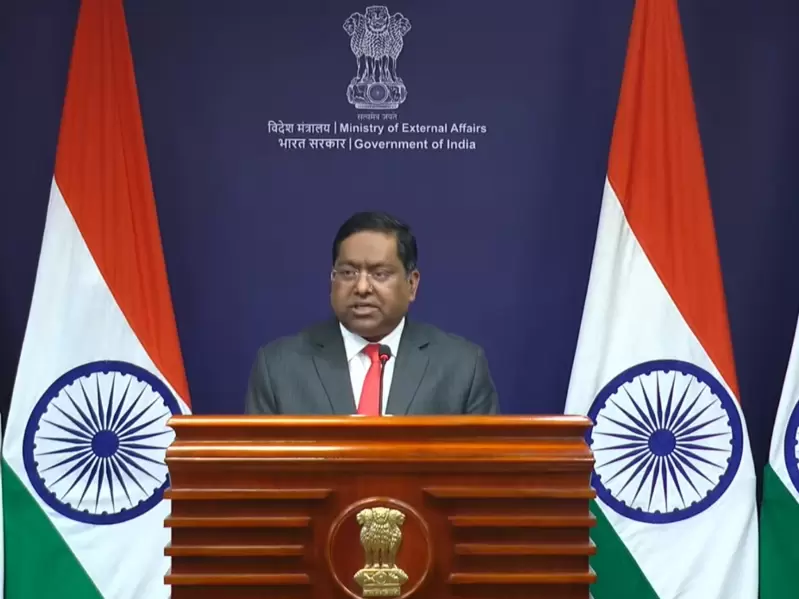 Ministry of External Affairs spokesperson Randhir Jaiswal. / Video grab courtesy: MEA
Even as two of its neighbours are pushing for a revival of the dormant South Asian Association for Regional Cooperation (SAARC), India on July 28 cleared its stand on the grouping’s future, linking the same with the requirement of goodwill from all member states, including Pakistan.
While the SAARC grouping has been dormant for about a decade now, India has been pushing the Bay of Bengal Initiative for Multi-Sectoral Technical and Economic Cooperation (BIMSTEC)—a stance that is also seen to be a way to cut to size the SAARC which was formed in 1985.
In a way, the BIMSTEC is also viewed as a counter to SAARC.
The SAARC which is viewed as the brainchild of former Bangladesh President Ziaur Rahman is receiving a push under the Bangladesh Nationalist Party-government of Tarique Rahman who happens to be the former’s son.
The eight member-organisation includes India, Pakistan, Sri Lanka, Afghanistan, Bangladesh, the Maldives, Nepal and Bhutan. Pakistan was supposed to host the last SAARC summit in 2016, but the same was boycotted by India, Afghanistan, Sri Lanka, Bangladesh, the Maldives and Bhutan following the 2016 terror attack in Uri.
Also read: Bravado, strategy or both? What is behind Sheikh Hasina's plans to return to Bangladesh
Bangladesh’s foreign minister Khalilur Rahman had recently called for the revival of the SAARC during the meeting of the National Security Chiefs of the BIMSTEC grouping held in July in New Delhi.
Days later, Maldives too has joined the Bangladesh-led chorus for a revival of the SAARC with its President Mohamed Muizzu urging member states to undertake “dialogue” to resolve differences and also offering to play the role of a negotiator.
Stating that SAARC member-states should return to the negotiating table in the interest of regional peace and cooperation, Muizzu suggested that The Maldives was ready to serve as a mediator (between India and Pakistan).
Everyone in South Asia aware which country,what activities stymying SAARC: India
However, India on July 28 clarified its stand on the revival of SAARC stating that while India favoured strong regional cooperation, everyone in South Asia was aware as to which country and what activities had been stymying the SAARC hinting at Pakistan.
Without naming any country, Ministry of External Affairs spokesperson Randhir Jaiswal said, "When it comes to regional cooperation, India favours strong regional cooperation and has been working towards it for several decades now. Everyone in South Asia is aware of which country and what activities are actually stymying SAARC... After all, cooperation does require goodwill.”
While Jaiswal didn’t name any country,MEA sources say that New Delhi’s reference was to Pakistan which has faced severe criticism from India over the latter failing to curb the menace of cross-border terrorism emanating from its soil.
What Maldives Prez Muizzu said
Addressing his country on the occasion of the 61st Independence Day of the Maldives on July 27, Muizzu urged that differences between the members of SAARC should be resolved through “dialogue.”
A statement from the office of the President of the Maldives said that Muizzu addressed “the current impasse within the SAARC.”
“Reiterating that differences should be resolved through dialogue, he called on SAARC member-states to return to the negotiating table in the interest of regional peace and cooperation. He added that the Maldives stands ready to serve as a mediator,” the statement said.
It added that while “referring to the foreign policies pursued by some previous administrations which distanced the Maldives from the Arab and Islamic world,” the President said that “such an approach did not reflect the aspirations of the Maldivian people.”
Why Bangladesh and the Maldives are calling for a revival of SAARC
While Bangladesh’s pitch for a revival of the SAARC can be viewed in the backdrop of the return of the Tarique Rahman-led BNP in the country and its growing proximity with Pakistan, the Maldivian President Muizzu has his own reasons for promoting the grouping.
Muizzu had risen to power riding on an assurance to the Maldivian public to wean away the country from India and Maldives under his regime has shown an inclination towards the Arab world and Islamic countries -something that the past governments of the country refrained from doing.
His latest comments on SAARC come at a time when Muizzu has served half of his term and his government has been diversifying its foreign relations with increasing engagement with the Arab world.
In fact, he made the comments about SAARC in the presence of the Bangladesh foreign minister and Prince Mansour bin Mutaib bin Abdulaziz Al Saud, the Advisor to the Custodian of the Two Holy Mosques, Minister of State and Cabinet Member of the Kingdom of Saudi Arabia.
The latter was the Guest of Honour at the 61st Independence Day celebrations of Maldives.
Maldives under Muizzu had signed a pact with Turkiye to purchase unmanned aerial vehicles (UAVs) to patrol the island archipelago’s maritime borders.
“Referring to the foreign policies pursued by some previous administrations, which distanced the Maldives from the Arab and Islamic world, the President said such an approach did not reflect the aspirations of the Maldivian people,” said the statement from Muizzu’s office.
While the ascent of Muizzu had resulted in unease between India and Maldives , ties between the two countries have improved over the past two years and India has repeatedly stepped in to help keep the fledgling Maldivian economy afloat.
Not only has India rolled over two treasury bills worth USD 50 mn owed by Malé, to help the country maintain liquidity of foreign exchange reserves, last year, India had also extended a USD 585 mn line of credit to the archipelago nation when Indian Prime Minister Narendra Modi attended the country’s 60th Independence Day celebrations.
Moreover in May 2024, India had announced two-currency swap lines – worth USD 400 mn as well as a similar amount in rupees – to ensure financial stability of Maldives during Muizzu’s visit to New Delhi.
After touching a high of USD 1.32 billion -the highest it had reached in almost a decade- in March 2026, Maldives’ foreign exchange reserves have fallen sharply to USD 670 million in last month.
Discover more at New India Abroad.
Leave A Comment
Related







ADVERTISEMENT

ADVERTISEMENT
E Paper
Video

Comments
Start the conversation
Become a member of New India Abroad to start commenting.
Sign Up Now
Already have an account? Login