ADVERTISEMENT
ADVERTISEMENT



4,400 Days: Civilizational and political saffronization under Modi
If Nehru's tenure may be characterized as building the institutions of the independent Indian state, Modi's generation has focused on reconnecting that state with the civilizational consciousness of Bharat.
-
 Vijendra Agarwal
 - Thu, 11, Jun 2026
- 15:56 EDT
- 24
 Narendra Modi / @BJP4India
Narendra Modi has completed 4,400 consecutive days as Prime Minister of India. That milestone is historic.
It not only marks twelve years in office but places Modi ahead of Jawaharlal Nehru (who was Prime Minister for 4,398 days) as India's longest continuously serving elected Prime Minister.
Yet the significance of 4,400 days is not simply a matter of political longevity.
The Modi era should ultimately be remembered for two distinct yet interconnected transformations, namely the civilizational saffronization of Bharat and the political saffronization of India's electoral map. The first relates to identity, while the second is about power. Together, they have reshaped the trajectory of modern India.
If Nehru's tenure may be characterized as building the institutions of the independent Indian state, Modi's generation has focused on reconnecting that state with the civilizational consciousness of Bharat.
That distinction is historic and one of the defining features of twenty-first-century India.
For much of the post-independence period, India's public life was framed primarily through the language and lens of the secular state, economic development, and constitutional governance. Perhaps, these were necessary priorities for a young republic after centuries of foreign rule.
Yet many Indians also felt that during the Nehru era and successive dynasties, the civilizational foundations of Bharat often occupied a secondary place within the national narrative. Its sacred geography, spiritual traditions, indigenous knowledge systems, historical memory, and heritage symbols were largely undermined and underappreciated.
Under Modi, that balance has shifted significantly. Examples include the Ram Mandir in Ayodhya, the Kashi Vishwanath Corridor, renewed attention to pilgrimage routes, and the global embrace of Yoga Day. In fact, a broader willingness to celebrate India's civilizational inheritance has become a defining feature of the national conversation in the last 4,400 days.
This phenomenon is often described as saffronization.
Critics view the term as a warning, while the supporters embrace it as a source of pride. Both interpretations, however, tend to miss an important distinction.
The first form of saffronization is civilizational. It reflects the re-emergence of cultural confidence among millions of Indians who increasingly see no contradiction between modernity and tradition, technological progress and spiritual heritage, economic development and civilizational continuity.
Whether one applauds or opposes this development, it is difficult to deny that the civilizational vocabulary of Bharat occupies a far more visible place in public life today than it did even a decade ago.
The second form of saffronization is political. Perhaps no achievement of the Modi era has been more remarkable than the transformation of India's political geography.
When Modi first emerged as a national leader, he was widely viewed as the successful Chief Minister of Gujarat. Few could have predicted that the political model associated with his leadership would eventually expand across such a large portion of the Indian Union.
Today, a significant share of India's population lives under either BJP-led governments or governments aligned with the National Democratic Alliance. What began as a movement anchored in Gujarat evolved into a national political force stretching across large parts of northern, western, central, and northeastern India, as shown in the map below.
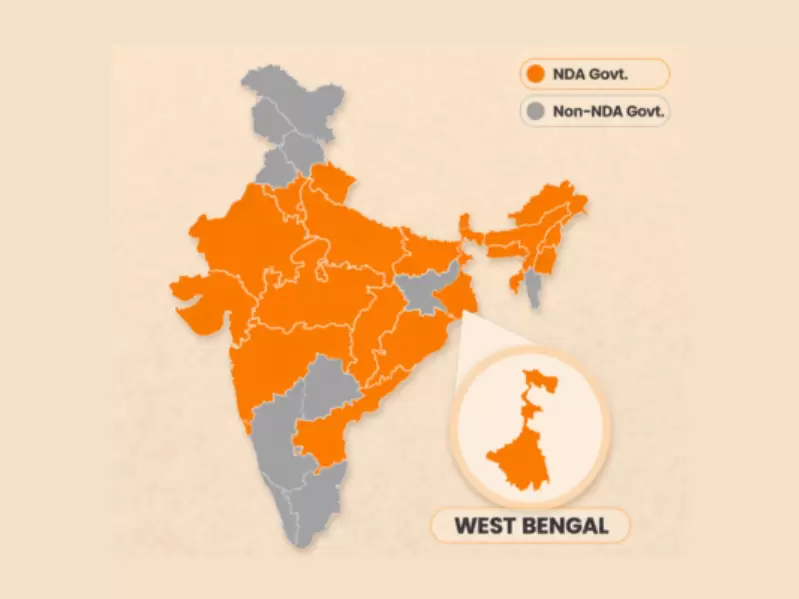
This political expansion did not occur through a single electoral victory. It was built over years through organizational discipline, coalition-building, leadership development, governance performance, and a narrative that resonated with voters across diverse linguistic, cultural, and regional boundaries.
The result has been a level of political consolidation by the BJP under Modi. Supporters argue that this consolidation has contributed to greater policy continuity, stronger national security, accelerated infrastructure development, and a more coherent pursuit of long-term goals such as Atmanirbhar (self-reliant) Bharat and Viksit (Developed) Bharat 2047.
India today is a confident nation that extends beyond economics. It increasingly presents as a nation capable of defending its borders, asserting its interests, expanding its global influence, and pursuing development without abandoning its cultural foundations.
The relationship between these two saffronizations is perhaps the most important story of the past 4,400 days.
Civilizational saffronization created a renewed sense of cultural confidence.
Political saffronization provided the institutional and electoral power necessary to translate that confidence into public policy and governance.
The two are not identical. Yet neither can be fully understood without the other.
The more important question, however, concerns the future. Would the civilizational confidence that has re-emerged during this period continue to shape India's national consciousness in the future? No one may know the answer.
However, a generation of Indians has now come of age during the Modi years. For many of them, cultural confidence, civilization pride, national self-assertion, and aspirations of becoming a developed nation are increasingly viewed as ordinary features of public life.
If that confidence endures, historians will someday conclude that the significance of these 4,400 days extended far beyond the tenure of a Prime Minister. At least this period is a pivotal chapter in the long story of Bharat's civilizational renaissance, a moment when political power and civilizational identity converged to reshape the direction of the world's largest democracy.
In that sense, 4,400 days is a marker in a much larger journey of Bharat and not just Modi as its Prime Minister.
In summary, 4,400 days have led to the growth of both types of saffronization. In a civilizational context, it is the re-centering of Bharat's identity, sacred geography, cultural memory, and Sanatani traditions. On the other hand, politically speaking, it is the unprecedented expansion of the BJP/NDA influence across India's electoral map under Modi's leadership.
Vijendra Agarwal is a Ph.D. physicist from IIT Roorkee.
(The views and opinions expressed in this article are those of the author and do not necessarily reflect the official policy or position of New India Abroad.)
Discover more at New India Abroad.
Related









ADVERTISEMENT

ADVERTISEMENT
E Paper
Video

Comments
Start the conversation
Become a member of New India Abroad to start commenting.
Sign Up Now
Already have an account? Login