ADVERTISEMENT
ADVERTISEMENT



Indian-origin CMU researchers win top U.S. honors
The awards recognize advances in data center systems, semiconductor design and energy-efficient computing research.
-
 Malvika Choudhary
 - Tue, 12, May 2026
- 16:51 EDT
- 531
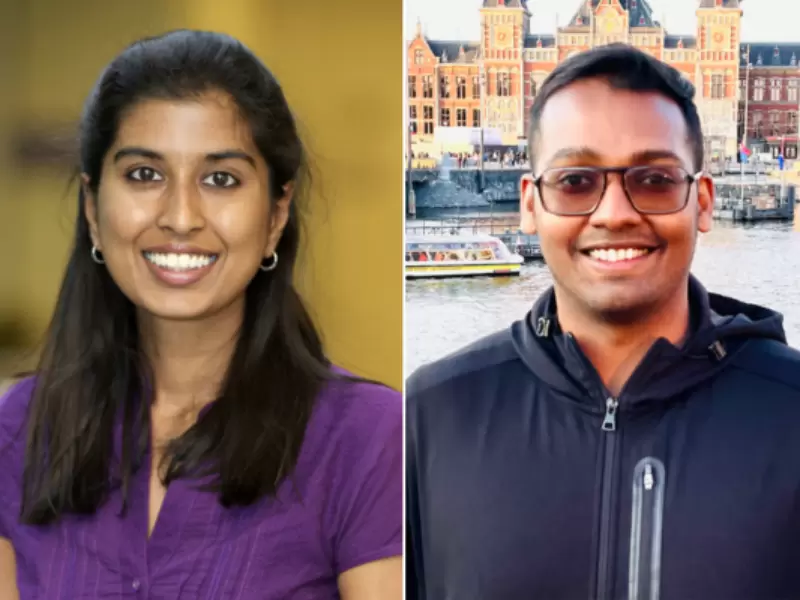 Akshitha Sriraman/ Tathagata Srimani / ece.cmu.edu
Indian-origin researchers at Carnegie Mellon University have received major recognitions for their work in computer engineering and semiconductor research.
Akshitha Sriraman, assistant professor of electrical and computer engineering, was named the 2026 recipient of the Computing Research Association’s Anita Borg Early Career Award.
Also Read: Tripti Kataria to lead Illinois State Medical Society
The award recognizes early-career researchers in academia, industry and government for impactful contributions to computing and leadership in expanding participation in the field.
Sriraman’s research focuses on computer architecture and systems software, particularly improving the efficiency, sustainability and fairness of hyperscale data center systems.
According to Carnegie Mellon University, her systems innovations are already deployed in hyperscale data centers serving billions of users and have generated millions of dollars in cost savings while helping reduce carbon emissions.
Her hardware research has also influenced technologies including Intel’s Alder Lake CPU architectures, Intel’s Infrastructure Processing Unit, Mangoboost’s Data Processing Unit and Intel’s Data Streaming Accelerator.
Sriraman earned her Ph.D. in Computer Science and Engineering from the University of Michigan and her master’s degree in embedded systems from the University of Pennsylvania.
Her previous honors include the NSF CAREER Award, the 2025 Google ML and Systems Junior Faculty Award, the 2024 George Tallman Ladd Research Award and the 2023 Intel Rising Star Award.
Separately, Carnegie Mellon assistant professor Tathagata Srimani received the National Science Foundation’s CAREER Award, a five-year grant supporting junior faculty in research and education.
Srimani’s work centers on ultra-dense three-dimensional integration of computing systems, a technology that vertically stacks logic and memory layers to create faster and more energy-efficient chips.
The research aims to reduce the energy consumed in transferring data between memory and processors while improving performance for artificial intelligence and other data-intensive applications.
“Today, a huge fraction of a chip’s energy budget is spent just shuttling data between memory and processing,” Srimani told the University Press. “By stacking these layers in 3D and co-designing the technology and architecture together, we can fundamentally change that equation.”
The project will develop new frameworks for designing and optimizing three-dimensional integrated circuits and will also include prototype chip development and workforce training initiatives for the semiconductor industry.
Before joining Carnegie Mellon, Srimani was a postdoctoral scholar at Stanford University. He earned his Ph.D. and S.M. degrees in EECS from the Massachusetts Institute of Technology and completed his B.Tech in Electronics and Electrical Communication Engineering from Indian Institute of Technology Kharagpur.
Discover more at New India Abroad.
Leave A Comment
Related








ADVERTISEMENT

ADVERTISEMENT
E Paper
Video

Comments
Start the conversation
Become a member of New India Abroad to start commenting.
Sign Up Now
Already have an account? Login