ADVERTISEMENT

ADVERTISEMENT

The monk Bangladesh wants silenced: Chinmoy Krishna Das and the Hindu question

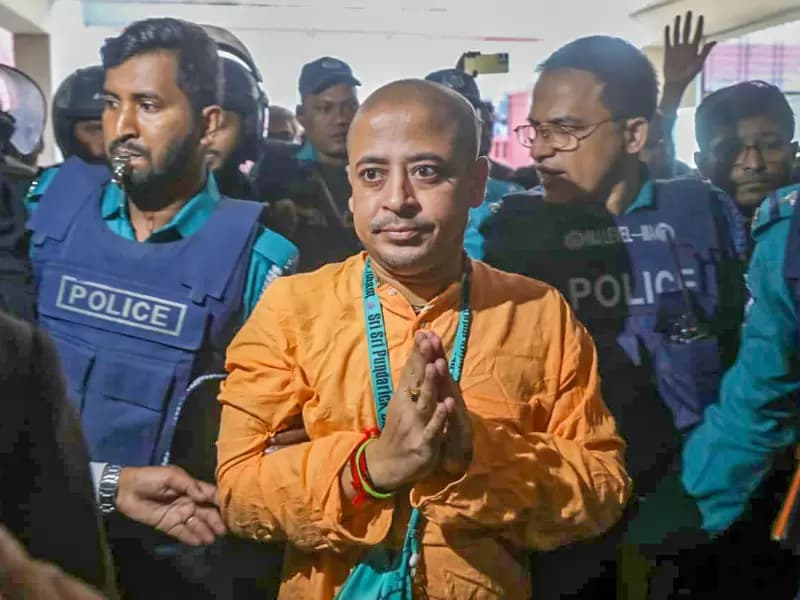
Chinmoy Krishna Das became one of the few Hindu religious leaders openly mobilising public opinion around minority rights and safety.

Chinmoy Krishna Das, a senior monk of the International Society for Krishna Consciousness (ISKCON) / IANS

Liberated in 1971, Bangladesh was built on a promise of secularism, equal citizenship, and shared cultural identity. Hindus played a significant role in the Liberation War and suffered heavily during the conflict.

Yet, decades later, recurring attacks on temples, demographic decline, communal violence, and growing insecurity continue to raise difficult questions about the condition of Hindus in Bangladesh. Is co-existence, mutual respect for culture, dignity of human life or human rights of minorities exist in Bangladesh? 

It is within this larger context that the case of Chinmoy Krishna Das has acquired significance far beyond that of an individual legal battle.

A Bangladesh High Court recently rejected his bail petition in the lawyer Saiful Islam Alif murder case, while reserving its order on four other bail petitions filed by him in separate cases. This development points towards a more difficult legal battle ahead for a monk who emerged in 2024 as a rare, vocal defender of minority rights.

To understand the rise of Chinmoy Krishna Das, one must look at the condition of Hindus in Bangladesh. The country’s Hindu population, which stood at nearly 22 percent in 1951, has steadily declined over the decades to around 8 percent today. Minorities, particularly Hindus of Bangladesh have a history of facing persecution, violence and even migration.

This time, reason was the political unrest and collapse of the Sheikh Hasina government in 2024. Reports of attacks on Hindu homes, temples, businesses, and religious institutions emerged from multiple parts of Bangladesh. There were videos and reports of vandalised temples, targeted attacks, and intimidation of Hindu families circulating widely across social media.

All this intensified fears within the minority communities. It was during this difficult circumstances Chinmoy Krishna Das became one of the few Hindu religious leaders openly mobilising public opinion around minority rights and safety.

Born in Satkania Upazila of Chattogram district, Chinmoy Krishna Das displayed remarkable oratorical abilities from a very young age and reportedly began delivering religious sermons when he was barely six or seven years old. Around 1996–97, he came into contact with Jayapataka Swami, a senior disciple of ISKCON founder A.C. Bhaktivedanta Swami Prabhupada, an association that deeply shaped his spiritual path. He formally received religious initiation in 2000 and later rose to become the monk-president of the historic Pundarik Dham in Chattogram in 2007.

Under his leadership, Pundarik Dham developed into an active centre of devotional and social engagement. His supporters credit him with mobilising Hindu youth, strengthening religious outreach, and reclaiming temple lands allegedly encroached upon by politically influential groups. Over time, his influence expanded among sections of Bangladesh’s Hindu community, particularly younger Hindus drawn to his assertive articulation of minority concerns.

After the fall of the Sheikh Hasina government in 2024 attacks on temples, Hindu localities, and minority institutions increased manifold in different parts of the country. he emerged as one of the strongest public voices demanding accountability and protection for minorities.

He became the spokesperson of the Bangladesh Sommilito Sanatan Jagaran Jot, a coalition formed through the coming together of Bangladesh Sanatan Jagaran Manch and Bangladesh Sommilito Shankhaloghu Jot.

Through large public rallies attended by thousands, Chinmoy Krishna Das advocated what became known as the organisation’s “eight-point demand.”

These included the creation of a tribunal to address atrocities against minorities, a minority protection law, enhanced safeguards for temples and religious institutions, and stronger legal protection for Hindus and other vulnerable communities. His speeches and mobilisation efforts rapidly gained attention across Bangladesh.

On October 31, 2024, a sedition case was filed against Chinmoy Krishna Das and several others at Chattogram’s Kotwali Police Station. The allegations stemmed from a Hindu rally in Chattogram’s New Market area, where complainants accused participants of placing a saffron flag above the Bangladesh national flag. Supporters of Chinmoy rejected the allegations and questioned why similar displays by Islamist organisations had not attracted comparable legal scrutiny.

Chinmoy himself stated in media interactions that the Sanatani organisations had nothing to do with the controversial flags and that the incident had occurred 2 km away from the main rally venue.

On November 25, 2024, Chinmoy Krishna Das was detained by the Detective Branch of Dhaka Metropolitan Police from the Hazrat Shahjalal International Airport area in Dhaka. His arrest immediately triggered protests among Hindus, particularly in Chattogram, where demonstrators demanded his release. A court later rejected his bail plea and ordered that he be sent to jail in connection with the sedition case.

The unrest intensified on November 26, 2024, when clashes broke out near the Chattogram court premises after supporters of Chinmoy Krishna Das protested his continued detention. During the violence, lawyer Saiful Islam Alif was killed. Subsequent murder case named Chinmoy Krishna Das along with several others. Here, it must be pointed out that the clashes occurred while he was already in police custody and no direct evidence publicly established his involvement in the killing.

The atmosphere surrounding the case also raised concerns regarding intimidation within the legal process. Reports emerged that several lawyers were reluctant to appear for Chinmoy Krishna Das after the violence at the court premises. On December 3, 2024, when his bail matter came up before the Chattogram court, no defence lawyer appeared on his behalf, resulting in the hearing being postponed.

Senior lawyer Rabindra Ghosh, who later defended the monk, publicly alleged threats and intimidation- “No guarantee that I won’t be killed’: Chinmoy Krishna Das’ lawyer says ‘death threats’ won’t stop him from defending Hindu monk. He stated that lawyers associated with the case were facing harassment and warned that defending Chinmoy Krishna Das had itself become dangerous.

In the face of  the legal proceedings and political controversy, Chinmoy Krishna Das continued to retain substantial support among sections of Bangladesh’s Hindu community. Many viewed him not merely as an individual religious leader, but as a symbol of a deeper crisis confronting Hindus in Bangladesh.

Bangladeshi poet and philosopher Farhad Mazhar publicly remarked that in his interactions with Chinmoy, he never found him anti-national and criticised the use of colonial-era sedition provisions against him.

More than five decades after the creation of Bangladesh, the Chinmoy Krishna Das case has reopened difficult questions about the place of Hindus within the country’s national life. For many Bangladeshi Hindus, the issue is no longer limited to one monk, one organisation, or one courtroom battle. It is about whether a minority community can speak openly about insecurity, attacks on temples, demographic decline, and the demand for institutional protection without being viewed with suspicion.

Chinmoy Krishna Das emerged during a period when many Hindus in Bangladesh felt increasingly vulnerable after the political turmoil of 2024. His growing support among sections of Hindu youth reflects not merely religious mobilisation, but a deeper desire among many minorities to assert visibility, dignity, and equal citizenship in the country their families helped build in 1971.

Whether Bangladesh chooses to view that assertion as democratic participation or as criminal defiance may ultimately shape not only the future of one Hindu monk, but also the confidence of an entire minority community that continues to seek security and belonging in its ancestral homeland.


The writer is an author and columnist


(The views and opinions expressed in this article are those of the author and do not necessarily reflect the official policy or position of New India Abroad.)

Discover more at New India Abroad.


Comments

Related

To continue...

Already have an account? Log in

Create your free account or log in