ADVERTISEMENT
ADVERTISEMENT



Louise Arbour, former Supreme Court justice, to be Canada's next governor general
The new appointment comes with a couple of controversies over the French language credentials of the outgoing Governor-General and the continuation of the Prime Minister to choose the Governor-General.
-
 Prabhjot Paul Singh
 - Tue, 05, May 2026
- 18:47 EDT
- 198
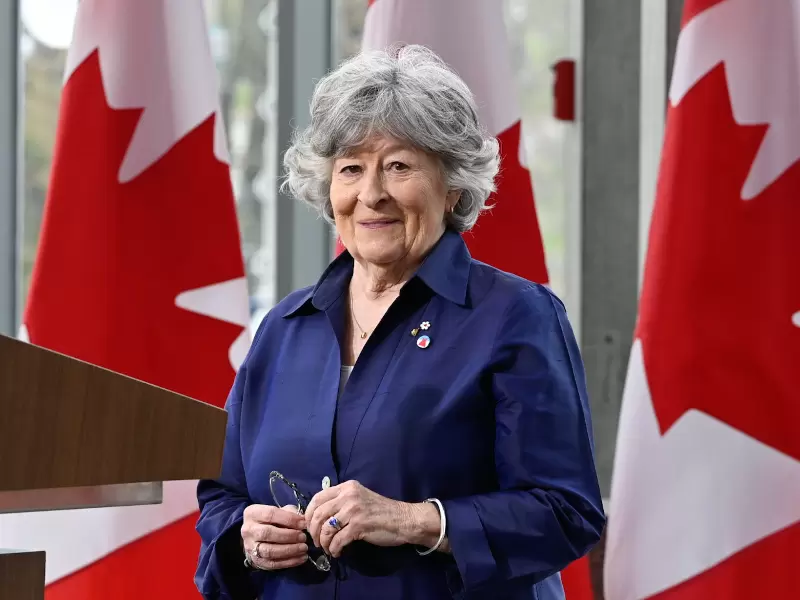 Louise Arbour / Facebook
Canada is all set to have a new Governor General, this time, a jurist who is well-versed in French, the second official language of the country.
At a news conference, Prime Minister Mark Carney announced that former jurist Louise Arbour will be the next governor-general. Louise Arbour would replace Mary Simon, who was dogged by French-speaking issues, when her term ends this month.
The new appointment comes with a couple of controversies over the French language credentials of the outgoing Governor-General and the continuation of the Prime Minister to choose the Governor-General.
Also Read: Hemant Shah to head Canada India Trade Development Committee
“Canada was built on the foundations of three peoples—Indigenous, French, and British,” Carney said during the ceremony, overlooking the rear of Parliament Hill, holding that "unity does not require uniformity, that our differences are a strength to be nurtured, not a risk to be managed. That insight has been sustained and reinforced generation after generation by our institutions—Parliament, the courts, the Crown, the treaties, the Charter, the public service, and a free press.”
The Crown, Carney said, represents a continuous thread through our constitutional life.
“The Governor General is the Crown’s representative in Canada,” Carney said. “Commander-in-chief of the Canadian Armed Forces, steward of our traditions—of peace, order, and good government—and above all, the governor general is the guardian of our constitutional order.”
While Simon was indeed bilingual and born in Quebec, she was raised in Kuujjuaq in the Quebec Arctic—the daughter of an English-speaking Canadian and Inuk mother—and came to Rideau Hall fluent in English and Inuktitut, but not French. She is set to step down this month.
“Canada is a wonderful country shaped by the diversity of its people, or perspective and experiences, but I think it is shaped also mostly by a common respect for strong public institutions and for the rule of law,” Arbour said Tuesday morning.
“Above all, we all strive to provide for each other in the spirit of equality and generosity.
Born in Montreal, Arbour earned her law degree from Université de Montréal in 1970.
In 1990, she became the first francophone appointed to the Ontario Court of Appeal, where she led an eye-opening Arbour Report into the condition of women prisoners at the now-shuttered Kingston Prison for Women—uncovering a pattern of “cruel, inhumane, and degrading treatment” that led to numerous resignations and important policy changes in Canada’s correctional system.
She served as UN High Commissioner for Human Rights from 2004 to 2008 and the UN’s special representative for international migration from 2017 to 2018.
Arbour also led the 2022 review into sexual misconduct in the Canadian Armed Forces and Canadian military colleges.
While Simon maintained she was committed to learning French upon being named governor general by former prime minister Justin Trudeau in July 2021, and Canadian military colleges. She never became fluent, causing much consternation in Quebec.
Following Simon’s appointment, the Office of the Commissioner of Official Languages received more than 1,300 complaints over her lack of English skills, but former commissioner Raymond Theberge ruled Simon’s appointment didn’t violate the Official Languages Act, as the role wasn’t covered under the legislation.
Despite her assurances and hundreds of hours of lessons costing taxpayers $52,000, she never became fluent in French.
A 2024 tour of Quebec City saw Simon speaking almost no French during her visit, causing controversy in the French-language press.
These controversies prompted the PM to explicitly state that Canada’s next viceroy will be fluent in both of Canada’s official languages.
Duff Conacher, co-founder of Democracy Watch, said the days of the prime minister choosing Canada’s head of state need to come to an end.
“Given how important it is for the governor general to be independent of the prime minister and impartial, Carney should not have handpicked his appointee through a secretive, partisan process,” Conacher said.
“The governor general should have been chosen through a democratic process, and the prime minister should also have told King Charles who Canada chose and not asked his approval, and if he had accepted that as the new protocol, it would have become clear that Canada chooses its own head of state.”
Discover more at New India Abroad.
Leave A Comment
Related






ADVERTISEMENT

ADVERTISEMENT
E Paper
Video

Comments
Start the conversation
Become a member of New India Abroad to start commenting.
Sign Up Now
Already have an account? Login