ADVERTISEMENT
ADVERTISEMENT



India Should Go All-In on Uncrewed Systems
New systems such as General Atomics Aeronautical Systems, Inc.’s (GA-ASI) Precision Exportable Launched Effect or PELE represent a transformative capability for India’s defence strategy.
-
 Dr. Vivek Lall
 - Sat, 15, Aug 2026
- 00:30 EDT
- 45
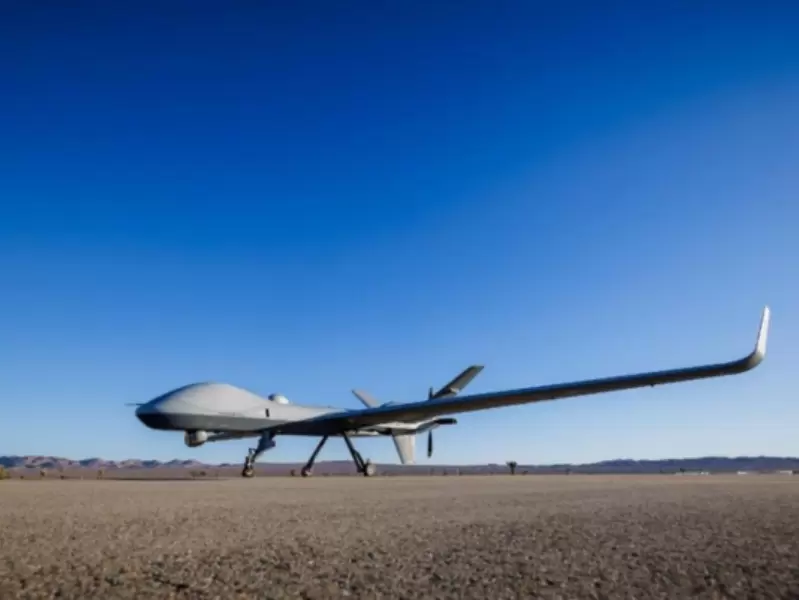 Photo caption: Deployed worldwide, GA-ASI’s MQ-9B is the highest-performing UAS in its class. / General Atomics
As global threat dynamics rapidly shift, India is standing at a transformative crossroads in its defence modernization, where cutting-edge technology and long-term vision meet to reshape national airpower.
The nation's strategic choice to field the MQ-9B SkyGuardian® unmanned aerial system represents far more than an operational upgrade—it marks a definitive shift toward a hybrid force architecture of crewed and uncrewed platforms. Embracing this integrated posture will expand India's operational reach while cementing its role as an international pioneer in defence innovation.
The MQ-9B SkyGuardian stands at the apex of modern remotely piloted aviation. Built with exceptional endurance, multi-domain versatility, and seamless joint interoperability, it functions as a critical force multiplier to secure India’s vast borders and sea lanes.
Yet SkyGuardian is merely the baseline. India’s force transformation will truly accelerate as it harnesses the MQ-9B's modular airframe to deploy airborne launched effects and bridge the operational path toward full Collaborative Combat Aircraft (CCA) integration. These advancements offer India's armed forces unprecedented precision, flexibility, and mass across contested environments.
New systems such as General Atomics Aeronautical Systems, Inc.’s (GA-ASI) Precision Exportable Launched Effect or PELE represent a transformative capability for India’s defence strategy. These small, expendable drones can be deployed from larger platforms like the MQ-9B to perform specialized tasks, ranging from reconnaissance to electronic warfare or kinetic strikes. By incorporating launched effects, India can expand its intelligence, surveillance, reconnaissance, and strike capabilities in a cost-effective manner, ensuring dominance across diverse operational domains.
Persistent Airborne Early Warning and Counter-Swarm Defence
Beyond strike and reconnaissance, the evolution of the MQ-9B platform is addressing one of the most pressing requirements in modern air combat: continuous airborne early warning and surveillance. The successful flight test of the GA-ASI and Saab Airborne Early Warning and Control (AEW&C) mission package—featuring the podded LoyalEye radar integrated onto an MQ-9B—marks a monumental leap in unmanned airborne sensing.
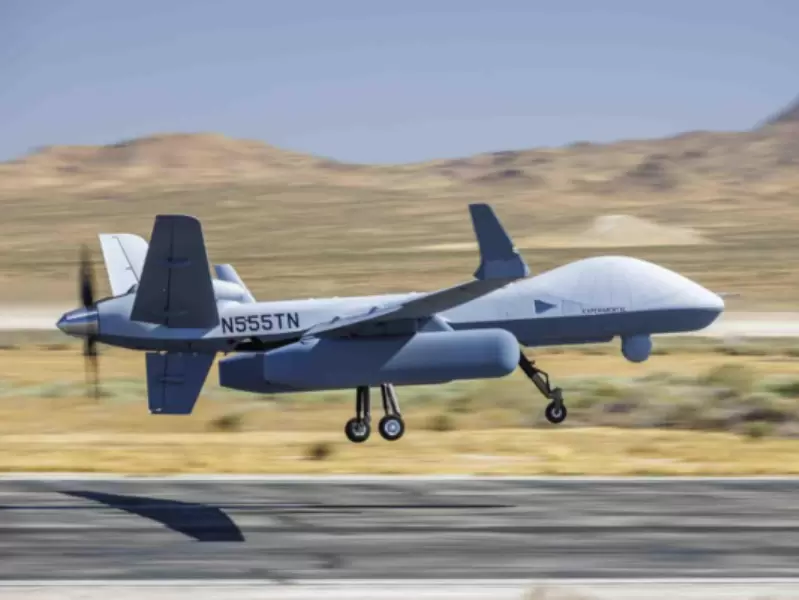 GA-ASI’s MQ-9B equipped with the AEW&C system successfully completed its first flight on May 19, 2026. / General Atomics
For the Indian military, this capability fills a vital operational gap. Traditional crewed AEW&C assets are invaluable, yet high-cost and operationally constrained. An AEW&C-equipped MQ-9B delivers long-endurance, persistent air and maritime surveillance, detecting incoming cruise missiles, low-altitude aircraft, and unmanned systems across vast frontiers—without placing aircrews in harm's way.
This airborne surveillance node unlocks revolutionary defensive tactics when paired with kinetic counter-drone solutions. Recent successful test fires of the Advanced Precision Kill Weapon System laser-guided rockets from MQ-9 platforms against aerial targets have demonstrated a highly effective, low-cost intercept capability.
When deployed in tandem, an AEW&C MQ-9B acting as an aloft radar picket and a loitering MQ-9B armed with a deep magazine of Advanced Precision Kill Weapon System rockets create a formidable layered defence against asymmetric drone swarm attacks.
The AEW&C platform provides persistent tracking and targeting data over tactical networks, allowing the shooter MQ-9B to detect, engage, and neutralize incoming swarms of one-way attack drones cost-effectively long before they threaten critical infrastructure or frontline forces.
The Collaborative Combat Aircraft Horizon
The potential of CCAs is equally exciting. These uncrewed systems are designed to operate alongside manned fighter jets, enhancing their effectiveness through advanced sensor integration, electronic warfare capabilities, and coordinated strike operations.
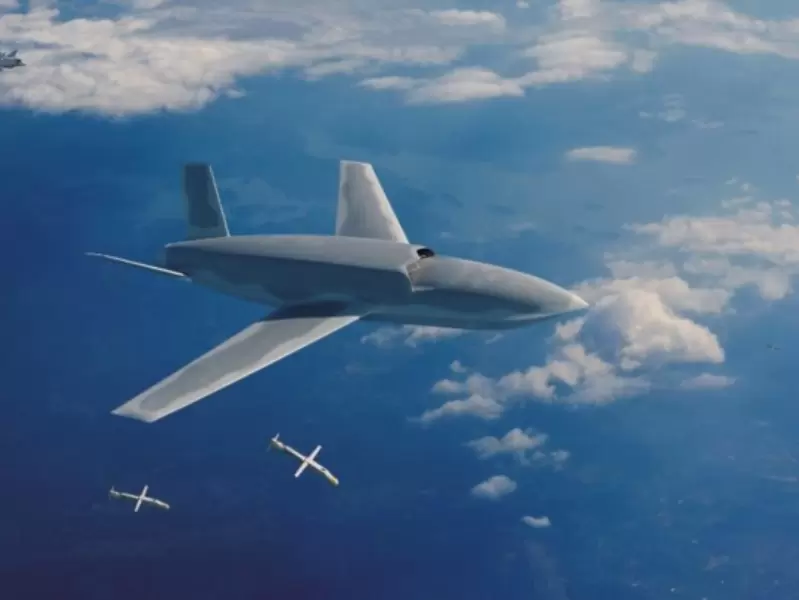 Designed for the global market, GA-ASI’s Gambit 6 works with crewed and uncrewed aircraft to secure the modern battlespace with precision air-to-ground strike capability. (Artist’s rendering) / General Atomics
Imagine a future where India’s manned fighter wing, including platforms like the Rafale and Tejas, is complemented by a fleet of cost-effective autonomous aircraft that amplify their reach and combat power.
This blended approach will enable India to overmatch potential adversaries while reducing risk to human pilots in contested environments.
Strategic Vision and Economic Impact
The integration of crewed and uncrewed systems is not just about technology; it is about strategy. A blended force structure allows India to adapt to the evolving nature of warfare, where threats range from high-end peer adversaries to low-cost drone swarms.
By leveraging the strengths of both manned and unmanned platforms, India can ensure readiness across the spectrum of conflict.
Moreover, this approach aligns with India’s vision of becoming a global leader in defence innovation. By collaborating with industry leaders like GA-ASI, India is pushing the boundaries of unmanned systems, developing capabilities that are not only cutting-edge but also tailored to its unique operational needs.
The strategic benefits of a blended force structure extend beyond the battlefield. For policymakers and legislators, this approach represents a sound investment in national security and economic growth.
The MQ-9B program has, for example, created opportunities for local manufacturing and workforce development, driving the growth of India’s defence industrial base.
As India continues to integrate advanced technologies into its force structure, the economic impact will only grow, fostering innovation and creating jobs across the country.
India’s approach serves as a model for integrating crewed and uncrewed systems in a way that enhances operational effectiveness and interoperability, and continuing to integrate uncrewed systems will ensure the nation remains an innovation leader for decades to come.
Looking Beyond the Headlines
The news today is dominated by headlines that might mislead some into believing that the strong relationship between India and the United States has somehow broken.
These sensationalist views shouldn’t be allowed to cloud our long-term vision or disrupt strong international business relationships like the one between India and GA-ASI.
Great powers like the United States and India inevitably will encounter disagreements as they navigate complex global trade dynamics, but these disputes should be viewed as natural aspects of a robust and evolving partnership rather than signs of permanent discord.
Both nations share a deep commitment to fostering prosperity, innovation, and stability in the Indo-Pacific region, grounded in mutual respect and shared democratic values. Temporary disagreements are opportunities for dialogue and resolution rather than barriers to collaboration.
The burgeoning success of the MQ-9B program speaks to the benefits of continued robust partnership. Together, GA-ASI and India are shaping the future of unmanned systems and redefining the landscape of modern warfare.
Whether through launched effects, AEW&C pods, laser-guided counter-swarm weapons, CCAs, or other next-generation technologies, this collaboration is poised to elevate India’s status as a global leader in defence innovation.
As India continues its journey toward self-reliance and technological excellence, the integration of crewed and uncrewed aircraft will play a central role in its force structure. The MQ-9B program stands as a shining example of what can be achieved through strategic partnerships, visionary leadership, and a shared commitment to innovation.
(The views and opinions expressed in this article are those of the author and do not necessarily reflect the official policy or position of New India Abroad.)
Discover more at New India Abroad.
Leave A Comment
Related










ADVERTISEMENT

ADVERTISEMENT
E Paper
Video

Comments
Start the conversation
Become a member of New India Abroad to start commenting.
Sign Up Now
Already have an account? Login