ADVERTISEMENT
ADVERTISEMENT



The rise of Indian Americans as mayors
The election of Zohran Mamdani as mayor of New York City has turned the spotlight on other successful Indian origin CEOs of American cities.
-
1747754650.png) Ishani Duttagupta
Ishani Duttagupta - Wed, 19, Nov 2025
- 19:22 EST
- 450
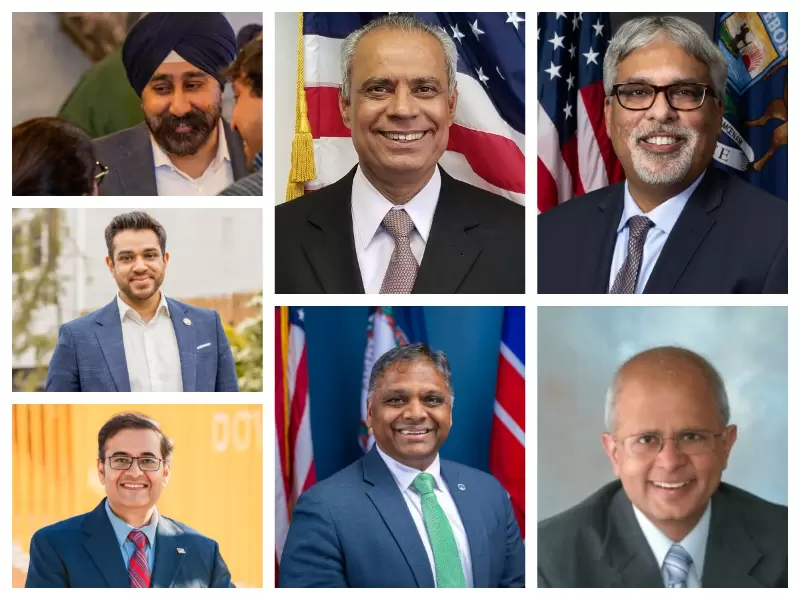 Indian American Mayors (clockwise)-- Ravi Bhalla, Upendra Chivukula, Sam Singh, Hemant Marathe, Danny Avula, Raj Salwan, and Sam Joshi. / Wikipedia
The election of Zohran Mamdani as the next mayor of New York City has been widely hailed by the Indian American community. As America’s largest city and a global financial and cultural hub, New York City operates under a strong-mayor model, where the mayor serves as the chief executive officer (CEO).
In this powerful role, Mamdani will wield significant executive authority over critical areas, including policing, schools, housing, city services, public property, and the city’s vast $110 billion to $115 billion annual budget—the largest municipal budget in the U.S. This scope includes managing 325,000 employees and the country’s largest public school system, which educates more than 1.1 million students.
And Mamdani’s victory also highlights a broader trend: The off-year U.S. elections earlier this month also saw the re-election of three other successful Indian American mayors—Hemant Marathe, Aftab Pureval, and Sam Joshi—underscoring the community's growing presence in U.S. politics and public life.
ALSO READ: Not just Mamdani: Indian Americans emerge winners
Hemant Marathe, the mayor of West Windsor, New Jersey, is the first Indian American to hold this position in his city. He won re-election to a third term in a nonpartisan election on Nov. 4, defeating his Indian American opponent Sujit Singh. Marathe, a graduate of IIT Bombay, moved to the U.S. as a student and holds a Ph.D. from the University of Washington. He has been a community leader in West Windsor for many years and has focused on economic development of the town. His re-election campaign highlighted fiscal restraint, experience, and incremental development to preserve the township’s character.
Sam Joshi, the first Indian American mayor of Edison, New Jersey, ran for re-election with his current term ending in December 2025. He was re-elected to a four-year term with a big margin. Asian Americans and Indian Americans supported his campaign in a big way. Joshi, 34, was born and raised in New Jersey. Many donors to his campaign, too, were Indian Americans. Through his campaign, Joshi highlighted fiscal responsibility, stable taxes, investing in town infrastructure, and stopping overdevelopment.
In Ohio, Cincinnati’s Tibetan Indian Mayor Aftab Pureval, who had made history as the city’s first Asian American mayor, was re-elected. Pureval, who holds degrees from Ohio State University and University of Cincinnati, has prioritized equitable economic growth, public safety, affordable housing, and investment in the green economy during his tenure. Before becoming mayor, he served as the Hamilton County clerk of courts.
“During their campaigns, many of these leaders actively engage with the Indian American community, mobilizing volunteers, seeking endorsements, and discussing issues like immigration reform, economic opportunities, and cultural recognition. This engagement energizes our community, encouraging higher voter turnout, civic participation, and even more candidates to run for office. It helps transform Indian Americans from a model minority focused on professional success to a politically empowered group that’s fully engaged in public life—from school boards to city halls,” says Ajay Jain Bhutoria, Democratic leader and former adviser to President Joe Biden.
In their roles combining legislative, executive, and ceremonial powers, Indian American mayors are emerging as influential local leaders and public figures. They address real issues like affordable housing, public safety, education, and economic growth in their cities, wielding significant influence over policies that impact millions.
In several American cities, mayors serve as very visible and powerful CEOs. They make their presence felt in the daily lives of their citizens in the most direct ways, in realms like sanitation, policing, and infrastructure development. “Local legislators and mayors of Indian origin in America are serving as guides, inspirational teachers, and examples to others in the community who wish to follow in their footsteps. The profile of Indian Americans is definitely raised in the best possible way, by showing that our community is deeply engaged in public service in this country,” says Sanjeev Joshipura, the Washington, D.C.-based executive director of Indiaspora, a nonprofit organization and network of global Indian-origin leaders.
An example, he feels, is Pureval, who has been mayor since January 2022. “Under his leadership, Cincinnati has seen significant improvements in public safety, housing affordability, economic revitalization, and environmental sustainability,” Joshipura says.
Raj Salwan, an earlier elected city council member, was elected mayor of Fremont in Silicon Valley, California, in November 2024. As Fremont’s first Indian American mayor, he drew significant support from the region’s large Indian American community. His mayoral campaign highlighted critical local issues, including rising homelessness, increased crime and public safety concerns, traffic congestion, deteriorating infrastructure, and a decreased quality of life.
Born in a village near Amritsar, Salwan immigrated to the U.S. at the age of six. He was raised in Fremont and graduated from UC Irvine. His long career in public life began in 2005 on the Fremont Human Relations Commission. He was first elected to the city council in 2016, where he focused on reducing traffic and organizing a committee to allocate land for school construction.
Democrat Danny Avula has been the mayor of Richmond, Virginia, since he won the election in 2024. The Hyderabad-born doctor is the city’s first Indian-born mayor. Avula went to medical school at Virginia Commonwealth University and earned a master’s degree at Johns Hopkins University. He earlier served as director of the health district covering Richmond and Henrico County.
Born in Nellore, India, Democratic politician Upendra Chivukula has had a long and illustrious career in public life, including serving as mayor of Franklin Township, New Jersey, in 2000. Currently serving on the New Jersey Board of Public Utilities, he represented New Jersey’s 17th District in the state’s General Assembly from 2002 to 2014. He was the first Indian American elected to the New Jersey Legislature and the fourth Indian American elected to state office anywhere in the United States. Chivukula also served on the Franklin Township Council from 1998 to 2005.
India-born Savita Vaidhyanathan served as mayor of Cupertino in Silicon Valley, California, from 2017 to 2018. She was elected to the Cupertino City Council in 2014. The first Indian American mayor of Cupertino, Vaidhyanathan holds a math degree from St. Stephen’s College, Delhi, and an MBA from San Jose State University.
Ravi Bhalla, who served as the first Sikh mayor of Hoboken, New Jersey, since 2018 and earlier on the Hoboken City Council from 2009 to 2018, is a civil rights lawyer. Earlier this month, Bhalla was elected to the New Jersey General Assembly, and with the race for mayor of Hoboken too close to call, a runoff election will be held in December 2025 to establish a clear winner among the two candidates with the most votes. Indian American Dini Ajmani, who ran for mayor, is not among the top two.
ALSO READ: Ravi Bhalla declares victory in NJ democratic primary
Bhutoria, a national fundraiser for the Democratic Party and a community leader, hails Salwan, who made history as Fremont’s first Indian American mayor in 2024, securing a competitive victory with 47 percent of the vote. His journey as a longtime Fremont resident and small business owner to city council member, including two terms as vice mayor, embodies the immigrant success story and his commitment to the city, Bhutoria, himself a Fremont resident who supported and endorsed Salwan’s campaign as mayor, feels.
“Salwan’s role as mayor reflects the strength of our community in the Bay Area, where Indian Americans are a vital part of the fabric,” he says. “The successes of Indian Americans in leadership roles, such as mayors of important towns and cities, are a testament to the community’s growth and the Democratic values of opportunity and inclusion.”
Under Salwan’s leadership, Fremont is driving a new agenda: vibrant downtown revitalization, improved parks, sustainable homelessness solutions, and making the city more affordable and family-friendly while promoting growth for small, medium, and large businesses, Bhutoria feels.
ALSO READ: Raj Salwan elected Mayor of Fremont
“The election and re-election of Indian American mayors—including Mamdani, Joshi, Marathe, Purewal, and Salwan, and earlier trailblazers like former mayors Upendra Chivukula, Savita Vaidhyanathan, and Ravinder Bhalla—significantly elevate the profile of the Indian American community across the United States.
“Mayors serve as the CEOs of their cities, managing budgets, public safety, and economic development. When Indian Americans hold these positions, it powerfully showcases our community’s talent, hard work, and commitment to public service, demonstrating that the American dream is achievable for immigrants and their children,” Bhutoria adds.
He concludes that leaders such as Pureval in Cincinnati and Salwan in Fremont are not just administrators but visible advocates for inclusive communities, bridging diverse groups and amplifying South Asian voices in mainstream politics. “This local influence often extends to state and national levels, fostering greater representation and policy changes that benefit all Americans.”
Michigan state Sen. Sam Singh started his career in public life and civic engagement as an elected councillor of the East Lansing City Council, where he served three terms, including one as mayor (2006–07). He is also the first Indian American elected to the Michigan Senate, where he serves as majority floor leader in his first term in office, since January 2023. Singh also served three terms as state representative, from 2013 to 2018. In his last term, he served as the Democratic leader. He was also president and CEO of the Michigan Nonprofit Association, senior consultant for the New Economy Initiative, and CEO of Public Policy Associates.
Other Indian-origin mayors include Kashmir Gill, mayor of Yuba City, California, in 2009–10 and 2013–14. Gill, a Republican, was the first Sikh to be elected mayor in the United States. His family immigrated to the U.S. from Hoshiarpur in Punjab when he was three, and he grew up working in the family’s fruit orchards, later becoming the business manager of the family’s farming business. He graduated with a degree in agricultural business. As mayor, Gill advocated for federal funds to be used for the city's levee upgrades.
Harvinder ‘Harry’ Anand, a former mayor of Laurel Hollow, New York, was the first Indian American in New York state to hold the position. He served in office for three terms between 2007 and 2013. A chemical engineer who graduated from Punjab University, Anand immigrated to the U.S. in 1982. He also served as commissioner of police for Laurel Hollow and attended the Civilian Police Academy in Nassau County, New York. He was also director of the Nassau County Law Enforcement Exploring Advisory Board and an active member of the Nassau County Police Reserves.
Indian American Satish Hiremath, a practicing dentist, was the mayor of Oro Valley, Arizona, between 2010 and 2018. As mayor, he made a significant impact on the development of the town of Oro Valley through philanthropy and advocacy for arts and cultural diversity.
ALSO READ: With Zohran poised to lead NYC, a Look at Indian-origin mayors in US
Even though mayors in the U.S. are the chief executives of the city government, with responsibilities that range from ceremonial duties and community leadership to managing city operations and budgets, the specific powers and duties vary significantly based on the city’s governmental structure, with some mayors having strong executive powers while others are more symbolic or have limited authority compared to the city council.
“The rise of Indian American mayors across the United States is an important marker of the community’s growing political maturity, but it is also crucial to understand that not all mayoral offices in America carry the same weight. New York City’s mayor, for instance, oversees a whopping annual budget of roughly $110 billion to $115 billion,” says Robinder Sachdev, president of the Delhi-based think tank Imagindia Institute and a co-founder of the U.S.-India Political Action Committee.
He adds that by contrast, a majority of mid- to large-sized U.S. cities operate under the council–manager system, where a professional city manager, appointed by the council, runs day-to-day administration. “Many towns where Indian Americans are elected mayor follow this model. So, while the title ‘mayor’ certainly elevates visibility, the actual governing power varies considerably.”
Even as Mamdani’s election in New York City is nothing short of historic, many Indian American mayors are becoming influential public figures, Sachdev adds.
Leave A Comment
Related


ADVERTISEMENT

ADVERTISEMENT
E Paper
Video

Comments
Start the conversation
Become a member of New India Abroad to start commenting.
Sign Up Now
Already have an account? Login