ADVERTISEMENT
ADVERTISEMENT



Face to face with Surjit Singh Rihal, Olympian and teacher
Hi book details his early life with accuracy and in minute detail, making it an authentic story of an immigrant who shared a one-room apartment with his family in the “Niagara” suburb of Nairobi.
-
 Prabhjot Paul Singh
 - Mon, 25, May 2026
- 16:03 EDT
- 30
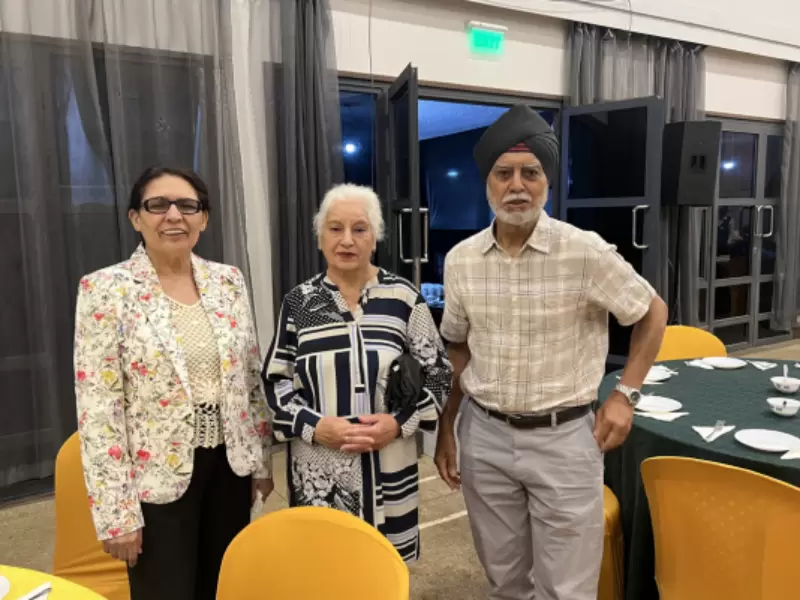 Surjit Singh Rihal, and his wife Kiran with Maninder / Maninder K. Chandhoke
Surjit Singh Rihal belongs to a rare clan of hockey Olympians who have several firsts to their credit. He took to academics and worked as a schoolteacher, a rarity among men Hockey Olympians. His deep association with the game as a player, a coach and a referee extended to three continents – Africa, Asia and America.
And lastly, Surjit Rihal took to both research work and writing, areas that have little or no takers among players of his class and calibre.
Though born in Kenya in 1948, then a British colony, Surjit Singh lived his early years between two worlds – Kenya and India. He started playing hockey at Juja Road Primary School in Nairobi, and moved on to Lyallpur Khalsa College, Jalandhar, to join the likes of Ajit Pal Singh, Hardial Singh Kular, Hardev Singh Kular and Pandit Ji, Shiv Datt.
On his return, he enrolled himself at the University of Nairobi and the mighty Sikh Union Club. His stars kept shining with his selection in the first World Cup in 1971 when he hit the international sporting ranks. This was followed by participation in the second World Cup in 1973.
He was selected for the World XI to play in the 1972 Munich Olympic Games. Surjit is like a king among other players, standing tall with charisma. He is among the unsung heroes who gave Kenyan hockey its heartbreak and popularity globally. After retiring from active hockey, he returned to the game as a coach and umpire.
He taught Geography, a subject about which many Sikh Hockey Olympians would be clueless.
After donning Kenyan colors in the 1971 first World Cup in Barcelona, Surjit Singh Rihal was an unstoppable forward for the 1972 Munich-bound Kenyan Olympic team. He went on to play the 1973 World Cup in Amsterdam.
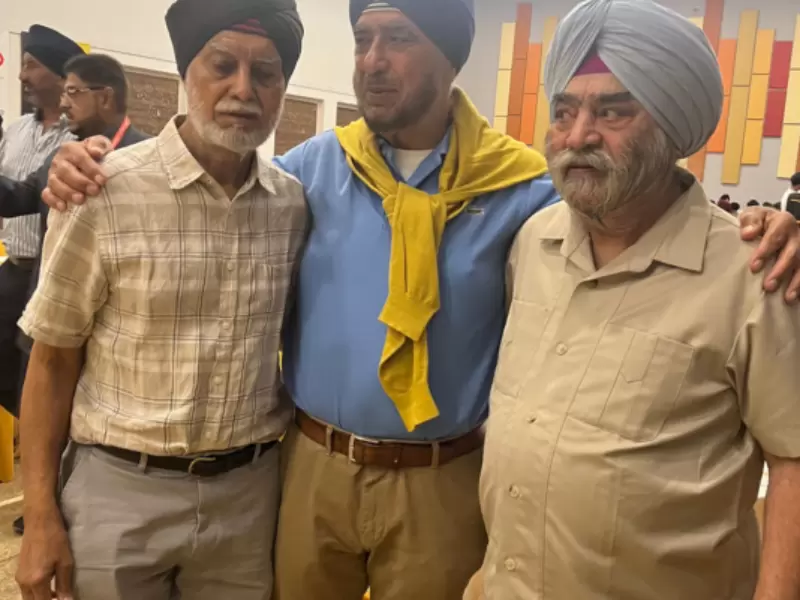 Surjit Singh Rihal with his friends and supporters / Maninder K. Chandhoke
This was the golden period of Kenyan hockey. Team led by Avtar Singh Sohal lost the bronze medal match to India in Barcelona. Going by its pre-Olympic record, it was unlucky to miss the podium in Munich.
Though Kenya continued its Olympic journey in hockey until 1988, but its later part could never emulate its years of descent till early 70s. Players of Indian descent, especially Punjabis, were the core strength of this African nation as it rose to the rating of the top four in world hockey.
This month when Surjit Singh Rihal, accompanied by his lovely wife, Kiran, came to Nairobi, to participate in the centenary celebrations of Sikh Union Club, his launch pad. Rihals brought with them a pack of books, printed on glossy paper, to tell the story of his family, including his ancestors, both in India and Kenya, in an easy, lucid, flowing style as a great storyteller. It is an absorbing academic work with beautiful pictures encompassing events and incidents that stood like monuments in his hard path to glory.
His ability to recall his early life with accuracy and in minute details make it an authentic story of an immigrant who shared one room apartment with his family in the “Niagara” suburb of Nairobi. It was this town that Punjabi settlers had “Punjabised” to Niagara, though its correct name is Nigara, now is a densely populated, mixed income area known for its residential apartments, commercial activity and a bustling local atmosphere.
 Title page of the book / Maninder K. Chandhoke
Surjit also recalls his early years living in one rented room with a kitchen and shared toilets and bathroom. The building belonged to Gurbux Singh Rehal, a businessman and landlord, who had several other properties in Nairobi.
As the 1950s began, his father and his uncle built their own house on Assam Lane in Park Road where the family moved in 1951. The new house had nine rooms, nine kitchens, two baths and two toilets upstairs and the same downstairs. It was a mansion.
Surjit also talks about his ancestral home in Punjab, Bhin, in NawanShahr district and his first journey to his village when the family traveled by ship from Mombasa to Mumbai and then by rail from Mumbai to Jalandhar. A final bus ride took them to NawanShahr, where a horse-pulled Tonga carried them to Bhin village, located on a mound. “Oh boy, that was a long Safari”.
In Kenya, three-time African Safari champion Tiger Joginder Singh and several other international sports stars of those days resided in Niagara. He also talks about his early days of learning hockey from Edgar Fernandes who was selected to represent Kenya at the 1960 Rome Olympic Games. It was perhaps Edgar that inspired Surjit to take to teaching. Edgar in 1973 moved to Australia, recalls Surjit Singh Rihal.
Surjit Rehal made his presence felt when he made a digital and illustrative presentation at one of the several banquets held during the week-long centenary celebrations.
Surjit, who also had a sojourn in Canada, where he worked as a coach.
He is now settled in England but keeps his association with Kenyan hockey alive. Instead of writing his sports career biography, Surjit has chosen to honor his grandparents, parents and extended family and to reflect on life in Rural Punjab as he did through his presentations, the book “Happiness is the main goal in this game of life," which is edited by Sham Lal Puri and printed by Crownbird Publishers, sums up a hockey star of different connotations.
Discover more at New India Abroad
Related





.jpg)

12.png)



ADVERTISEMENT

ADVERTISEMENT
E Paper
Video

Comments
Start the conversation
Become a member of New India Abroad to start commenting.
Sign Up Now
Already have an account? Login