ADVERTISEMENT
ADVERTISEMENT



Parties must address Indian American community concerns to win their vote
A recent Carnegie Endowment for Peace survey suggests that Indian Americans remain an influential Democratic constituency, but some are increasingly identifying as independent. Rising political independence suggests that political parties must be attentive to the specific issues of concern to Indian Americans.
-
1758210324.png) Sital Kalantry
Sital Kalantry -
 Ashini Jagtiani-Williams
 - Thu, 02, Apr 2026
- 07:26 EDT
- 151
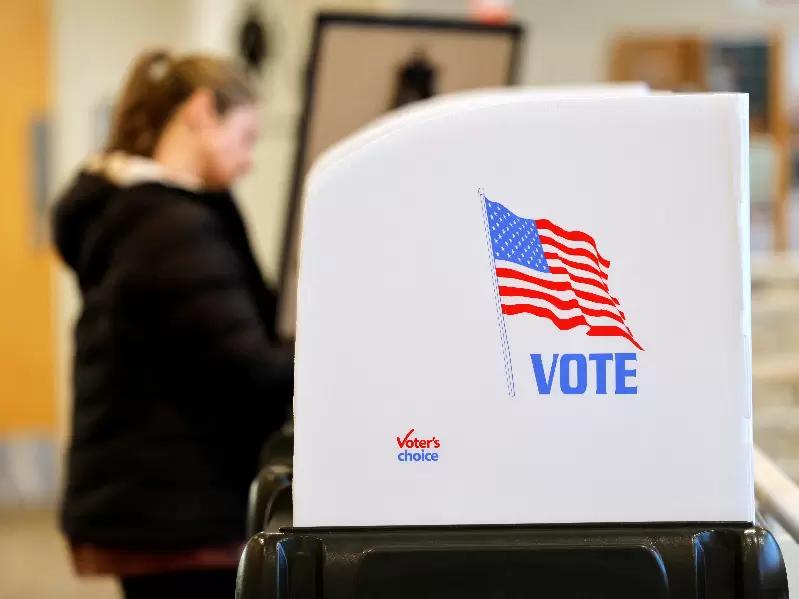 A woman votes during the state’s primary election to choose candidates for the November midterm elections, in Chapel Hill, North Carolina, U.S., March 3, 2026. / REUTERS/Jonathan Drake
For many years, the great majority of Indian Americans were Democrats. However, the Indian American Attitudes Survey, a recent methodologically rigorous study by the Carnegie Endowment for International Peace suggests that the community’s political identity is not as reliably democratic as it used to be.
Indian Americans are decreasingly identifying as Democrats and increasingly identifying as independent. This suggests that the Democratic party will need to address specific issues of concern to the Indian American voter in order to win them back.
Listen to an insightful conversation with Milan Vaishnav and Sital Kalantry on Roundglass India Center’s latest podcast episode about the wider implications of the survey here.
Carnegie conducted three surveys on Indian American attitudes, one in 2020, another in 2024 and the third and most recent in 2026. Examining the longitudinal data, we observe that while in 2020, about 52 percent of Indian Americans identified as Democrats, in 2024 only 48 percent viewed themselves as Democrats, and by 2026, that number has decreased to 46 percent.
Yet, this decrease did not translate into direct gains for the Republican party. The percentage of Indian American who identified as Republicans grew slightly from 15 percent in 2020 to 19 percent in 2024 and remained stable in 2026. The Indian Americans who are disaffected with the Democratic party seem to be increasingly identifying themselves as independent rather than Republican.
Also Read: First-of-its-kind Indian American voter data platform launched
American political parties have historically grouped Indian Americans into a larger camp with other Asian Americans and Pacific Islanders. While there are many shared goals across different Asian communities, Indian Americans are just as unique as the rest of individual communities of the bloc.
According to the most recent Carnegie survey, specific issues of concern for Indian Americans include immigration, high skilled visas, and personal experiences with discrimination. For example, the survey found that two-thirds of Indian Americans oppose a recent $100,000 fee for H-1B visas, a policy that significantly affects Indian origin workers who made up 71 percent of new petitions in 2024. When political parties fail to address these issues squarely, they will fail to gain broader community vote.
The survey also points to heightened discrimination that could influence future voting patterns. Many Indian Americans report worrying about discrimination and the lack of pathways for legal immigration. Even though 71 percent disapprove of the current administration’s overall performance, this hasn't automatically led to an increase in Democratic support.
The survey also reflects the diversity of the Indian American community. Political views vary across generations and migration experiences. Younger Indian Americans tend to show more support for Democratic candidates. Indians over the age of 50 have moved slightly in the other direction. There are also differences between U.S.-born citizens and more recent immigrants.
While the survey suggests that Indian Americans remain an important part of the Democratic coalition, their vote must be gained and not taken for granted. Many voters appear to be judging parties based on how well they address issues such as immigration, economic opportunity, and discrimination. For political leaders, the lesson is that earning the community’s trust will require paying closer attention to these specific concerns.
Sital Kalantry is a professor of law and Associate Dean at Seattle University School of Law and Founding Director of the Roundglass India Center.
Ashini Jagtiani-Williams is the Assistant Director at Roundglass India Center at Seattle University.
Leave A Comment
Related





ADVERTISEMENT

ADVERTISEMENT
E Paper
Video

Comments
Start the conversation
Become a member of New India Abroad to start commenting.
Sign Up Now
Already have an account? Login