ADVERTISEMENT
ADVERTISEMENT



Hockey inherited penalty card system from soccer
Starting on August 15, the FIH World Cups, both for men and women, will be held simultaneously in the Netherlands and Belgium.
-
 Prabhjot Paul Singh
 - Mon, 10, Aug 2026
- 16:16 EDT
- 38
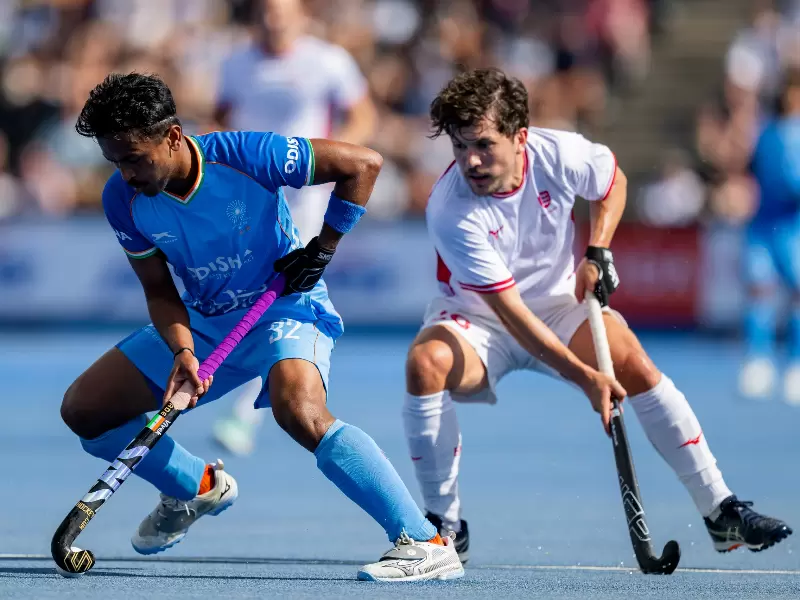 FIH Hockey Pro League / Hockey India
The hype created by the FIFA World Cup 2026 has started subsidising. Though the controversy emancipating from the FIFA FFE proposal is refusing to die down even after the FIFA chief Gianni Infantino has retracted his proposal, many member continental and national football federations are out with their knives to seek the end of the present regime.
Even before the FIFA FFE proposal was flashed in the public domain, the anti-Gianni Infantino lobby was up in arms after US President Donald Trump in a social media post said he had asked the FIFA chief for a review of the “Red Card” awarded to a US player. The FIFA relented and provided a waiver of not enforcing the “ban on Folarin Balogun in the round of 16 match against Belgium”.
The USA striker Folarin Balogun had received a controversial red card in the 64th minute of a 2026 FIFA World Cup Round of 32 match against Bosnia & Herzegovina. FIFA later suspended his automatic one-game ban under Article 27 of the FIFA Disciplinary Code, placing him on a one-year probation and allowing him to play in the next match.
Also Read: Inaugural International Gatka Championship to be held in Texas
What happened afterwards is a history now?
It is, however, interesting to trace the history of “waving penalty cards” in ball games, like soccer and field hockey.
Incidentally, the man that led to the origin and implementation of the concept of penalty cards was an Argentine soccer star, Antonio Rattin, who unfortunately died while the FIFA World Cup 2026 reached its quarterfinal stage.
The England-Argentina rivalry is older than the famous Falklands war.
Just to refreshen the memory of our readers, "The Falklands War was a 74-day conflict in 1982 between Argentina and the United Kingdom over control of the Falkland Islands and South Georgia. It began when Argentine forces invaded on April 2. Britain responded by sending a naval task force, ending in an Argentine surrender on June 14, 1982.”
Sixteen years before the Falklands conflict, England and Argentina were face-to-face in a 1966 FIFA World Cup match. During that game played with tempers running high, Argentine striker Antonio Rattin had an impassioned run-in with the referee. It was this incident that ultimately paved the way for the origin of the penalty card system.
Antonio Rattin, a forgotten hero of yesteryears, was in the news during the quarterfinal match of the FIFA World Cup 2026 when Argentina took on Switzerland. The Argentines were wearing black armbands in honour of Antonio Rattin. Argentina won the game as a tribute to its former striker, star and captain.
Antonio Rattin was 2 metres plus and created waves as a midfielder. Before the match against England, he cautioned his team against an intense physical game. Rattin reportedly felt that the referee was not calling enough fouls on the English.
At the 35-minute mark – at that time the game used to be of two halves of 35 minutes each – the German referee, Rudolf Kreitlein, awarded a penalty to the English. Rattin contested the decision. Since he did not know German, Rattin wanted to know why an England team was not penalised the same way for a similar offence.
Since the German umpire did not understand what Rattin was saying in Spanish, he ordered Rattin off the field for the “violence of his tongue".
In his post-match comment, the referee said that he “believed seeing in his face” that he was “insulting me”.
Rattin refused to go out. He walked to the sidelines and sat on a red carpet reserved for the Queens’ viewing area.
After several minutes, two police officers escorted him off the field under a hail of chocolates hurled by English fans. Rattin grabbed one of those chocolates, ate and threw back the wrapper.
As he was going out, he grabbed a pennant that featured the Union Jack flag and rubbed it between his fingers. The spectators threw beer cans. Rattin paused again when his path was blocked by a Shetland pony belonging to the English marching band.
Though he explained later that he was trying to bring order to the chaotic scene. He said that he was telling the referee that he should have spoken to him about the penalty against his side. “But before I could get him to understand, he threw me out of the game." Rattin was quoted saying in a later media interaction.
Down by a player, Argentina lost the match 0-1. Subsequently, England went on to beat Germany in the championship game.
It was the communication gap between Rattin and the German referee that led to the head referee, Ken Aston, saying that some reforms were needed for discipline in the game.
Inspired by traffic lights, it was he who created the system of penalty cards – yellow for warning and red for expulsion.
The penalty cards have since then become an integral part of most of the ball games.
After the FIFA World Cup, now another World Cup is in the offing. Though it may not be that great a crowd puller or attraction as the FIFA World Cup is, it has its own following the world over.
Starting on August 15, the FIH World Cups, both for men and women, will be held simultaneously in the Netherlands and Belgium.
And hockey has its own stories about the "penalty cards". Of many such episodes, I want to share the most recent one – of the Paris 2024 Summer Olympic Games.
I was in Paris for the summer Olympic Games when the Red Card fiasco happened. It was a crucial game against the 1988 Olympic champions Great Britain. Here are some excerpts of my match report about what was later known as a “match marred by controversial umpiring decisions”:
“India did it. It was no less than a miracle. Playing the last 43 minutes with 10 men, it not only held 1988 Olympic champions Great Britain to a 1-1 draw but also scored an exciting 4-2 win in the subsequent penalty shoot-out to earn a place in the semi-finals of the 2024 Olympic Games hockey competition.
It was a controversial start to the knockout round with one of the ground umpires waving a red card to Indian deep defender Amit Rohidas in the 17th minute for hooking a British player, William Calnan. Shellshocked by the dreaded award, Indian players protested but to no avail. They did not reflect that they were impacted, as they remained high in their spirits. They continued to attack their opponents with a vengeance.
It was the spirit of fighting odds, including umpiring blues, that helped bronze medallists of the 2020 Tokyo Olympic Games to take the lead in the 22nd minute, when Harmanpreet Singh, with yet another exemplary leadership display, found the target from the fourth penalty corner earned by his team.
The goal shook the Britons. Playing with 10, India conveyed a strong message. There was no let-up in the spirits of the team players as they accepted the challenge to play the rest of the game without their dependable defender,” the report said.
India protested but had no “Donald Trump” to speak to FIH to get a reprieve for Amit Rohidas. The difference has been that India played its next game without its star defender and went on to win bronze, while the USA played with Folarin but lost the pre-quarterfinal to Belgium.
Discover more at New India Abroad
Leave A Comment
Related









ADVERTISEMENT

ADVERTISEMENT
E Paper
Video

Comments
Start the conversation
Become a member of New India Abroad to start commenting.
Sign Up Now
Already have an account? Login