ADVERTISEMENT
ADVERTISEMENT



Usha Mahajan on making ancient Hindu wisdom accessible to young minds
Mahajan speaks to New India Abroad about her children's book, Discovering Hinduism, her Indian roots and making Hindu philosophy accessible to young readers.
-
 Bhavana P
 - Sun, 16, Aug 2026
- 12:28 EDT
- 302
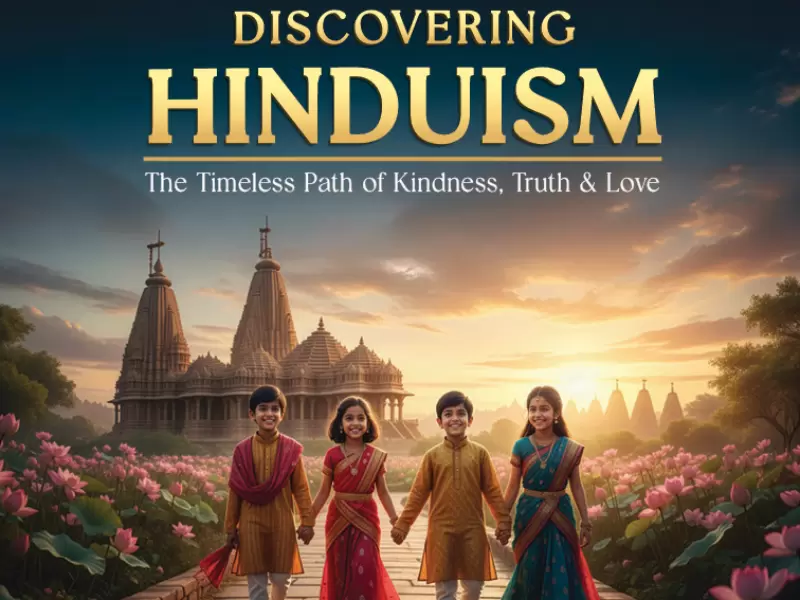 Discovering Hinduism: The Timeless Path of Kindness, Truth & Love / Usha Mahajan
For Ohio-based author Usha Mahajan some of Hinduism's most enduring ideas did not need to be taught through textbooks or complicated explanations. They could begin with a child's question, a family conversation or a simple lesson about kindness.
That realization became the foundation for Discovering Hinduism: The Timeless Path of Kindness, Truth & Love, a children's book through which the Ohio-based author seeks to introduce young readers to concepts such as dharma, karma and moksha through stories and experiences they can understand.
Drawing on her Indian roots, her decades-long career in mental health and her experiences raising grandchildren in the United States, Mahajan set out to make Hindu philosophy less abstract and more personal for children growing up in a world far removed from the traditions she knew.
In an interview with New India Abroad, Mahajan reflected on the personal journey behind the book, the values she hopes young readers will carry with them and why she believes Hindu philosophy can offer timeless guidance to children today.
A grandmother's question
The idea emerged from a simple question: How could she introduce her grandchildren to the values and philosophy of Hinduism in a way they could understand?
After retiring, Mahajan began searching for a book that could provide young children with a broad and engaging introduction to Hinduism. While she found books on individual subjects, including the Ramayana, Mahabharata and Bhagavad Gita, she could not find one that brought together its fundamental concepts in an accessible format.
“I went online looking for books, and I could not find a single book that was comprehensive, that would at least expose the young kids to all the concepts of Hinduism,” she said.
Beyond festivals and rituals
Mahajan also recognized a wider challenge among Hindu families in the United States: Children were often introduced to their heritage through individual stories, festivals or rituals without necessarily understanding how these traditions were linked.
“Many children were learning about Hinduism in fragments, like a Diwali festival here or a story there or a ritual somewhere else, without seeing how everything is connected,” she said. “So I tried to connect those dots for them.”
According to Mahajan, the book is not intended to offer a complete account of a philosophical tradition as vast and diverse as Hinduism. Instead, she hopes it provides children with a foundation for further exploration.
“Hindu philosophy is incredibly rich and one book could never capture all its depth,” she said. “So I see this book as the beginning of a lifelong journey, not the final destination.”
Indian roots
Mahajan credits her upbringing for shaping her approach to writing.
She grew up primarily in Chandigarh, although her father's government service meant the family travelled extensively, particularly within Punjab. “Growing up in India, the values were not just taught only in the classroom. They were woven into everyday life,” she recalled.
After moving to the United States in her early 20s, Mahajan built a career in mental health spanning more than four decades. Working with people from different backgrounds, she said, reinforced her belief that education should extend beyond simply acquiring information.
“It's not just the information. It's how you discern that information. How you get the wisdom from that,” she said.
That belief informs the way she explains Hindu philosophy to children. Mahajan acknowledged that simplifying concepts such as dharma, karma and moksha was challenging, but said making them accessible did not mean stripping them of meaning.
“Simple does not mean shallow,” she said.
Rather than beginning with complex philosophical definitions, Mahajan connects these ideas to situations children encounter in daily life, including questions of fairness, honesty and helping others.
Addressing misconceptions
Mahajan’s commitment to clarifying misunderstandings about Hinduism is deeply rooted in her own experiences. Her path to teaching Hinduism in the United States was sparked when her son came home from a sixth-grade world religions class, brimming with questions about the contrasts between what he had learned at school and his family's perspective on the faith.
On sharing her concerns with the school, she was eventually invited to teach the class, later even expanding her role to teach Hinduism at other schools.
“That’s how my journey began, actually, as a teacher for Hinduism,” she said.
A lifelong journey
Ultimately, Mahajan hopes young readers will look beyond Hinduism as simply a collection of festivals and rituals and discover the values underlying them.
“If I could hope one thing, it wouldn't be that the child memorizes all the facts about Hinduism,” she said. Instead, she hopes they develop “a deeper appreciation of the values that it teaches.”
She is now working on a second version aimed at young adults, which will explore the ideas introduced in Discovering Hinduism in greater depth.
Discover more at New India Abroad.
Leave A Comment
Related












ADVERTISEMENT

ADVERTISEMENT
E Paper
Video

Comments
Start the conversation
Become a member of New India Abroad to start commenting.
Sign Up Now
Already have an account? Login