ADVERTISEMENT
ADVERTISEMENT



Nepal’s reform under PM Balen Shah faces test of delivery
Nepal’s rapidly evolving political landscape—marked by an ambitious reform agenda, bold economic targets, and renewed regional diplomacy—is at a critical juncture, with experts cautioning that delivery, not intent, will define its trajectory.
-
1759953093.png) Staff Reporter
Staff Reporter - Fri, 17, Apr 2026
- 18:43 EDT
- 42
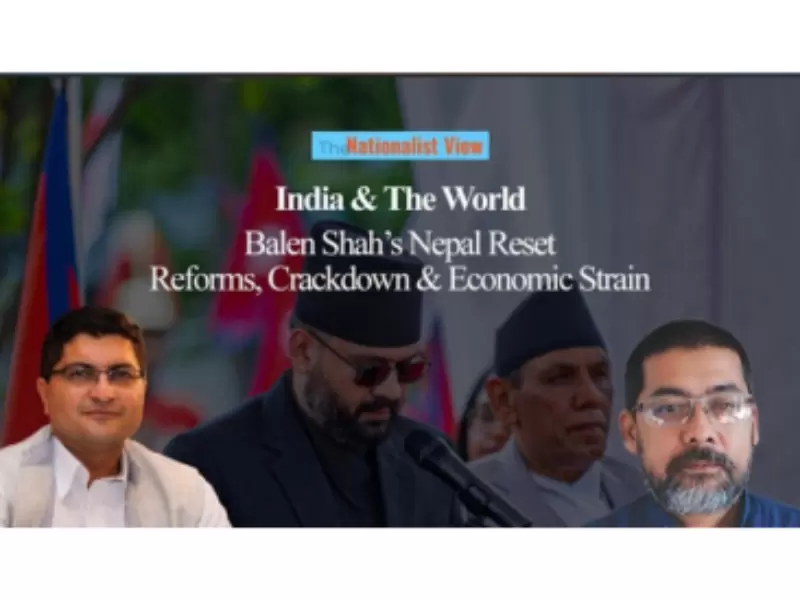 Nationalist View Podcast / Screengrab
Nepal’s evolving political landscape is under sharp focus as a new leadership push, anchored in an ambitious 100-point reform agenda, promises to reset governance, tackle corruption, and steer the country toward a $100 billion economy. But analysts warn that the real test will lie not in intention, but in execution.
In the latest episode of The Nationalist View, author and columnist Arun Anand spoke with political scientist Chandra D. Bhatta, who described the reform blueprint as an attempt to establish a “new social contract” between the government and the people. The agenda, he noted, is rooted in restoring effective governance, improving service delivery, and introducing digitalization across key sectors.
Also read: Political Tsunami in Nepal
The reforms come on the back of a strong public mandate in favor of Balen Shah, driven by the rise of a new political leadership that has generated high expectations among citizens seeking change.
The government’s 100-point agenda spans governance overhaul, education and health sector reforms, and job creation, alongside a vision to significantly expand Nepal’s economic output in the coming years. "They have come up with their 100 points program; if they could really implement it, that will really change the political landscape of the country in the days to come. This will provide a lot of impetus to the society at large," Bhatta said.
However, Bhatta cautioned that the scale and ambition of the program present significant challenges. Securing adequate financial resources, ensuring bureaucratic alignment, and building consensus across political stakeholders will be critical to its success. “You can come up with any kind of policy,” he said, “but the biggest question is whether it can be implemented.”
The discussion also highlighted structural hurdles within the ruling political establishment, including internal divisions that could affect the pace and coherence of reforms. Bringing key actors, particularly the bureaucracy, into confidence will be essential for translating policy into tangible outcomes.
On the government's vision of building a $100 billion economy within the next five to seven years Bhatta said it is “really ambitious,” particularly at a time when the global economy is grappling with multiple crises. He emphasized that without significant investment, the goal would remain out of reach. “We need investment for that. Without investment, I don’t think we will be able to create that kind of economy,” he said.
Identifying potential growth drivers, Bhatta pointed to agriculture and the digital economy as key sectors. Revitalizing agriculture, he suggested, will require making the sector more attractive to younger generations, who have largely moved away from it. Engaging youth in modernized agricultural practices could unlock productivity and contribute meaningfully to economic growth.
At the same time, he highlighted the importance of investing in the IT sector, including digital technologies and artificial intelligence, as a pathway to accelerate Nepal’s transition toward a knowledge-based economy. “If we make investments in these fields, I think we can create an economy,” he said, noting the sector’s potential to drive substantial growth.
However, beyond sectoral focus, Bhatta stressed that the most critical factor remains political commitment. “The most important part here is the political commitment—whether there is really a real political commitment or they just wanted to say it for the sake of saying,” he observed.
Finally, Bhatta highlighted the significance of a possible meeting between Indian Prime Minister Narendra Modi and Nepal's Balen Shah, noting that renewed dialogue at the leadership level could help address lingering gaps in confidence between the two neighbors.
“It is clear that if the visit takes place, this will really be good for both the countries because this will at least help to build confidence,” Bhatta said, referring to the anticipated meeting.
In conclusion, he added that a direct interaction between the two leaders could play an important role in bridging the existing trust deficit that has shaped aspects of India-Nepal relations in recent years.
Discover more stories on New India Abroad
Related



ADVERTISEMENT

ADVERTISEMENT
E Paper
Video

Comments
Start the conversation
Become a member of New India Abroad to start commenting.
Sign Up Now
Already have an account? Login