ADVERTISEMENT
ADVERTISEMENT



NC leaders push for stronger India business ties at Raleigh dialogue
North Carolina’s political and business leaders said the state’s growing Indian American community and technology economy were creating new opportunities for deeper trade, investment and innovation partnerships with India.
-
1759953093.png) Staff Reporter
Staff Reporter - Mon, 11, May 2026
- 18:37 EDT
- 45
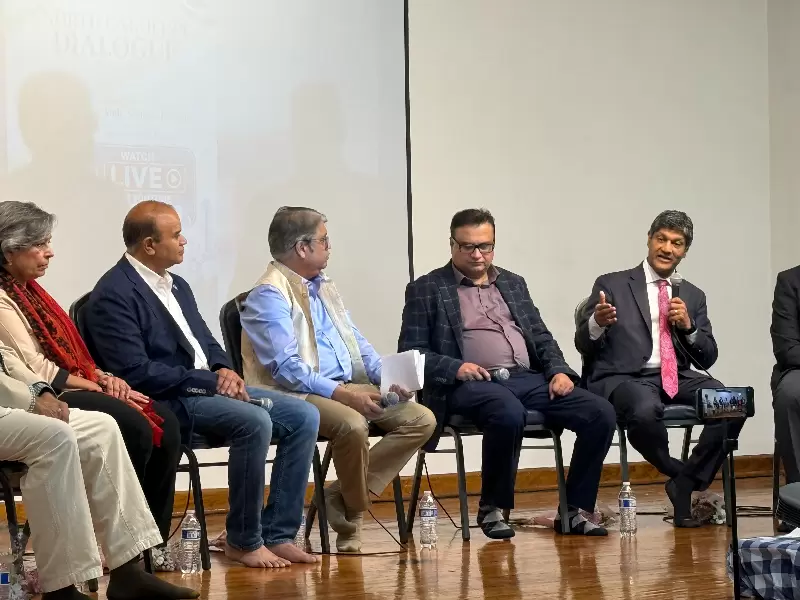 Glimpse of the event / New India Abroad
Political leaders, business executives and Indian American community voices in North Carolina called for deeper trade, investment and technology partnerships with India during the “India Abroad North Carolina Dialogue 2026” in Raleigh, saying the state is increasingly positioned to serve as a vital economic bridge between India and the United States.
Speakers at the dialogue, organized by India Abroad newspaper, highlighted North Carolina’s growing appeal for Indian investment, particularly across technology, manufacturing, research and innovation sectors.
Also Read: Educational ties central to India-US partnership: Indian envoy
North Carolina State Senator Jay Chaudhuri said the future of India-US ties would increasingly be shaped not only by national governments, but also by states and local communities building direct economic and cultural partnerships.
“For the last 40 or 50 years, US-India relations have relied on the president,” Chaudhuri said. “But I think the real driver of the relationship between the two countries can really be driven by the states.”
He pointed to North Carolina’s growing economic engagement with India through trade offices, foreign direct investment initiatives and expanding business collaborations.
“North Carolina is a great example of that because we’ve been able to attract foreign direct investment,” he said.
Business leader and philanthropist Sajjan Agarwal said Indian companies were already playing a significant role in job creation and economic growth across the state.
“As you know, Bharat Forge is very active,” Agarwal said, referring to the Indian manufacturing major with operations in the Sanford area.
“There are other companies who are looking at it also,” added Agarwal, who also serves as Board Chairperson of the Hindu Society of North Carolina.
He said Indian American business groups were also urging policymakers in Washington to address immigration bottlenecks, particularly long green card wait times affecting skilled professionals.
“These are the issues that they have kind of agreed to fight for us in Washington,” he said.
Entrepreneur and angel investor Sandesh Sharda said Indian Americans needed to more assertively communicate their economic contributions to local communities.
“We are not just taking jobs,” Sharda said. “We are integrating with society. We are investing in society.”
Sharda said his investments in golf resorts and hospitality businesses in North Carolina and South Carolina had helped revive struggling local economies while generating employment opportunities.
“When I took over golf courses, they were doing around $3 million. Now they’re doing $20 million in a span of three years,” he said.
Deputy Chief of Mission at the Indian Embassy Namgya Khampa said North Carolina held significant potential for expanded partnerships with India in business, technology, education and research.
“I felt that there was interest reciprocated,” Khampa said. “There is an opportunity to really look at some of those areas more closely.”
She said the Indian Embassy was keen to deepen collaboration in trade, innovation, research and educational exchanges.
The discussions also spotlighted the growing strategic relevance of the Research Triangle Park region within India’s expanding global technology and innovation ecosystem.
Satish Garimella, mayor of Morrisville, said Indian Americans were increasingly looking beyond community engagement toward long-term industrial and business partnerships.
“The tone has changed,” Garimella said. “We are ready to start taking the next step — welcoming industries and building collaborations.”
He also noted that North Carolina has consistently ranked among America’s top states for business, making it an attractive destination for Indian companies and professionals alike.
Over the past decade, North Carolina — particularly the Raleigh-Durham technology corridor — has emerged as a major hub for Indian professionals, entrepreneurs and businesses, supported by leading universities, pharmaceutical companies, research institutions and a rapidly growing Indian American population.
Discover more at New India Abroad.
Related




ADVERTISEMENT

ADVERTISEMENT
E Paper
Video

Comments
Start the conversation
Become a member of New India Abroad to start commenting.
Sign Up Now
Already have an account? Login