ADVERTISEMENT
ADVERTISEMENT


Beyond the Basket: How sport can become a force for social change
Hi5 Youth Foundation uses basketball not as recreation, but as a structured pathway through which children learn competence, confidence, and the belief that they can shape their own futures.
-
 Prasad Kaipa
 - Sat, 22, Aug 2026
- 15:13 EDT
- 81
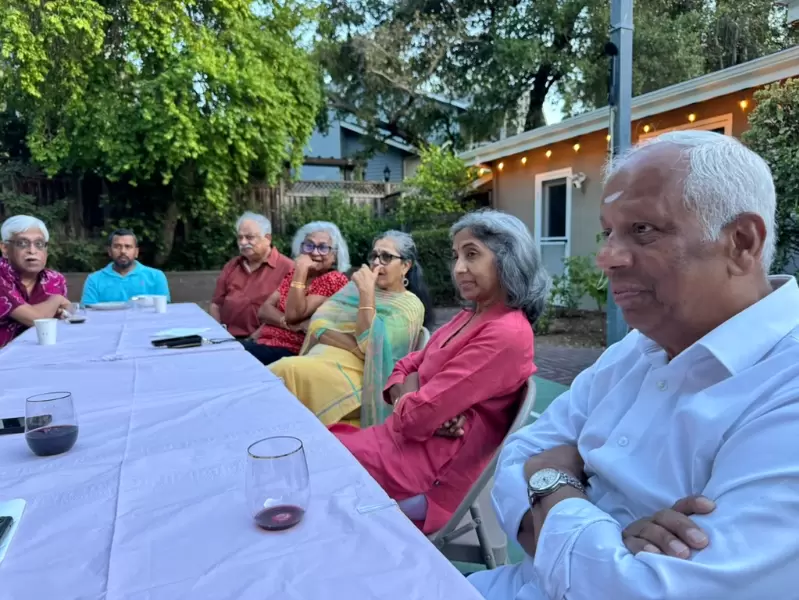 Sundar Radhakrishnan in the person who is right most in the picture and Usha Sundar is the fourth person from the right. Their son Shankar who is getting more and more engaged with Hi5 is wearing a green shirt. Others are friends who attended the gathering to meet Girish Kulkarni and Anshu Gupta. / Courtesy Photo
Can sport change a life? R. Sundar and Usha Sundar believe it can—not because every child will become an athlete, but because learning to improve, compete, and win can give a child an enduring conviction: I am somebody. I can do this.
That belief is at the heart of Hi5 Youth Foundation, which uses basketball as a structured pathway for underserved and tribal children in India to develop competence, confidence, and educational possibility. Hi5 says it now works with more than 4,000 children across eight states.
When I recently visited the Sundars’ Bay Area home, I had come to meet their guests, Dr. Girish Kulkarni of Snehalaya and Anshu Gupta of Goonj. I left equally struck by the social-change proposition embodied in Hi5.
“Sport has the power to change the world,” Nelson Mandela famously said. Sundar applies that insight at the level of one child. The question animating Hi5 is simple: Can a young person who learns to play well, compete, and win begin to believe that the same disciplined effort can change what is possible in school and in life?
Sundar and Usha began Hi5 in 2015 with P. Ramaswamy. Their original intention was to work in education, but they saw that many organizations were already pursuing familiar educational interventions. They wanted to explore sport as a different vehicle for development.
The idea was shaped partly by their son Varun’s experience coaching basketball in Cupertino, California. Young players looked up to him, while parents saw that a coach could sometimes reach children in ways that adults at home could not. A coach could be an instructor, mentor, and bridge.
The family also saw how Varun’s disciplined study of Carnatic violin shaped the rest of his life. His teacher expected more than casual participation. Practice, preparation, and mastery became habits that carried into education, work, and relationships.
Could basketball provide children from low-income and tribal communities in India with a comparable experience of excellence?
Hi5 began with roughly 120 children and three young coaches at a YMCA facility in Mumbai. The founders refused to treat sport as a one-day activity or a charitable photo opportunity. If sport was to change a child’s life, it had to be taught seriously.
Sundar found that many coaches could promise to build a good team in three years, but could not say what a child would learn after three months, six months, or a year. The process depended largely on a coach’s instinct.
“If you have to create an excellence program, there has to be a structure,” Sundar told me.
Hi5 developed a 36-week first-year curriculum built around 36 foundational basketball skills. Children learn a skill, practice it, demonstrate it, and build upon it. They progress through beginner, intermediate, advanced, and elite levels. Coaches are trained not simply to play basketball, but to teach it—and they are employed as full-time professionals.
Hi5’s innovation is not simply that it uses sport for development. It has built a system intended to deliver that developmental experience repeatedly: a sequenced curriculum, trained coaches, multi-year participation, and support that continues into higher education and work.
Good intentions do not scale into social change. Systems do.
Hi5’s early expansion reflected that discipline. When Mumbai’s municipal school system invited the organization into dozens of schools, the founders initially accepted only 12. They would not grow faster than their capacity to recruit and train coaches, create the needed infrastructure, and preserve the quality of the learning experience. Hi5 reports that its centers provide more than 300 hours of annual training.Beyond-the-Basket-article.docx+1
The outcome Hi5 seeks is more than better basketball. A child who has repeatedly been told—directly or indirectly—that opportunity belongs to someone else experiences something different on the court: I practiced. I improved. I helped my team. I won.
For some children, that experience becomes a defining moment. It tells them: I am somebody. I can do it.
Confidence, in this view, is not empty reassurance. It comes from competence—from confronting something difficult, learning it step by step, and seeing effort produce a result. Once a child has learned that process in sport, the same logic can be applied to mathematics, writing, college, work, or any other demanding undertaking.
Hi5’s model follows children beyond the court. Its Pathways to Success program supports participants through grades 11 and 12, college admissions, scholarships, internships, and early employment. The organization reports that 96 percent of its students complete tenth grade, 93 percent complete twelfth grade, and 91 percent of tribal students become first-generation college-goers.
Hi5 is now developing the Hi5 Basketball Academy, a residential campus near Mumbai intended to provide camps, elite-player development, advanced coaching, and tournament preparation for its growing network.
The larger question is not whether every child should become an athlete. It is whether we have underestimated sport as a medium of human development. Too often, sport is treated as recreation—valuable while children are young, then abandoned after high school. Sundar argues that we need a different mindset. Sport, taken seriously, can be a cause of significant and far-reaching change.
Social change happens when thousands of children—not merely a fortunate few—gain repeated opportunities to experience competence, belonging, discipline, and possibility. A court, a trained coach, a thoughtful curriculum, and a team can become a proving ground for the capacities that education and life require.
A basketball passes through a hoop in an instant. The transformation behind it takes years. The basket matters—but what matters more is the discovery it can ignite: If I can do this, what else might I be capable of?
(The views and opinions expressed in this article are those of the author and do not necessarily reflect the official policy or position of New India Abroad.)
Discover more at New India Abroad.
Leave A Comment
Related



ADVERTISEMENT

ADVERTISEMENT
E Paper
Video

Comments
Start the conversation
Become a member of New India Abroad to start commenting.
Sign Up Now
Already have an account? Login