ADVERTISEMENT
ADVERTISEMENT



Where the mind is without fear: Tagore’s message to Bengal
For Tagore, Bengal’s identity rested not merely on politics, but on a shared consciousness rooted in culture, memory, literature, and spiritual openness.
-
 Dr. Vinay Nalwa
 - Sat, 09, May 2026
- 16:15 EDT
- 26
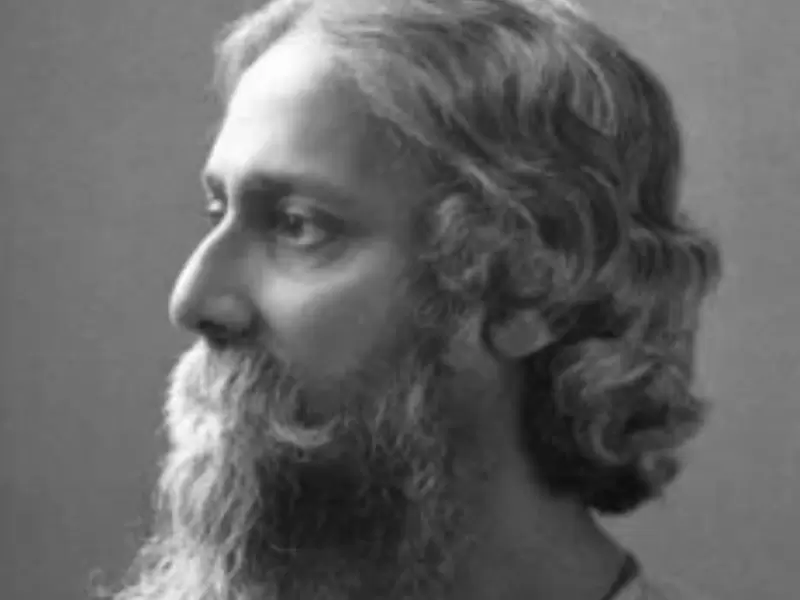 Rabindranath Tagore / nobelprize.org
As Bengal observed the birth anniversary of Rabindranath Tagore on May 7, commemorating the birth of the poetic conscience of modern India and the Rishi of Santiniketan, the occasion arrives at a moment of profound reflection for West Bengal.
Tagore, the first Asian Nobel laureate in Literature and one of the modern world’s most prolific literary figures, authored thousands of poems, essays, songs, stories, and philosophical reflections that shaped the intellectual consciousness of Bengal and modern India alike. Across generations, among both young and old Bengalis, there exists an unmistakable search for continuity, a desire to reconnect Bengal’s present with the deeper cultural and spiritual rhythms that once defined its intellectual confidence.
Also Read: Beyond the Mughal Myth: Why India’s Identity is Not a "Gift" of the 16th Century
Tagore’s philosophy emerged from the Upanishadic tradition, which viewed nation not as a political arrangement alone, but as a moral and spiritual organism. As Sarvepalli Radhakrishnan observed in The Philosophy of Rabindranath Tagore, Tagore’s writings mirrored “the soul of ancient India” while responding to the anxieties of the modern age. Deeply influenced by the Upanishads and the teachings of the Buddha, Tagore himself wrote: “To me the verses of the Upanishads and the teachings of Buddha have ever been things of the spirit, and therefore endowed with boundless vital growth.” His thought was therefore not antiquarian nostalgia, but an attempt to preserve what he believed was India’s essence, a culture rooted in spiritual freedom, moral responsibility, and social cohesion.
For Tagore, India was a civilisation sustained by what he described as the strength of the Samaj (society) the organic life of society itself. In his reflections on Indian society, he warned against excessive dependence on governmental power and the blind imitation of Western materialism. Traditional Indian society, he argued, had long survived political upheavals because its cultural foundations remained decentralised and self-sustaining.
Education, agriculture, trade, and community welfare were historically managed by society rather than by an all-powerful State. As interpreted by Radhakrishnan, Tagore believed that India’s continuity survived repeated invasions because its society rested not solely on political authority but on the moral vitality of its people. His concern was that modern India, in replacing social self-confidence with dependence upon the State, risked losing the spirit of sacrifice and cultural self-awareness that had sustained it for centuries.
This concern becomes especially significant in Bengal’s historical experience. Bengal witnessed not only colonial exploitation and the destruction of its once flourishing textile and river trade economy under British rule, but also repeated ruptures in its social and cultural fabric through Partition, refugee displacement, and ideological violence.
The decline of Bengal’s traditional institutions of learning, patronage, and community life weakened an older cultural confidence that had once made the region one of Asia’s foremost intellectual and artistic centres. Tagore’s response to such historical trauma was neither political revenge nor cultural withdrawal. Instead, he articulated the doctrine of Atmashakti, or Self Power, as the recovery of civilisational confidence through inner awakening.
“The great gift of freedom can never come to a people through charity,” Tagore wrote in his famous 1919 letter to Mahatma Gandhi. “We must win it before we own it.” Freedom, in Tagore’s understanding was psychological, moral, and spiritual than mere territorial. A nation that viewed its own culture through borrowed categories or external ideologies had already surrendered part of its freedom. His concern was not simply foreign rule, but mental dependency, sort of inability of people to recognise the worth of their own ancient inheritance.
This vision found poetic expression in Where the Mind is Without Fear from Gitanjali, where Tagore prayed for a nation “where the mind is without fear and the head is held high.” The poem was not only a nationalist prayer against colonial domination; it was equally a warning against intellectual timidity, social fragmentation, and moral decline. Tagore feared a civilisation losing its “clear stream of reason” in the “dreary desert sand of dead habit.” Fearlessness, or Abhaya, was therefore central to his thought and not arrogance, but the confidence born from spiritual clarity and cultural rootedness.
Tagore’s distinction between Samaj and Sarkar remains particularly relevant in contemporary Bengal. In his 1904 address Swadeshi Samaj, he argued that while Western society derived its organising principle from the State, Indian society historically drew its strength from society itself, from local communities, sacred traditions, family structures, and cultural institutions. The State, in his view, should remain limited; society could not survive if it surrendered all responsibility to political power. His critique anticipated modern anxieties regarding over-centralisation, bureaucratic dependency, and the erosion of local cultural authority.
Yet Tagore’s thought was never narrowly political. It remained deeply ethical and profoundly spiritual. Writing to Gandhi on the eve of the Jallianwala Bagh massacre, Tagore warned against allowing resistance itself to descend into hatred or vengeance. “Conquer anger by the power of non-anger and evil by the power of good,” he wrote, invoking the Buddha. He insisted that moral courage required not weakness, but fearlessness before overwhelming force. “To stand against wrong which has overwhelming material power behind it is victory itself,” Tagore declared. Such statements reflected his conviction that spiritual strength ultimately outlasts material domination.
The emotional core of Tagore’s philosophy, however, lay in his profound attachment to India itself. Despite poverty, political subjugation, and social suffering, he declared: “I shall be born in India again and again; with all her poverty, misery, and wretchedness I love India best.” This was not sentimental patriotism. It was a extreme spiritual devotion rooted in the belief that India represented a unique experiment in human history, one that valued life above possession, intuition above mechanical intellect, and inner freedom above domination.
For Bengal today, Tagore’s relevance lies not in ritual commemoration alone but in the enduring questions he raised about civilisation, identity, and freedom. His writings continue to challenge both cultural amnesia and ideological fanaticism. He warned equally against blind imitation of the West and against allowing nationalism to degenerate into hatred or empty slogans. “Martyrdom for the cause of truth,” he cautioned, “may never degenerate into fanaticism for mere verbal forms.”
The legacy of Rabindranath Tagore transcends modern political borders. Born in undivided Bengal, Tagore belongs as much to Bangladesh as to India; its national anthem itself emerged from his pen. The recent vandalism of Tagore’s ancestral home in Bangladesh therefore carries significance beyond an isolated act of destruction. It reflects a deeper question that Tagore repeatedly warned about: whether a society can preserve its cultural and spiritual inheritance while allowing sectarianism, historical erasure, or ideological intolerance to weaken its foundations.
For Tagore, Bengal’s identity rested not merely on politics, but on a shared consciousness rooted in culture, memory, literature, and spiritual openness. His message remains equally relevant on both sides of Bengal’s borders today.
As Bengal celebrated Tagore once again, his message remains strikingly contemporary. A civilisation survives not merely through political victories or economic growth, but through the preservation of moral imagination, cultural confidence, and spiritual depth. For Tagore, the future of India depended upon whether its people could retain inner freedom while engaging with the modern world. In that sense, the Rishi of Santiniketan still speaks to Bengal, reminding it that renewal begins not in resentment but in self-knowledge, not in borrowed identities but in the fearless recovery of one’s own soul.
The writer is an author and columnist
(The views and opinions expressed in this article are those of the author and do not necessarily reflect the official policy or position of New India Abroad.)
Discover more at New India Abroad.
Related


.jpg)







ADVERTISEMENT

ADVERTISEMENT
E Paper
Video

Comments
Start the conversation
Become a member of New India Abroad to start commenting.
Sign Up Now
Already have an account? Login