ADVERTISEMENT
ADVERTISEMENT



Researcher Nikhil Seshadri named 2026 Hertz Fellow
He earned a bachelor’s degree from Harvard University with a double concentration in chemistry and physics.
-
1759953093.png) Staff Reporter
Staff Reporter - Sat, 09, May 2026
- 01:55 EDT
- 16
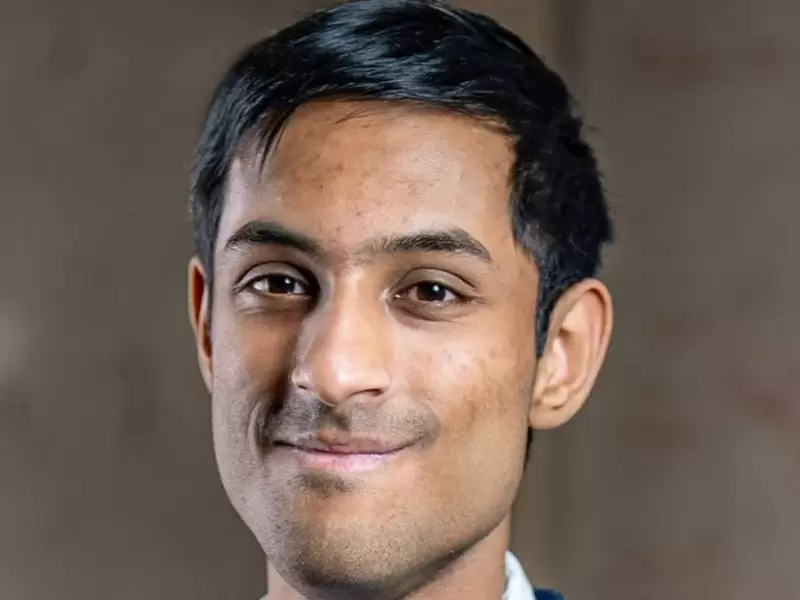 Nikhil Seshadri / Hertz Foundation
Indian-origin researcher Nikhil Seshadri, a post-bachelor’s student at Los Alamos National Laboratory, has been named among the 19 recipients of the 2026 Hertz Fellowship, one of the United States’ most competitive doctoral fellowships in science and technology.
Seshadri, who graduated from Harvard University and will begin doctoral studies at the California Institute of Technology in fall 2026, was selected by the Hertz Foundation for his work in theoretical chemistry, chemical physics and materials science.
At Los Alamos National Laboratory, Seshadri works with Dr. Yu Zhang on cavity quantum electrodynamics, focusing on extending the Gutzwiller wavefunction method to account for nonlocal electron-electron and electron-photon interactions. The research seeks to create a unified framework for studying how such interactions influence quantum phases and material properties.
According to the foundation, the Hertz Fellowship provides up to five years of financial support, including a stipend and full tuition equivalent, for doctoral studies in applied sciences, engineering and mathematics.
Seshadri said his research focuses on applying “rigorous mathematical methods and first-principles approaches” to fundamental problems in chemistry and physics, particularly systems governed by quantum mechanics.
He earned a bachelor’s degree from Harvard University with a double concentration in chemistry and physics, specifically chemical physics, and computer science, along with a secondary in mathematical sciences.
Before college, Seshadri conducted research in quantum thermodynamics with Professor Michael Galperin at the University of California, San Diego. As an undergraduate, he worked on research involving open quantum systems, porphyrin chemistry and X-ray diffraction.
While working with Galperin, Seshadri used Nonequilibrium Green’s function techniques to study entropy production and information flow in open quantum systems strongly coupled to baths. He also examined the use of Liouvillian exceptional points in nanoscale open quantum systems through Nonequilibrium Green’s function and Bloch quantum master equation formulations.
The research found that introducing a Markov approximation into systems with non-Markovian evolution could artificially create exceptional points not originally present in the system dynamics.
Born in San Diego, Seshadri also studied music and performed as a member of the Harvard Baroque Chamber Orchestra at the Harvard Memorial Church. He plays the violin and piano and has a particular interest in baroque music.
The Hertz Foundation described the fellowship as supporting students working on major scientific and technological challenges, including artificial intelligence, quantum simulation, biotechnology and astrophysics.
Discover more at New India Abroad.
Related


ADVERTISEMENT

ADVERTISEMENT
E Paper
Video

Comments
Start the conversation
Become a member of New India Abroad to start commenting.
Sign Up Now
Already have an account? Login