ADVERTISEMENT
ADVERTISEMENT


Violence Continued, Accountability Did Not
The crisis in Bangladesh is not merely a localized human rights issue; it is a critical geopolitical fault line with profound implications for regional stability and the broader global order.
-
 Dr. Vinay Nalwa
 - Sun, 07, Jun 2026
- 03:29 EDT
- 36
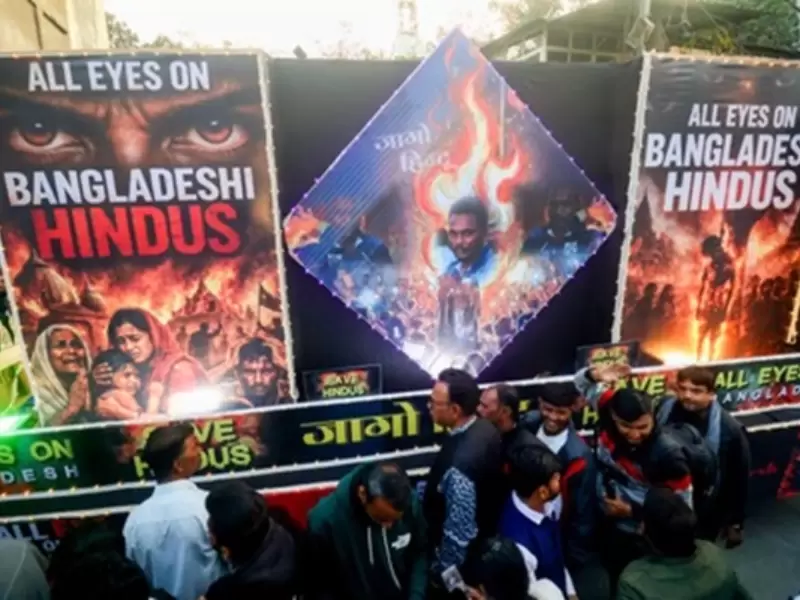 Bangladesh / IANS
The most significant development in Bangladesh’s ongoing minority crisis is not the occurrence of violence itself. Tragically, attacks on religious minorities have been cyclically reported for decades. What makes the current situation extremely alarming is that the violence has persisted despite a historic political transition, regime change, and repeated high-level assurances of protection from the interim leadership.
For the international community, Bangladesh’s current transition was heralded as a victory for student-led democratic renewal. Yet, for the country's vulnerable populations, the dawn of this new era looks familiar.
According to the Human Rights Congress for Bangladesh Minorities (HRCBM), 505 incidents targeting religious and ethnic minorities were documented between January and April 2026 across 62 districts and all eight divisions of Bangladesh. The incidents included killings, physical assaults, kidnappings, sexual violence, attacks on temples and religious institutions, land grabbing, arson, looting, intimidation, and blasphemy-related persecution. The pattern remained remarkably consistent. January witnessed 124 recorded incidents, February 118, March 117, while April registered 146 incidents, the highest monthly figure during the period.
The April escalation is especially revealing. Had these attacks been driven solely by political uncertainty, one would expect them to diminish as the transition period passed. Instead, violence persisted and intensified. The pattern suggests a deeper structural problem, sustained by local power networks, ideological radicalisation, and the failure to hold perpetrators accountable.
Equally troubling is the question of accountability. Concerns about weak redress are not confined to advocacy groups; a stakeholder submission to the United Nations Universal Periodic Review (UPR) observed that while Bangladesh has taken nominal steps to protect religious minorities, effective investigation and punishment remain profoundly inadequate. In many cases, the principal perpetrators continue to evade justice due to deliberate gaps in evidence gathering or direct political patronage.
This institutional failure is not a recent phenomenon. A baseline study by Minority Rights Group International illustrated how violence has historically been followed by total impunity. The report documented severe cases ranging from the systematic targeting of communities to facilitate land grabbing, to the harrowing 2016 abduction of an eleven-year-old Hindu girl in Bogra, where families faced immediate intimidation simply for approaching the authorities. These episodes underscore a broader, systemic reality: violence is routinely deployed as an economic tool, where the state's reluctance to register complaints or mount strong prosecutions allows property dispossession to continue with virtually no deterrence.
Consequently, while new incidents are regularly documented, far less public information is ever available regarding successful convictions or property restoration. Even within Bangladesh's domestic press, the exhaustion over this cycle is palpable. In a commentary on recurring attacks targeting Hindus and temples, the newspaper New Age noted that many cases remain unresolved years after the fact, raising severe concerns about the absolute lack of protection afforded to victims and witnesses.
History offers a sobering lesson that communities rarely disappear through a single catastrophe. More often, they are weakened by the cumulative effect of countless smaller, unpunished acts. Taken together, these multi-decade findings point to a deeper institutional design rather than a failure of law enforcement. When a state consistently exhibits delayed investigations and low prosecution rates, it ceases to be a passive bystander. It becomes an active guarantor of the continuing cycle of minority insecurity.
Why the World Must Pay Attention
The crisis in Bangladesh is not merely a localized human rights issue; it is a critical geopolitical fault line with profound implications for regional stability and the broader global order. First and foremost, weaponized majoritarianism within the country risks triggering a dangerous chain reaction across South Asia, where escalating internal violence can easily spill over into destabilizing cross-border migrations and spark retaliatory political polarization among neighboring nations.
Furthermore, this crisis serves as a crucial democratic litmus test for the international community. If Bangladesh’s new political order ultimately fails to protect its most vulnerable citizens, its celebrated democratic transition will lose all international legitimacy; it will serve as grim proof that the recent regime change has merely altered the identity of the rulers, rather than establishing the rule of law.
Finally, this ongoing violence undermines the very architecture of international law. The persistent, widening gap between Bangladesh’s lofty constitutional promises and the lived reality of its minorities directly challenges the efficacy of global human rights mechanisms, proving that platforms like the United Nations Universal Periodic Review risk becoming toothless assemblies if state impunity is allowed to remain absolute.
To stop this cycle of domestic violence and prevent wider international fallout, the government must move past empty promises and put real legal protections into action.
The recommendations given by rights groups and UPR submissions have repeatedly called for a Minority Protection Act, a National Commission for Minorities, stronger safeguards for minority-owned property, and impartial investigations irrespective of political affiliation. That such recommendations remain necessary more than five decades after Bangladesh's independence highlights the prevailing gap between constitutional promises and the lived reality of many Hindus.
(The writer is an author and columnist )
(The views and opinions expressed in this article are those of the author and do not necessarily reflect the official policy or position of New India Abroad.)
Discover more at New India Abroad.
Related











ADVERTISEMENT

ADVERTISEMENT
E Paper
Video

Comments
Start the conversation
Become a member of New India Abroad to start commenting.
Sign Up Now
Already have an account? Login