ADVERTISEMENT

ADVERTISEMENT



Penn State’s Jainendra Jain to lead Indian research institute
Jain is internationally recognized for his work in theoretical condensed matter physics and received the 2025 Wolf Prize in Physics.
-
1759163132.png) Anushka Pathak
Anushka Pathak - Mon, 23, Mar 2026
- 13:42 EDT
- 17
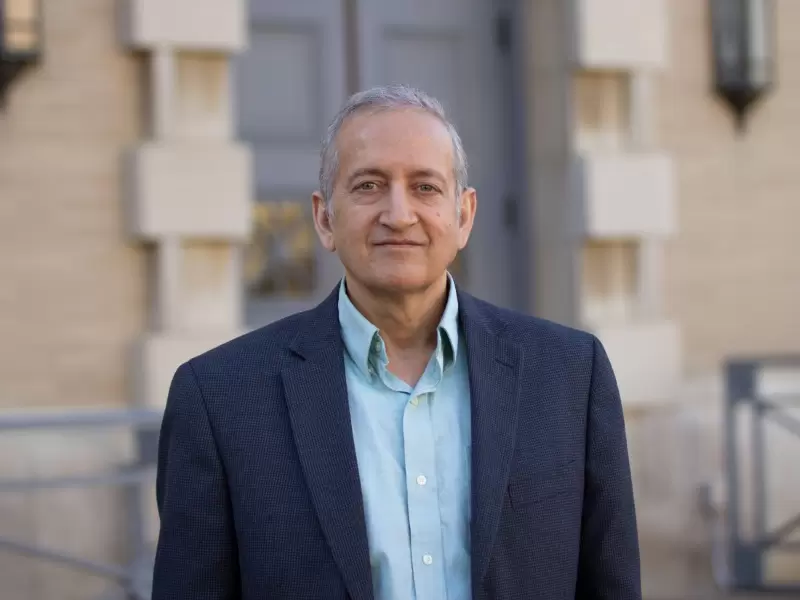 Jainendra Jain / Courtesy: Penn State
Indian-origin physicist Jainendra Jain has been appointed the founding director of the Lodha Theoretical Physics Institute (LTPI), a newly established research center in India.
The LTPI, set up by the Lodha Foundation, aims to advance long-term research in theoretical physics while fostering global collaboration and developing future scientists through sustained research and academic exchange.
ALSO READ: Indian-origin students recognized as CAS Future Leaders
According to the university, Jain, who currently serves as an Evan Pugh University professor, an Erwin W. Muller professor of physics, and holds the Eberly Family Chair in the Penn State Eberly College of Science, will continue his faculty role alongside the new appointment.
In a statement released by the university, Jain said, “I am excited to help establish LTPI as a world-class center, with internationally competitive faculty, exceptional postdoctoral researchers and a vibrant visitors’ program — an environment designed to spawn bold ideas and seminal, transformative discoveries.”
Ashish Kumar Singh, chief mentor at the Lodha Foundation, said the institute is part of a broader push to strengthen India’s scientific ecosystem. “With this vision, we are pleased to welcome Professor Jainendra K. Jain as the founding director of the Lodha Theoretical Physics Institute,” he said, noting Jain’s academic experience and connection to India.
Tracy Langkilde, Verne M. Willaman dean of the Eberly College of Science, said Jain’s work “has deepened our understanding of quantum matter and paved the way for real-world innovations,” while also highlighting his role in mentoring future researchers.
Mauricio Terrones, George A. and Margaret M. Downsbrough, head of the department of physics and Evan Pugh University professor, said his composite fermion theory “stands as one of the most significant contributions to condensed matter physics in the past four decades.”
Jain is internationally recognized for his work in theoretical condensed matter physics and received the 2025 Wolf Prize in Physics. He also leads Penn State’s Center for Theory of Emergent Quantum Matter, which focuses on advancing quantum science through collaborative research.
His research introduced composite fermions, which explain fractional quantum Hall states, and has contributed to understanding superconductors and Majorana particles with potential applications in quantum computing and electronics.
Apart from his professional roles, Jain has served as a member of the National Academy of Sciences, an American Academy of Arts and Sciences fellow, and received multiple academic honors in India and the United States.
He joined Penn State in 1998 after serving at Stony Brook University and previously held postdoctoral positions at Yale University and the University of Maryland. He earned his doctoral degree from Stony Brook University after completing his undergraduate and master’s studies in physics in India.
Discover more stories on New India Abroad.
Related











ADVERTISEMENT

ADVERTISEMENT
E Paper
Video

Comments
Start the conversation
Become a member of New India Abroad to start commenting.
Sign Up Now
Already have an account? Login