ADVERTISEMENT

ADVERTISEMENT


Namaskar: The Hindu philosophy behind a global gesture
Kings greet sages with it. Students address teachers with it. Warriors initiate dialogue with it. It does not mark servitude. It marks dignity within reverence.
-
 Dr. Vinay Nalwa
 - Tue, 17, Feb 2026
- 16:34 EST
- 26
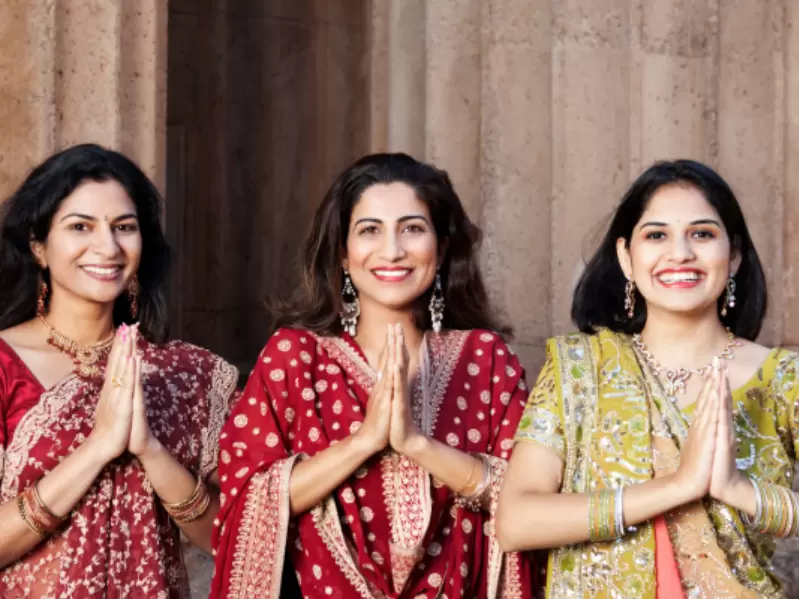 Representative Image / Canva
Before it became a global emoji or a yoga studio sign-off, before political leaders adopted it during the COVID-19 pandemic, Namaskar was already a civilizational discipline, a way of meeting another human being without aggression, submission, or intrusion.
It is not merely a greeting.
Namaskar is a civilizational grammar encoded in gesture. It arises from, and remains inseparable from, the philosophical architecture of Sanātana Dharma.
The Sanskrit root namas appears repeatedly in the Ṛgveda (Rigveda 1.1.7; 1.89), denoting reverential salutation. Not flattery. Not fear. Not coercion. It signifies conscious acknowledgment, a voluntary bowing of awareness before what is worthy of regard.
“Namaste,” from namas and te, means “salutations to you.” English lexicons trace its Sanskrit origin and record its early twentieth-century appearance in the Indian press. By the mid-twentieth century, dictionaries defined it as a respectful Indian salutation performed with joined palms and an inclined head. Yet the English archive captures only the surface. The civilizational meaning lies deeper.
Also Read: Desi Dharma aur Dilemma: A guide to Hindu identity abroad
The grammatical structure matters. The reverence is directed not toward rank, wealth, or political authority, but toward the person addressed. In Vedic thought, namas begins as an inward act of recognition. The gesture of añjali mudrā, in which the palms are joined at the centre of the body while the spine remains upright, gives visible form to that inward recognition. Language becomes gesture. Philosophy becomes discipline.
One of the clearest textual depictions appears in the Bhagavad Gītā (11.14):
praṇamya śirasā devaṁ kṛtāñjalir abhāṣata
“Bowing his head, with folded hands, he spoke.”
The term kṛtāñjaliḥ is “having joined the palms” precise. Arjuna beholds the cosmic form of Krishna and is overwhelmed. Yet he does not collapse. He does not prostrate. He joins his palms and remains upright.
That detail is not incidental. It is civilisational.
Across much of recorded history, greeting rituals encoded hierarchy , kneeling before monarchs, prostration before emperors, bodily lowering before power. In this posture, reverence is expressed without self-erasure. The body remains upright. Dignity is preserved even in humility. It signals recognition — not defeat.
The posture appears throughout the Rāmāyaṇa and the Mahābhārata . Kings greet sages with it. Students address teachers with it. Warriors initiate dialogue with it. It does not mark servitude. It marks dignity within reverence.
In classical Sanskrit dramaturgy, characters do not enter into speech abruptly. They approach with joined palms. The Nāṭyaśāstra codifies this gesture as añjali mudrā, placing it among the formal hand postures of performance and ritual discipline (Nāṭyaśāstra 9.127–128, trans. Manomohan Ghosh). The gesture prepares the encounter. It disciplines the self before dialogue begins. Power is regulated before it is expressed.
The same text specifies that the placement of the joined palms varies according to context. In prayer before a deity, the hands are raised toward the head or above it. When greeting a venerable person, they are held before the face or chin. Among friends or equals, they rest near the chest. The body thus encodes hierarchy without humiliation and reverence without self-erasure.
This posture is not confined to theatre. It forms part of the vocabulary of Indian classical dance traditions such as Bharatanatyam, where añjali signifies salutation, invocation, and disciplined presence. It also appears within yogic practice, including sequences such as Surya Namaskar, where the joining of the palms centres attention and aligns breath, body, and intention.
Namaste, as spoken expression, accompanies this embodied grammar. It functions as a respectful greeting that acknowledges and welcomes relative, guest, teacher, or stranger. In certain contexts, it also conveys gratitude for assistance received or kindness extended. The word and the gesture operate together. Recognition is first interior, then spoken, then embodied.
Archaeological continuity reinforces this record. Reliefs at the Sanchi Stupa (1st century BCE) to the murals of the Ajanta Caves (5th century CE) depict devotees with palms joined near the chest. Sculptures at Bharhut (3rd–2nd century BCE) portray figures before sacred symbols in folded-hand salutation. This is not a reconstructed narrative. It is a continuous visual archive across millennia.
Few cultural gestures in the world exhibit such structural stability.
Namaskar draws meaning from the metaphysical vision of Sanātana Dharma, where the individual self is understood as participating in a larger, shared reality. The Upanishads articulate this insight in different formulations, affirming that the same essence pervades all existence. The gesture does not merely echo that philosophy. It renders it visible.
If the ātman participates in a larger cosmic order, greeting becomes recognition of that participation. The joining of the palms symbolizes alignment, the meeting of duality without domination. Both hands, symmetrical and balanced, meet at the centre of the body. There is no grasping, no extension to seize, no lowering to submit. The ego pauses, but dignity remains intact.
Early modern observers recorded what they encountered. Duarte Barbosa in the sixteenth century described Indians greeting one another with joined hands (hyperlink retained). François Bernier in the seventeenth century noted the same practice in Mughal India (hyperlink retained). The gesture was neither marginal nor ceremonial alone; it was visible, habitual, and civilizational.
Also Read: Dharma Endowment Fund opens applications for 2026 grants
As Indic civilization moved across the Himalayas and into Southeast Asia, the folded-hand salutation travelled with it. In Nepal and Thailand, it remains structurally intact, palms joined, spine composed, respect conveyed without prostration.
Empires rose and fell. Languages shifted. Political orders transformed.
The gesture endured.
Modern research in embodied cognition suggests that posture shapes perception: open palms signal non-threat; symmetry conveys balance; hands near the chest reduce aggressive signalling . Ancient texts did not speak in neuroscientific terminology, yet the design of Namaskar aligns with what contemporary psychology now recognises that gesture communicates intention before speech.
It is also non-intrusive. It assumes neither physical contact nor forced familiarity. It leaves space. In an age negotiating boundaries and identity, that restraint is not archaic. It is refined.
During the COVID-19 pandemic, global leaders adopted the gesture as an alternative to handshakes. What was ancient required no adaptation. Its civilisational design was already sufficient.
Namaskar does not dramatise hierarchy. It does not advertise dominance. It does not perform subservience. It recognises.
Civilisations endure not only through texts and monuments, but through embodied disciplines that transmit philosophy into daily conduct. Namaskar is one such discipline. From Vedic namas to epic añjali, from sculptural relief to living practice across continents, it has persisted with remarkable continuity, preserved, practised, and transmitted by Sanātana Dharma.
It requires no proclamation of belief, but awareness.
Two palms meet. The ego pauses. Recognition precedes speech. Power is governed rather than displayed. In that restraint, Namaskar reveals itself as a living civilisational grammar of dignity, sustained across millennia by Sanātana Dharma.
The writer is an author and columnist on history and civilizational issues.
(The views and opinions expressed in this article are those of the author and do not necessarily reflect the official policy or position of New India Abroad.)
Discover more at New India Abroad.
Related








ADVERTISEMENT

ADVERTISEMENT
E Paper
Video

Comments
Start the conversation
Become a member of New India Abroad to start commenting.
Sign Up Now
Already have an account? Login