ADVERTISEMENT

ADVERTISEMENT



Interim agreement on framework will lead to broader U.S.-India trade deal negotiations
At 18 percent, India’s tariff position is slightly better than those levied on ASEAN economies.
-
 IANS
IANS - Sat, 07, Feb 2026
- 10:19 EST
- 15
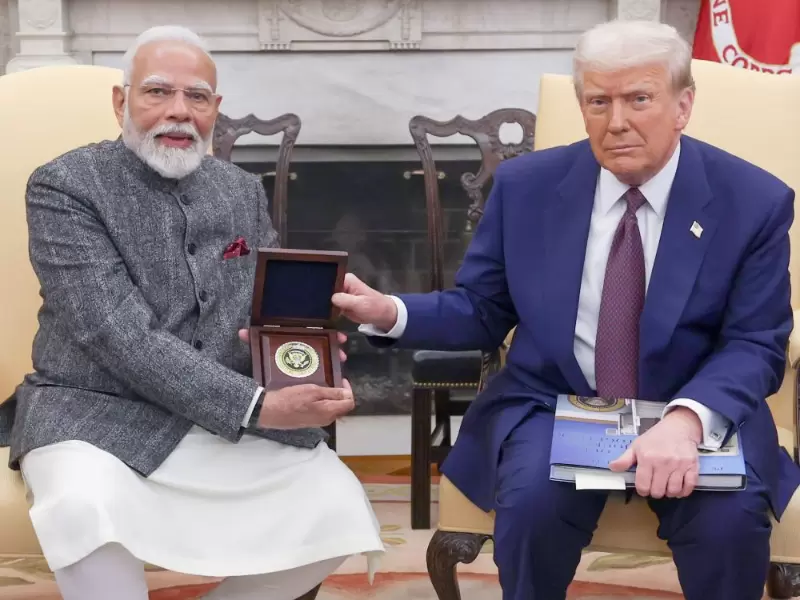 U.S. President Donald Trump presents a gift to Prime Minister Narendra Modi at the White House in Washington, DC, on Friday, February 14, 2025. / Courtesy: IANS
When U.S. President Donald Trump officially confirmed the much-awaited bilateral trade deal, immediately reducing American tariffs on Indian goods from 25 to 18 percent, and Prime Minister Narendra Modi corroborated, there was a mixed reaction. And on Feb. 7, even before India woke up, the news had broken of a U.S.-India joint statement announcing an interim agreement.
The framework will lead to the broader U.S.-India Bilateral Trade Agreement (BTA) negotiations, launched by President Trump and PM on Feb. 13, 2025.
The breakthrough came after months of tense negotiations, with a telephone call with PM Modi that preceded the president’s announcement on Feb. 2.
ALSO READ: Interim pact to unlock India–U.S. trade gains: Jaishankar
The market rejoiced—the United States was, after all, the largest trade partner—but there were some doubts, mainly among the farming community.
First there was critique over the deal ever happening; now there is suspicion on surrendering domestic interests, even though the final agreement has yet to be firmed up. But most reactions termed it the “father of all deals”—following India’s “mother‑of‑all” trade deal with the European Union a week earlier—where the agreement will put India at a competitive advantage and stabilize Washington‑New Delhi relations.
At 18 percent, India’s tariff position is slightly better than those levied on ASEAN economies and South Asian neighbors like Pakistan and Bangladesh.
Washington’s reciprocal tariff ranges between 19 and 20 percent with these countries. While sectors like textiles, footwear, light manufacturing, and engineering goods stand to benefit, concerns were raised over the alleged opening of trade gates to farm and milk-based products.
The key terms of the U.S.-India Interim Agreement included “India will eliminate or reduce tariffs on all U.S. industrial goods and a wide range of U.S. food and agricultural products, including dried distillers’ grains (DDGs), red sorghum for animal feed, tree nuts, fresh and processed fruit, soybean oil, wine and spirits, and additional products.”
Most of these products are already being procured and were expected to feature in the agreement.
Commerce Minister Piyush Goyal has been emphasizing that India’s food and agriculture sensitivities were safeguarded. Meanwhile, the government framed the deal as beneficial for MSMEs, entrepreneurs, skilled workers, and access to advanced technologies.
Many details yet remain to be worked out. The agreement is described as an “interim” framework. Negotiators will now translate headline commitments into legally binding tariff schedules, lists of products eligible for preferential treatment, and mechanisms to resolve disputes.
Overall, lower reciprocal tariffs will reduce the landed cost of Indian goods in the U.S. market, which is especially important for labor‑intensive sectors such as textiles, apparel, footwear, and certain engineering goods.
There is an expectation that exporters in these categories will regain some market share lost to competitors facing lower U.S. duties, reports have pointed out.
Moreover, the framework explicitly mentions opportunities for small and medium enterprises, where reduced tariffs and clearer rules of origin can make it easier for smaller suppliers to access U.S. buyers and integrate into global value chains.
Additionally, gems and jewelry, chemicals, rubber, home decor, and seafood (notably shrimp) are cited as likely beneficiaries because tariff relief eases margin pressure and inventory movement.
Conversely, import‑competing domestic industries—some capital goods, ICT hardware, and medical devices—may face stiffer competition from U.S. suppliers if India lowers protection in those areas.
The deal is framed as part of a broader geopolitical alignment: Closer economic ties with the U.S. can unlock technology transfers, investment in data centers and semiconductors, and cooperation on supply chain resilience—areas India has prioritized in its industrial strategy.
Discover more at New India Abroad.
Related

.jpg)




ADVERTISEMENT

ADVERTISEMENT
E Paper
Video

Comments
Start the conversation
Become a member of New India Abroad to start commenting.
Sign Up Now
Already have an account? Login