ADVERTISEMENT
ADVERTISEMENT



Indian PM's Australia Visit Delivers 18 Major Deals: Here’s What India Really Gained
The biggest takeaway from the visit is the renewed focus on security cooperation
-
 Richa Singh
 - Fri, 10, Jul 2026
- 01:35 EDT
- 28
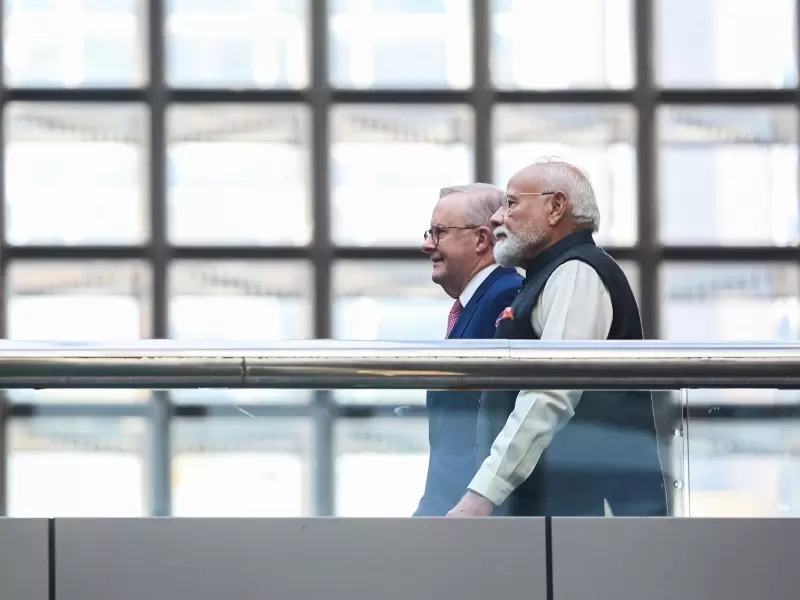 PM Modi in Australia / X@narendramodi
Prime Minister Narendra Modi’s visit to Australia has resulted in one of the most comprehensive expansions of India-Australia ties in recent years, with 18 key agreements and initiatives spanning defense, energy, critical minerals, cybersecurity, education, technology, and cultural heritage.
While both countries have steadily deepened cooperation over the past decade, the latest announcements signal a shift from diplomatic intent to concrete strategic collaboration. From securing Australian uranium supplies for India’s nuclear energy ambitions to expanding defense interoperability and bringing world-class Australian universities to India, the outcomes reflect a partnership that is increasingly focused on long-term geopolitical and economic priorities.
ALSO READ: Australia values India as top-tier security partner
Defense and Maritime Security Move to the Next Level
The biggest takeaway from the visit is the renewed focus on security cooperation. India and Australia signed a Joint Declaration on Defense and Security Cooperation (JDDSC), replacing the 2009 framework with an updated roadmap that expands collaboration in military interoperability, maritime domain awareness, defense manufacturing, cybersecurity, counterterrorism, humanitarian assistance and disaster relief.
Complementing this is the Maritime Security Collaboration Roadmap, designed to improve information sharing, operational coordination and capability development across the Indo-Pacific, a region witnessing growing strategic competition.
The two countries also signed an MoU between the Indian Coast Guard and Australia’s Maritime Border Command, strengthening cooperation on maritime law enforcement and border security.
In another notable step, Australia invited an Indian military instructor to join the Australian Defence College during 2028-29, reflecting growing military trust between the two partners.
Energy Security Gets a Major Boost
Energy cooperation emerged as another major pillar of the visit. The India-Australia Joint Statement on Energy Security reaffirmed both countries' commitment to strengthening energy resilience amid global geopolitical uncertainties.
Perhaps the most significant breakthrough was the operationalization of the India-Australia Civil Nuclear Agreement, originally signed in 2014. The administrative arrangements have now been finalized, enabling Australia to supply uranium to India for its civilian nuclear energy program.
The visit also marked the operational launch of the Rooftop Solar Training Academy at Pandit Deendayal Energy University in Gujarat. The initiative aims to train 2,000 women and young professionals as solar technicians, supporting India's clean energy transition under the PM Surya Ghar initiative.
Cybersecurity, AI and Supply Chains Take Center Stage
Recognizing the growing importance of emerging technologies, both countries unveiled the Australia-India Partnership for Cyber, Critical Technologies and Supply Chains (PACTS). The framework focuses on strengthening cyber resilience, securing critical supply chains and enhancing collaboration in advanced technologies that are increasingly shaping global economic and national security.
India also joined Australia and Canada under the Australia-Canada-India Technology and Innovation (ACITI) Partnership, expanding trilateral cooperation in innovation and emerging technologies.
Australian Universities Expand Their India Presence
Education emerged as another major success story. Flinders University received a Letter of Intent to establish its campus in Bengaluru, while Victoria University secured approval to open a campus in Gurugram.
The visit also included an agreement between India's National Council for Vocational Education and Training (NCVET) and Australia's Skills Quality Authority (ASQA) to improve vocational education standards, strengthen regulatory cooperation and align occupational skills across priority sectors.
Research, Innovation and Creative Industries Get New Momentum
The Council of Scientific and Industrial Research (CSIR) signed an agreement with the University of Melbourne to collaborate on drug discovery, faculty exchanges, trainee programs and joint research.
Meanwhile, the Satyajit Ray Film and Television Institute partnered with Australia's Griffith Film School to develop collaborative film projects, workshops, academic exchanges and short-term training programs.
India's Traditional Knowledge Digital Library (TKDL) will also become accessible to IP Australia, strengthening intellectual property protection for India's traditional knowledge.
Priceless Indian Heritage Returns Home
One of the most symbolic announcements came with Australia's repatriation of three ancient Indian artifacts. These include the sacred Nandi, the granite bull associated with Lord Shiva; an 11th-century bronze Trident with Bhadrakali; and a 12th-century basalt sculpture of the six-headed Skanda (Kartikeya), all originating from Tamil Nadu. The return reinforces growing cultural cooperation alongside strategic and economic ties.
Bigger Than Bilateral Diplomacy
Taken together, the outcomes of PM Modi's Australia visit go far beyond routine diplomatic agreements. They deepen cooperation in defense, critical minerals, nuclear energy, cybersecurity, advanced technology, education, scientific research, clean energy and cultural heritage, areas that are increasingly shaping the strategic balance in the Indo-Pacific. The breadth of the 18 agreements also underscores how India-Australia relations are evolving into a comprehensive strategic partnership driven by shared economic interests and common regional security objectives.
Discover more at New India Abroad.
Leave A Comment
Related







ADVERTISEMENT

ADVERTISEMENT
E Paper
Video

Comments
Start the conversation
Become a member of New India Abroad to start commenting.
Sign Up Now
Already have an account? Login