ADVERTISEMENT
ADVERTISEMENT



India needs more bravado while negotiating trade deal with US: Expert
The executive chairman and chief executive of the Institute of Strategic and International Studies (ISIS) Malaysia said that he doesn't see the right optics coming from the Indian side.
-
 Shikha Salaria
 - Mon, 13, Jul 2026
- 15:18 EDT
- 74
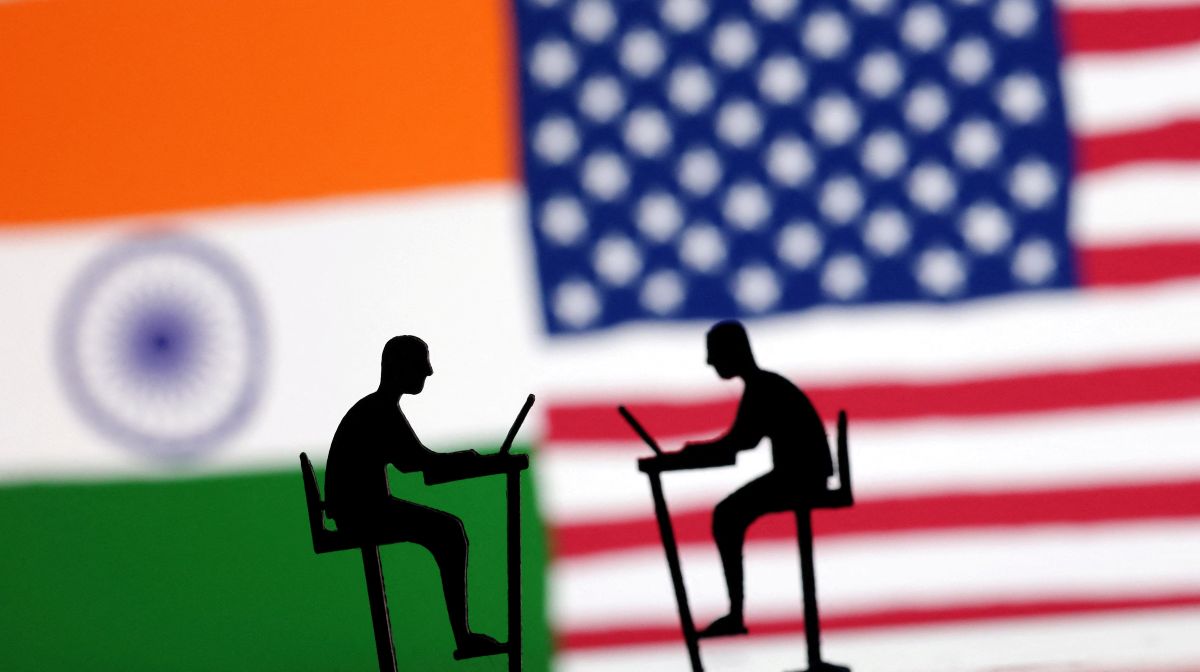 The Indian flag, the U.S. flag and people miniatures with laptops are seen in this illustration taken March 10, 2024. / REUTERS/Dado Ruvic/Illustration/File Photo
India is not only independent but must also be seen to be independent when it comes to foreign policy, executive chairman and chief executive of the Institute of Strategic and International Studies (ISIS-Malaysia) Datuk professor Mohd Faiz Abdullah said while commenting on how India should deal with the US vis-a-vis the India-US trade deal.
Answering a question about Malaysia's experience of walking out of the trade deal with the US, Abdullah, who delivered a lecture at New Delhi's Sapru House on July 13 on the "The Future Trajectory of Malaysia-India Ties," said that India needs a little more bravado in its expressions while dealing with the US in the backdrop of the trade deal.
Also Read: Piyush Goyal junks Reuters report on India-US trade talks as 'false and baseless’
Malaysia which is the first country to have pulled out of a trade deal with the US after the country's Supreme Court struck down the reciprocal tariffs levied by the US President Donald Trump under the 1977 International Emergency Economic Powers Act (IEEPA) in February 2026.
Announcing the move, the country's Minister of Investment, Trade and Industry Johari Abdul Ghani had said in March this year that the Agreement on Reciprocal Trade (ART) between the two countries was “null and void."
"We follow the rule of law. The apex court in the US decided that the US administration has no authority (to levy reciprocal tariffs). So the agreement that we had on account of the 'Liberation Day' tariffs was based on an understanding that it they were valid but since they have been ruled to be invalid, the doctrine of law becomes void ab initio and if the agreement is based on a fundamental principle which is void ab initio, the following agreements become automatically void. So, we were very, very sure that we worked out a legal doctrine on that and the statement that came from the minister was based on a statement that came from that stand... to certify that this is the position in law. It was not in any way a declaration of some sort of economic independence or some sort of needing or not needing an agreement. So, we were principally well taken care of," Abdullah said.
Asked what suggestions he would like to give to India which is also negotiating a trade deal with the US and is finding it difficult to get agreeable terms from the country, Abdullah said that he doesn't see the right optics coming from the Indian side.
"I do not propose to be able to offer any suggestions for India. You have a lot of experts... much well qualified ...but if you want some suggestions, the first thing is that you need to have the right optics. I don't see that optics coming. Perhaps, Ambassador BN Reddy (moderator of the event) and the others in the foreign service would be able to counsel them but I do believe that it would work to have some optics to show that India is not only independent but must also be seen to be independent, when it comes to foreign policy," he said.
Abdullah added that while the External Affairs Minister of India S Jaishankar had a very good image, he felt that in this specific area (trade deal), there should be a little bit more bravado in the expressions.
"I still recall Jaishankar's very good statement in relation to the oil sanctions. He said that India is sovereign and it is for India to decide to buy oil from whichever country they want. This was before the 'Liberation Day' tariffs but when it comes to Liberation Day tariffs, I think they have been a little bit neutral. Not that I am saying that there should be any specific mechanism. Of course, Trump always has other ways of circumventing the law and can come with some other doctrine from some interpretation of the trade act to see if the US can impose another 10 per cent or 15 per cent but that is something that should be discussed by experts," he said.
Answering a question on the paradox that data centres bring to fore vis-a-vis climate change, he said that while on one hand data centres bring in billions of investment, they also use guzzles of electricity and water.
"This has led to reworking of the timeline to shorten the climate targets by five-10 years and measuring milestones. We are not looking at nuclear at a big time. We have a strong fiscal policy including incentivising of electric vehicles. This is not a paradox but a reality and we have to follow European targets 2050, which are achievable. They (western countries) had a good time deforesting, cutting down trees but now they want the rest of the Global South to save trees," he said.
Talking about the India-Malaysia relationship in the backdrop of its equations with China, he said that the China factor must not be seen as an impediment.
"When it comes to joint defense exercises, the general view is that when you are mentioning Asia-Pacific, you are talking about the ascendance of China and when you talk about the Indo-Pacific, it is understood that you are talking about the ascendance of India. Really we have an Asia-Pacific roundtable at ISIS, we have dealt with this issue. There should not be any geographical idea of where India and China fit in when it comes to geography. It should be about how these countries should work together, because this is minilateralism. For example, in BRICS. Malaysia is coming to Delhi again for the BRICS Summit (September). The china factor must not be seen as an impediment, not be seen as any kind of pivot away from proximity with India . China is there because of trade and at the same time, the foreign direct investment from the US is very high and qualitative. That dispels the notion that Malaysia has pivoted away from the West/US and towards China. There should not be any assumption as there is no threat in the long run," he said.
Discover more at New India Abroad.
Leave A Comment
Related




ADVERTISEMENT

ADVERTISEMENT
E Paper
Video

Comments
Start the conversation
Become a member of New India Abroad to start commenting.
Sign Up Now
Already have an account? Login