ADVERTISEMENT
ADVERTISEMENT



How U.S. Agtech and Seattle can lead the global farming revolution
At the heart of this evolution lies a powerful concept that industry leaders now call "the farm's operating system."
-
 Badri Narayanan Gopalakrishnan
 -
 Sunil Madan
 - Tue, 14, Apr 2026
- 14:16 EDT
- 19
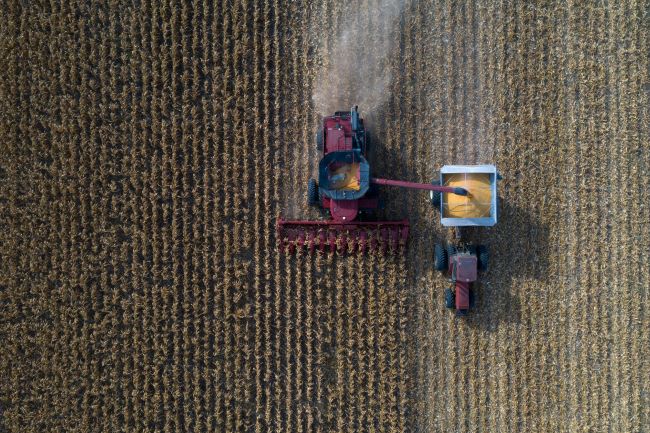 File Photo / REUTERS/Adrees Latif
On a soybean farm in Illinois, the future of farming is already here. A tractor navigates itself with precision guidance from satellites and digital prescription maps, applying seeds at exactly the right rate for each inch of soil.
The farmer, thousands of miles away, monitors every movement on an iPad, watching real-time data stream into cloud platforms. This isn't science fiction, it's the reality of modern American agriculture, where success increasingly depends not on engine power, but on computational intelligence.
Yet this technological transformation has reached a pivotal moment. The sophisticated data analytics and artificial intelligence systems that have optimized Midwestern harvests are now being reimagined for an entirely different context: the small-scale farms of South Asia, Sub-Saharan Africa, and Latin America.
For forward-thinking U.S. companies, this global expansion represents far more than a new market opportunity. It's a fundamental strategic shift that could reshape global food security and unlock new economic models for farming communities worldwide.
Also Read: Indian pomegranates reach Seattle-area Costco
At the heart of this evolution lies a powerful concept that industry leaders now call "the farm's operating system." The sequence of “collect-analyze-act” has become the central business model for America's leading digital agriculture companies.
As these solutions mature and shift toward flexible, pay-as-you-go pricing models, a transformative question is emerging from beyond the Corn Belt: can the same data-driven advisory approaches that have revolutionized American farming also empower smallholder farmers across the developing world? And if so, what opportunities await U.S. innovators who make this transition?
The AgTech Playbook: How Data Analytics Transformed American Farming
American agriculture has undergone a quiet revolution. High-resolution imagery and advanced data-driven tools have fundamentally changed how farmers make decisions, converting satellite pixels and machine logs into precise, actionable field instructions.
Modern farm operating systems, platforms like John Deere Operations Center, Granular Insights, and Climate FieldView, integrate equipment, maps, and targeted prescriptions into unified ecosystems. Soil test results, weather forecasts, yield maps, and satellite or drone imagery all converge into a single analytical platform.
What makes these platforms truly transformative is their capacity to automate decision-making. Rather than simply displaying dashboards for farmers to interpret, they generate “specific, location-based instructions”: spray here, plant at this rate, apply nitrogen to that section. These actionable files integrate seamlessly with modern equipment, from precision planters to variable-rate sprayers, adjusting inputs by individual field zones.
“Machine vision and AI-powered robotics” are key commercial breakthroughs in on-farm automation, especially for pest management. John Deere's See & Spray uses cameras to distinguish weeds from crops in real time at 20+ mph. Despite high hardware and per-acre fees, university trials show herbicide savings justify the costs.
Carbon Robotics' Laser Weeder uses AI and computer vision to eliminate weeds with lasers instead of chemicals. With over 100 producers in North America, Europe, and Australia, it is popular for high-value crops facing labor shortages and herbicide resistance.
“The imagery-first revolution” goes beyond automation. A new generation of agtech platforms uses drones and aerial photos for precise agronomic guidance. Sentera, now part of John Deere, pairs high-res multispectral cameras with FieldAgent to create weed maps and herbicide scripts for variable-rate sprayers. Ceres Imaging and DroneDeploy offer thermal imaging, multispectral analysis, water-stress indices, and mapping tools, allowing agronomists to survey thousands of acres quickly.
Instead of days walking fields, a single drone-equipped agronomist can monitor crop health, irrigation, pests, and plant counts across large areas in hours. This scaling of advisory capacity enables one person to oversee much larger areas, forming a key competitive edge.
“Beyond pure agronomy”, a growing segment of digital agriculture focuses on financial and transactional risk reduction. Platforms like Bushel Farm function as operational and financial command centers, integrating field records, performance analytics, and marketing tools within tiered pricing structures that lower barriers to entry for all farm sizes.
Simultaneously, carbon and sustainability verification systems have emerged as a distinct market category. Companies like Indigo Ag use digital measurement and verification of soil carbon to unlock credit programs purchased by major corporations such as Microsoft, effectively converting climate impact reporting into a new income stream for data-informed growers.
Why the Global South Opportunity is More Realistic Than It Appears
The case for U.S. Agtech companies expanding into global markets is compelling and increasingly grounded in reality. The fundamental value proposition, using data to make smarter farming decisions, proves remarkably durable across borders, even in contexts where landholdings are small. The numbers tell a compelling story: FAO data indicates approximately 570 million farms operate globally, the vast majority of them family-owned and managed.
Research demonstrates that smallholder farmers collectively produce nearly “one-third of the world's food supply”, despite controlling relatively modest land areas. This economic centrality, combined with growing smartphone penetration and emerging digital payment systems, creates unprecedented opportunities.
However, success in developing agricultural markets requires fundamental product and service adaptations. Advisory services must become hyperlocal and crop-specific, reflecting the unique agro-ecological conditions and farmer knowledge within each region. Pricing models must shift dramatically, moving away from annual subscriptions toward affordable, result-based micropayments that farmers can access seasonally.
Technology platforms must function reliably offline and be designed first for mobile devices, recognizing that many smallholder farmers have limited connectivity. Most critically, digital solutions gain meaningful traction only when woven into trusted, existing distribution channels: extension agents, agro-dealers, farmer producer organizations, and community cooperatives that already have farmer relationships and credibility.
Also Read: Western diets harming Indian immigrants’ health, warns Neha Shah
Seattle's Blueprint for Global Agricultural Innovation: A Hub Reimagining Food Production
Seattle has become something rarely seen in American cities: a genuine convergence point where cutting-edge technology directly meets the complexities of modern agriculture.
By 2025, the city has evolved far beyond its reputation as merely a software and cloud computing capital. Seattle's innovation ecosystem now bridges urban technology hubs and rural agricultural systems, leveraging world-class expertise in artificial intelligence, cloud infrastructure, and connected devices to fundamentally rethink how food is grown, measured, and brought to market.
Homegrown Champions: Seattle's Diverse Digital Agriculture Ecosystem
The depth of Seattle's agricultural innovation becomes clear when examining the companies pioneering solutions across the entire agricultural value chain. “IUNU” exemplifies this diversity by applying advanced artificial intelligence to controlled environment agriculture, dramatically enhancing greenhouse productivity and operational efficiency.
Meanwhile, “Nori” is building trust and market incentives through blockchain technology, creating the first transparent marketplace that directly compensates farmers for regenerative practices and measurable carbon sequestration, aligning profit with environmental stewardship.
The ecosystem extends beyond production optimization. “Ganaz” addresses a critical but often overlooked challenge, the human infrastructure of agriculture, by deploying digital human resources and workforce management tools that help farm operations scale efficiently.
On the biological frontier, “Adaptive Symbiotic Technologies” takes a different approach entirely, engineering beneficial microbial consortia that strengthen crop resilience to drought, heat, and other environmental stressors without requiring additional chemical inputs.
Automation represents another frontier where Seattle is leading. “Orchard Robotics” is developing autonomous systems that redefine what's possible in tree crop management. The company's "AI farmer" platform uses robotics and machine vision to automate traditionally labor-intensive orchard operations, simultaneously optimizing yields and reducing the reliance on seasonal labor forces that face growing shortages across specialty crop regions.
Perhaps most notably, “Carbon Robotics”, a company that translates Seattle's laser technology heritage into agricultural application, represents the convergence of hardware innovation and field-level practicality. The company's Laser Weeder technology uses high-powered laser systems guided by computer vision to eliminate weeds without chemicals, now operating across more than 100 farms in North America, Europe, and Australia.
This single company signals a broader regional momentum: Seattle's concentration of AI-for-orchards startups, combined with research activity across the University of Washington, Washington State University, and specialty crop industries facing acute labor shortages and sustainability mandates, is creating unstoppable pressure toward automation and data-driven decision-making.
“Research Excellence and Policy Innovation: Creating the Conditions for Scale
Seattle's leadership in digital agriculture extends far beyond entrepreneurship. The city's research institutions are establishing the intellectual and scientific foundations that make innovation practically deployable and policy-relevant.
The “AgAID Institute” and the “University of Washington's Tech Policy Lab” are pioneering applications of artificial intelligence to some of agriculture's most complex challenges: water resource management in water-stressed regions, autonomous crop monitoring systems that reduce manual labor, and climate-resilient farming strategies that strengthen farmer adaptation capacity.
Regional research initiatives are translating academic work into farmer-accessible tools. “WSU's AgWeatherNet” provides hyperlocal, real-time weather and agronomic data that farmers depend on for precise decision-making, while the “5G Open Innovation Lab in Snohomish County” is bridging the digital connectivity gap that has historically left rural areas at a disadvantage.
By piloting next-generation wireless connectivity in agricultural settings, these initiatives are testing how advanced infrastructure can enable autonomous systems, real-time monitoring, and predictive analytics in field environments.
Perhaps uniquely, Seattle's progressive approach to urban agriculture and food systems policy is creating a complete ecosystem feedback loop. Progressive urban farm codes and a robust network of agricultural technology investors are catalyzing a new generation of digitally enabled rooftop farming, vertical agriculture, and hyperlocal food production models.
This combination—where city policy actively supports sustainable food production, where research institutions rapidly prototype solutions, and where venture capital provides patient capital for climate-focused founders, creates a self-reinforcing cycle of innovation.
A Global Model for Agricultural Transformation
What makes Seattle's ecosystem distinctive isn't any single company or innovation, but rather the “integrated architecture” that connects entrepreneurs, researchers, policymakers, and investors around shared challenges.
The city demonstrates how a technology hub can deliberately redirect its capabilities and capital toward fundamental problems in food security and environmental resilience.
For developing markets and smallholder farming communities across the Global South, Seattle's model offers a powerful template: technology innovation is most valuable when it's grounded in deep understanding of field realities, when it's supported by rigorous research, and when it's shaped by policy ecosystems that reward sustainability and inclusion.
Seattle isn't just building better farming tools, it's establishing the blueprint for how innovation cities can help feed the world.
Sunil Madan is a Consultant with the Farming and Agribusiness Department at the World Bank.
Badri Narayanan Gopalakrishnan is the founder of Infinite Sum Modeling, Sammamish, WA.
Discover more at New India Abroad.
Related











ADVERTISEMENT

ADVERTISEMENT
E Paper
Video

Comments
Start the conversation
Become a member of New India Abroad to start commenting.
Sign Up Now
Already have an account? Login