ADVERTISEMENT
ADVERTISEMENT


Aruna Miller's trailblazing rise
Miller’s story tracks closely with the rise of Indian Americans in public life across the United States.
-
1759953093.png) Staff Reporter
Staff Reporter - Sun, 17, May 2026
- 02:22 EDT
- 28
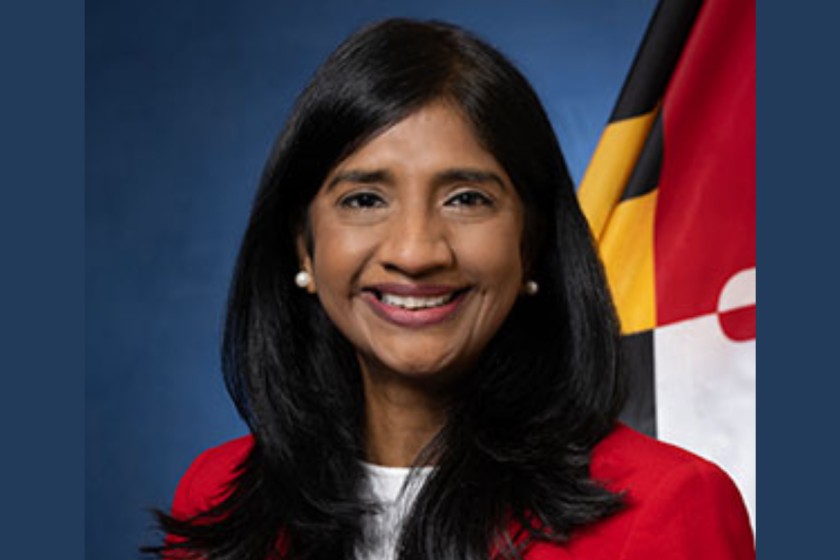 LT Gov. Aruna Miller. / Courtesy photo
Aruna Miller still remembers her first glimpse of America.
She was seven years old, arriving from India in 1972 after being raised largely by her grandmother. At New York’s JFK Airport, she stepped off the plane holding her father’s hand, overwhelmed by the crowd inside the terminal.
“In my little seven-year-old mind, I thought, wow, I love this country,” Miller said during an exclusive interview with India Abroad. “Look at all these people waiting for my dad and me to arrive.”
Then came the snow.
“I thought they were throwing confetti to welcome us,” she recalled, laughing softly. “I had never seen snow before.”
More than five decades later, Miller serves as Maryland’s lieutenant governor, one half of what became the first elected Black and Brown gubernatorial ticket in American history. But listening to her describe her journey, politics still sounds less like ambition than surprise.
“I often say I’m an accidental politician,” she said.
Miller’s story tracks closely with the rise of Indian Americans in public life across the United States. Yet she speaks about that ascent with the perspective of someone who grew up at a time when Indian Americans were nearly invisible in American politics.
ALSO READ: Lt. Gov Aruna Miller to address Maryland graduates
“There wasn’t a lot of Indian Americans living in the United States,” she said of her childhood in the 1970s. “Maybe about 20 or 30 families met together to celebrate Diwali and other Indian festivals.”
Her family eventually settled in St. Louis, where she studied engineering before moving to Maryland with her college sweetheart, now her husband of decades.
Public service came before politics. For 25 years, Miller worked as a civil engineer with Montgomery County’s transportation department, helping design roads, sidewalks and bike paths.
“When you come here as an immigrant, you’re grateful for all the opportunities that have been available to you,” she said. “I wanted to give back.”
At home, however, politics was rarely discussed.
“When you are growing up as an immigrant and sitting at the kitchen table, you’re trying to keep your head low, work hard and not rock the boat,” she said.
That changed after she became an American citizen in 2000 and voted for the first time.
“I even cried in the polling booth,” she said. “It was such an emotional moment for me.”
Her candidate lost. Instead of walking away disappointed, she called the local Democratic Party and volunteered.
Years later, party leaders encouraged her to run for office herself. She resisted immediately.
“I said, ‘I’m an engineer. I don’t know how to be a politician.’”
What persuaded her was a conversation with her husband.
“I remember saying, ‘What if I lose?’” Miller said. “And he looked at me and said, ‘But what if you win?’”
She won a seat in the Maryland General Assembly in 2010 and gradually became known for work on transportation policy, computer science education and domestic violence protections.
ALSO READ: Aruna Miller to kick off re-election campaign
But it was another race — a losing congressional campaign in 2018 — that unexpectedly led her toward statewide office.
In 2021, Miller met Wes Moore, then preparing his run for governor. She remembers walking away deeply impressed.
“He is such an incredibly dynamic individual,” she said. “Really compassionate.”
What struck her most was Moore’s governing philosophy.
“One of the areas that he wanted to work on is to leave no one behind,” she said. “Whether it’s individuals being left behind economically or because of their faith or culture.”
Months later, Moore asked her to become his running mate during a Zoom call.
Miller thought it was another campaign interview.
“Then he asks me the question,” she recalled. “‘I’d like you to be my running mate.’”
Her reaction — joyful disbelief — was being recorded the entire time.
“He put it on social media immediately,” she said, laughing again.
The campaign that followed was historic but uncertain. Moore entered the race with little political experience and weak polling numbers.
“He was polling at one percent,” Miller said. “I always say I bumped him up to two percent.”
There were also doubts that two candidates of colour could win statewide office together.
“I remember going up to Wes Moore and saying, ‘Are you sure you want to pick me?’” she said.
Moore dismissed the concern instantly.
“He said anybody that isn’t going to vote for me because there’s two people of colour on the ticket were never going to vote for me in the first place.”
When the pair won in 2022, Maryland elected its first Black governor and first Indian American immigrant lieutenant governor. Miller speaks carefully about the symbolism of that victory, resisting the temptation to romanticise it.
“The assignment wasn’t to make history,” she said. “The assignment is to make a difference in people’s lives.”
As lieutenant governor, Miller has focused heavily on technology sectors, economic development and access to government services. She points to growth in cybersecurity, artificial intelligence and life sciences as central to Maryland’s future.
Yet some of her strongest language comes when discussing immigration and hate crimes.
“It’s deeply hurtful,” she said of recent immigration policies and restrictions affecting H-1B visa holders. “How could you stop having some of the brightest, most talented individuals from around the world coming here to our great country?”
She also described rising hostility toward minority communities as something public officials must confront directly.
“We will not tolerate hate in the state of Maryland,” she said.
Still, Miller remains optimistic about the next generation of Indian Americans entering politics.
“You need to be civically engaged,” she said. “The policies that are passed directly impact our lives every single day.”
Indian Americans now hold some of the highest-ranking positions in American politics, business and technology, a transformation far removed from the small immigrant gatherings Miller remembers from her childhood.
But she insists the broader American story remains unfinished.
“The road to progress is always under construction,” she said. “We’ve got to build on what we’ve already done and do more for the next generation.”
Discover more at New India Abroad.
Related


ADVERTISEMENT

ADVERTISEMENT
E Paper
Video

Comments
Start the conversation
Become a member of New India Abroad to start commenting.
Sign Up Now
Already have an account? Login