ADVERTISEMENT
ADVERTISEMENT


Binghamton University expands partnerships with Indian universities
The partnership aims at expanding student exchanges and joint research in the field of pharmacy education.
-
1759163132.png) Anushka Pathak
Anushka Pathak - Thu, 05, Mar 2026
- 14:04 EST
- 67
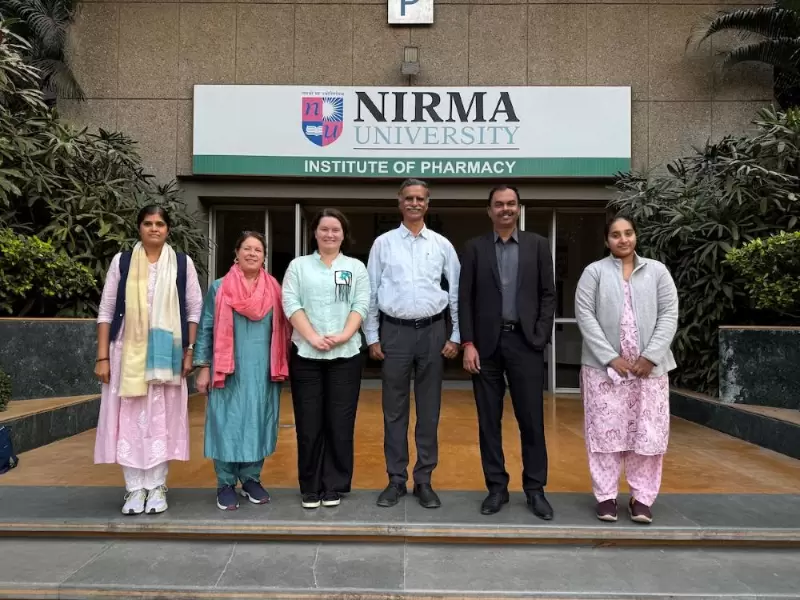 Faculty members from Binghamton University and Nirma University / Courtesy: Binghamton University
Binghamton University partnered with India’s Nirma University and Manipal Academy of Higher Education to expand international collaborations in pharmacy education.
The initiative aimed to advance student exchanges, curriculum sharing, and joint research, supported by the Lois B. DeFleur International Innovation Fund.
The faculty of Binghamton University visited India in Jan. 2026 to focus on deepening academic cooperation and exposing students to different healthcare systems and professional training environments.
ALSO READ: IndoUSrare unveils agenda to boost diaspora role in rare disease research
Elizabeth Hageman, director of skills education and clinical assistant professor of pharmacy practice, and KarenBeth Bohan, professor of pharmacy practice, spent 10 days at the Nirma University Institute of Pharmacy in Ahmedabad and the Manipal Academy of Higher Education College of Pharmaceutical Sciences in Manipal.
Their visit included meetings with administrators, pharmacists, and students; hospital tours; and participation in CPCON 2026, the 11th International Conference on Clinical Pharmacy themed “Next-gen Clinical Pharmacy towards safer and more progressive patient care.”
Hageman said the initiative is part of a broader effort to help students understand global health challenges and healthcare systems. “This is part of a larger outreach of understanding global health initiatives and global health challenges,” she said, adding that exposure to another country’s healthcare environment helps students broaden their perspective and “think outside of the box.”
Bohan highlighted structural differences between pharmacy education in the United States and India. She explained that pharmacy coursework in the United States is governed by the Accreditation Council for Pharmacy Education, while India follows a prescribed curriculum that limits student enrollment and restricts direct interaction with physicians.
According to Bohan, students from Nirma who study at Binghamton gain experience in collaborative healthcare settings through pharmacy skills labs and experiential rotations. “When Nirma students enroll here, they get to see what collaborative practice can be,” Bohan said, noting that the training allows them to learn how to communicate with other healthcare practitioners.
She added that the exchange also benefits Binghamton students by exposing them to new healthcare contexts and cultures. “For our Binghamton students, I think these opportunities expose them to another culture,” Bohan said.
Alongside the in-person visit, the collaboration also included a virtual exchange through the course PHRM 551: Public Health and Global Health Problems. The session brought together 37 Binghamton students and 26 Nirma students to discuss topics including diabetes treatment and the role of community pharmacists.
Hageman said the exercise was designed to highlight how healthcare practices vary globally. “The biggest thing, to us, is helping students understand that the way things work in the U.S. isn’t the same as all over the world,” she said, explaining that students compared healthcare systems in the United States and India to better understand factors shaping those differences.
Hageman also described the Lois B. DeFleur International Innovation Fund as “a seed fund for faculty to establish partnerships with people from abroad,” noting that the support helps faculty develop research collaborations, involve students in international initiatives, and share curriculum models.
Future plans include pharmacovigilance research with Nirma faculty and the submission of an abstract for a poster presentation at an international conference in Sept. 2027.
Discover more stories on New India Abroad.
Leave A Comment
Related






ADVERTISEMENT

ADVERTISEMENT
E Paper
Video

Comments
Start the conversation
Become a member of New India Abroad to start commenting.
Sign Up Now
Already have an account? Login