ADVERTISEMENT
ADVERTISEMENT



Beyond three Guinness World Records: What Oakland Arena really celebrated
When Guinness certifies a world record, it measures what happened on one particular day. What it cannot measure are the twenty-five years that made that day possible
-
 Prasad Kaipa
 - Thu, 06, Aug 2026
- 14:55 EDT
- 62
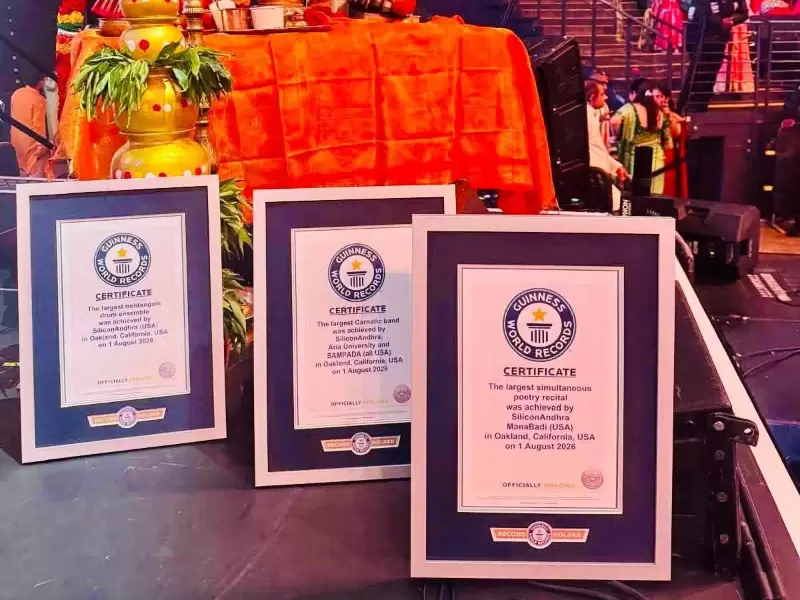 Guinness World Record certificates / Facebook/Lalita Padmini Adibhatla
Like many others, I went to Oakland Arena On August 1 expecting to witness a record-breaking celebration. SiliconAndhra was marking its Silver Jubilee with three Guinness World Record attempts, thousands of performers and one of the largest Telugu artist gatherings that I have ever heard of.
I left thinking about something entirely different.
As I watched children recite verses from the Sumati Satakam and Vemana Satakam, listened to hundreds of musicians perform together, and saw classical dancers, folk artists, theatre performers and volunteers moving with quiet purpose throughout the arena, a question stayed with me.
Also Read: Why some immigrant institutions outlive their founders
What does it take for an immigrant community not merely to preserve its culture, but to transmit it across generations?
That, I believe, is what Oakland Arena really celebrated.
Walk into many Indian community conventions in North America and you generally know what to expect. Film personalities, celebrity performers, political speeches and entertainment dominate the program. These events play an important role in bringing communities together and helping first-generation immigrants reconnect with their roots. They are not wrong; they simply answer a different question than the one SiliconAndhra set out to ask twenty-five years ago.
Oakland offered a different proposition.
Here was an arena filled not by cinema glamour but by Kuchipudi, Carnatic music, percussion ensembles, Telugu poetry, folk traditions and theatre. The stars of the day were teachers, students, artists and volunteers. The audience came not merely to watch performances but to celebrate traditions that had become part of their own lives.
For immigrant communities, preserving culture is rarely the greatest challenge. The first generation naturally remembers its language, festivals and traditions; it carries them instinctively, the way one carries an accent. The more difficult challenge is whether children and grandchildren, growing up in a different society, with different pressures and different definitions of success, will discover meaning in that heritage for themselves, rather than treating it as an obligation.
Watching the performances, I realized that I was not simply witnessing a cultural festival. I was watching the outcome of thousands of learning experiences accumulated over many years.
Every child reciting Vemana represented years of language instruction. Every musician represented years of disciplined practice. Every dance ensemble reflected teachers who had quietly devoted evenings and weekends to transmitting an art form. Every volunteer represented a community that had learned to contribute rather than merely consume. What appeared to be a grand celebration was, in reality, the visible expression of a long educational journey, one that rarely makes headlines because it unfolds one weekend class at a time.
Earlier that morning, I had spoken with SiliconAndhra founder Anand Kuchibhotla. As we spoke, he returned to a theme I had heard him express before, in different words each time: he had never wanted SiliconAndhra to become another organization defined by celebrity appearances or political speeches. His consistent aspiration, however he phrased it, was an institution where children growing up in America would discover the richness of Telugu language, literature, music, dance, traditions, food and values, and feel that these belonged to them rather than to a country they had left behind.
Looking around Oakland Arena, it was clear that this vision had taken root.
Young children recited classical Telugu poetry with confidence. Teenagers who had grown up almost entirely in American schools performed Indian classical arts with remarkable discipline. Professionals, entrepreneurs and corporate executives rehearsed alongside students and retirees. Parents who initially enrolled their children in language or dance classes had themselves become volunteers, organizers and cultural ambassadors, discovering along the way that teaching a tradition often deepens one's own attachment to it.
What I witnessed was not an attempt to recreate Andhra Pradesh in California. It was something more interesting.
A distinctly Telugu-American cultural ecosystem had emerged, rooted in classical traditions yet shaped by the realities of growing up in the United States, fluent in two vocabularies at once. That may prove to be SiliconAndhra's most enduring contribution.
The three Guinness World Records earned during the Silver Jubilee added to a list SiliconAndhra has been building for more than a decade, spanning Kuchipudi dance conventions, a nadaswaram ensemble and now a Carnatic orchestra and Telugu poetry recitation, among others. That is an extraordinary body of achievement by any measure. Yet, in my view, the records are not the organization's greatest accomplishment.
The greater achievement is creating an ecosystem in which thousands of children and adults willingly choose to learn, practice and transmit a living cultural tradition.
When Guinness certifies a world record, it measures what happened on one particular day. What it cannot measure are the twenty-five years that made that day possible: the teachers who patiently trained children week after week, the parents who drove them to rehearsals, the volunteers who quietly built an institution, the friendships that formed along the way, and the confidence that develops when young people discover that their heritage is not something their parents left behind in India, but something they themselves can carry into the future.
That, more than the Guinness certificates, is what Oakland Arena really celebrated.
(The views and opinions expressed in this article are those of the author and do not necessarily reflect the official policy or position of New India Abroad.)
Discover more at New India Abroad.
Leave A Comment
Related
.png)






ADVERTISEMENT

ADVERTISEMENT
E Paper
Video

Comments
Start the conversation
Become a member of New India Abroad to start commenting.
Sign Up Now
Already have an account? Login