ADVERTISEMENT
ADVERTISEMENT



Beyond Success: Indian Americans and Universal Oneness
A fuller description of the Indian American community is needed, one that speaks not just to achievement but to character
-
 Mandar Pattekar
 - Mon, 13, Jul 2026
- 02:52 EDT
- 22
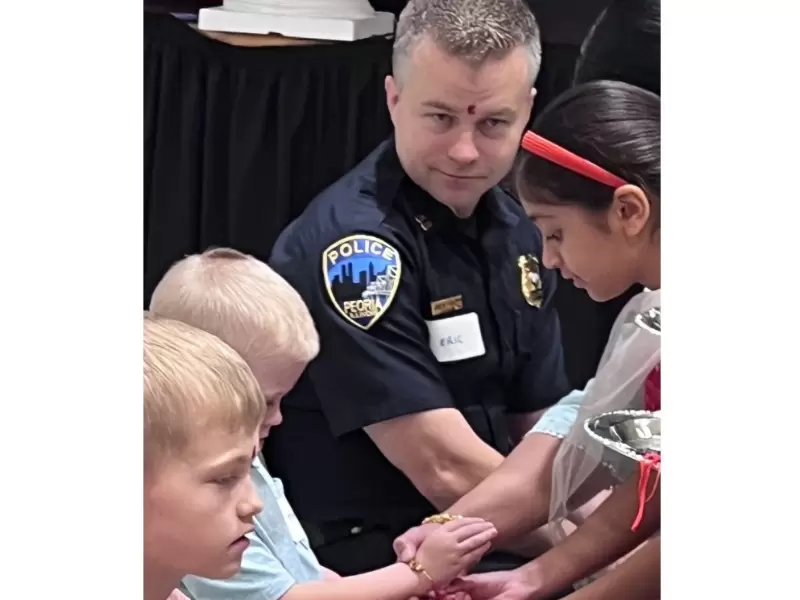 Universal Oneness Day, observed by Hindu Swayamsevak Sangh USA and other Hindu groups through a civic celebration of the Raksha Bandhan festival. / Courtesy photo
Indian Americans are usually portrayed through the language of success: spelling-bee victories, elite degrees, high incomes, corporate leadership. These familiar markers overlook a deeper, more enduring trait: a commitment to service rooted in the Hindu principle of Universal Oneness.
In the 1980s Bollywood film Albert Pinto Ko Gussa Kyoon Aata Hai?, Albert complains that Hindi cinema cannot imagine a Goan or a Christian doing much beyond singing, feasting, and drinking. American popular culture shows a similar failure of imagination, whether in Raj Koothrappali of The Big Bang Theory, Baljeet Tjinder of Phineas and Ferb, or Dr. Lawrence Kutner of House.
ALSO READ: India’s Next Knowledge Bridge
Indian characters are cast again and again as the brilliant scientist, the gifted physician, or the anxious overachiever, feeding a public image of the Indian American as perpetual coder, doctor, immensely rich technocrat, or a groom arriving on an elephant. Even Alex Parrish in Quantico, played by Priyanka Chopra, had to become half-white to be an action hero.
Indian festivals receive the same selective treatment. The camera delights in color, food, and spectacle, then loses interest just as the philosophy begins. Diwali becomes simply the "festival of lights," detached from its deeper teachings about truth, duty, discipline, and the triumph of wisdom over ignorance. The lamps are highlighted; what they are meant to illuminate is not.
A fuller description of the Indian American community is needed, one that speaks not just to achievement but to character. This large, internally diverse community, spanning regional, linguistic, generational, and denominational differences, is best captured not by a résumé or a net worth, but by its manifestation of the ideal of Universal Oneness.
The Hindu ideal of Vasudhaiva Kutumbakam, "the world is one family," teaches that the world is one family, that service is a duty, and that success finds its highest meaning when it benefits others. One's responsibility does not end at the boundaries of family, ethnicity, religion, or nationality. Its practical expression is sewa: selfless service performed without expectation of recognition.
ALSO READ: Finding purpose in an age of despair
Across the United States, Hindu individuals, temples, and organizations stock food pantries, prepare meals, respond to disasters, organize blood drives and health fairs, tutor children, assist refugees, support seniors, and volunteer at shelters. Hindu chaplains comfort patients, military personnel, prisoners, students, and grieving families of all faiths or none.
A physician running a free screening, a student packing backpacks, a family serving meals after a hurricane; these moments occasionally earn a one-cycle evening news segment, but never the feature story. No Hollywood film or TV show has ever alluded to this kind of pan-humanistic quality in its Indian-American characters. This attribute clearly reveals something wealth and test scores cannot: a culture of responsibility.
One public expression of this ethic is Universal Oneness Day, observed by Hindu Swayamsevak Sangh USA and other Hindu groups through a civic celebration of the Raksha Bandhan festival. Traditionally, an occasion honoring affection and protection, it is extended civically as volunteers tie rakhis to first responders, defense personnel, and public officials, affirming that mutual care binds society together. Universal Oneness Day thus turns a family tradition into a civic one, promoting social harmony, interfaith friendship, gratitude toward public service, and the conviction that every person belongs to a wider human family. It asks people not merely to coexist, but to take responsibility for one another.
This is a richer way to understand Indian Americans than the familiar catalogue of achievements. Detractors may point to caste-based discrimination, linguistic animosity, and economic disparity within India itself. Yet despite centuries of invasion and forced religious conversions, a colonial policy of "Divide and Rule" that critics say continued, only slightly more subtly, for decades after independence, and an education system some argue has downplayed India's own history, India remains the only nation of its size and diversity to stay so durably united, and it continues to rise. Only in India can it happen that the majority of devotees at the Catholic basilica of St. Mary in Mumbai, or at the Muslim dargah of Ajmer Sharif in Rajasthan, are practicing Hindus. That same instinct to honor the Divine in all its forms shows up in how most Indian Americans treat their fellow human beings and animals in this country.
This spirit of Oneness is not foreign to America, a nation built by newcomers and their children, many of whom served it long before being fully accepted by it. By recognizing and embracing the Universal Oneness already carried by so many of its citizens of Indian origin, America as a whole stands to embody that same spirit.
(The views and opinions expressed in this article are those of the author and do not necessarily reflect the official policy or position of New India Abroad.)
Discover more at New India Abroad.
Leave A Comment
Related








ADVERTISEMENT

ADVERTISEMENT
E Paper
Video

Comments
Start the conversation
Become a member of New India Abroad to start commenting.
Sign Up Now
Already have an account? Login