ADVERTISEMENT
ADVERTISEMENT



At 250, America's Greatest Achievement Is Still E Pluribus Unum
This capacity to absorb diversity while sustaining national cohesion distinguishes the United States from much of the world
-
 Gitesh Desai
 - Fri, 03, Jul 2026
- 23:50 EDT
- 16
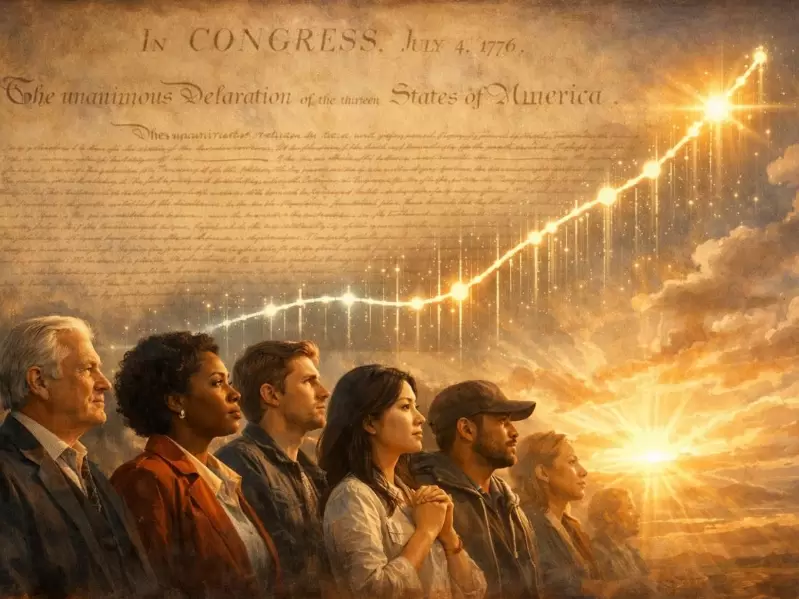 Representative Image / Generated using AI
As fireworks illuminate the skies and communities gather across the nation this Independence Day, Americans will celebrate a rare and remarkable milestone: the 250th anniversary of the nation's founding. Such moments are rare in the life of any country. They invite more than celebration; they invite reflection. They ask us to look back with gratitude, to look around with honesty and to look forward with hope.
Yet this anniversary is about more than looking backward. It also invites a deeper question: What is America's greatest achievement?
It is not merely the nation's wealth, military power, technological innovation or global influence. Impressive as those accomplishments are, America's most remarkable achievement has been the creation of a civic identity that unites people from vastly different backgrounds around a shared democratic enterprise. For 250 years, people from different cultures, faiths and continents have come together not because they share a common ancestry, but because they share a commitment to a common set of principles.
That achievement is captured in the national motto, E Pluribus Unum — "Out of Many, One." More than a slogan, it expresses a defining idea of the American experiment: that unity need not require uniformity, and that citizenship can transcend differences of background, culture, faith and ancestry.
This idea was never easy to realize. Throughout American history, successive waves of newcomers were often greeted with suspicion and resistance. Irish immigrants were accused of being incapable of assimilation. Italians and Eastern European Jews faced prejudice and exclusion. Chinese immigrants encountered legal discrimination. Later generations of immigrants from Latin America, Asia, Africa and the Middle East would face similar doubts about whether they could fully belong.
Yet history tells a different story. The very communities once viewed as outsiders became indispensable contributors to American life. They built businesses, strengthened neighborhoods, served in the armed forces, advanced scientific discovery, enriched the nation's culture and helped shape its civic institutions. The descendants of immigrants once regarded with suspicion would go on to become military leaders, governors, members of Congress, entrepreneurs, scientists, judges and public servants. The American story is not one of static identity. It is one of continual incorporation.
This capacity to absorb diversity while sustaining national cohesion distinguishes the United States from much of the world. Many nations derive their identity primarily from a shared ethnicity, language, religion or historical lineage. The United States, by contrast, has always been something more ambitious: a nation bound together by civic ideals. Americans may differ in countless ways, but they are united by constitutional principles, democratic institutions and a shared commitment to liberty, equality under law and self-government.
That does not mean the American experiment has been free of contradiction. The nation's history includes slavery, discrimination, exclusion and periods when its practices fell short of its professed ideals. Yet the measure of America lies not in the absence of flaws but in its capacity for renewal. Again and again, the country has adapted to changing circumstances, expanded opportunity and sought to bring its realities closer to its principles. Its greatest strength has never been perfection. It has been the willingness to strive toward a more perfect union.
As a naturalized citizen who came to the United States from India, I view this history with particular appreciation. I arrived carrying the values, traditions and heritage of an ancient civilization. Yet America offered something precious: the opportunity to participate in a larger civic project. Citizenship did not require me to abandon my roots. It invited me to join a national community whose identity was defined not by where I came from, but by a shared commitment to where we aspire to go together.
That experience has convinced me that America's tradition of civic belonging remains one of its most valuable and underappreciated achievements. The country's diversity is often described as a challenge to be managed. More often, it has been a source of strength. Across generations, Americans of different origins, backgrounds and beliefs have found ways to participate in a common civic enterprise while preserving much of what makes them distinct. That ability to create unity without demanding uniformity may be America's most enduring accomplishment.
The nation's founders understood that unity would always require effort. In his First Inaugural Address, Thomas Jefferson sought to calm a deeply divided young republic by reminding Americans that "Every difference of opinion is not a difference of principle. We have called by different names brethren of the same principle." More than two centuries later, his observation remains relevant. Disagreement is inevitable in a free society. Division is not.
George Washington expressed a similar concern in his Farewell Address when he urged citizens to place their common American identity above narrower loyalties. "The name of American," he wrote, "which belongs to you in your national capacity, must always exalt the just pride of patriotism more than any appellation derived from local discriminations." His words were not a call for conformity. They were a recognition that democratic self-government depends upon a sense of shared belonging.
That lesson may be especially important as America marks its 250th anniversary. The challenges facing the nation are real. Political polarization, economic anxiety, technological disruption and cultural conflict often dominate headlines. Americans increasingly debate not only public policy, but also questions of identity, belonging and national purpose. Yet previous generations confronted challenges no less daunting. What sustained the republic through wars, depressions, social upheavals and periods of profound disagreement was the belief that Americans could remain one people despite their differences.
The United States has generated extraordinary prosperity, innovation and influence. Yet its greatest achievement may be something less visible and ultimately more enduring: the creation of a common national identity strong enough to unite people from every corner of the world in a shared democratic enterprise.
As Americans commemorate 250 years of independence, they should celebrate not only what the nation has built, but also what it has made possible. The abiding promise of America is not that its citizens will think alike. It is that people from vastly different backgrounds can choose to build a common future together. Generation after generation, newcomers have added their voices to the American story while embracing a shared sense of American citizenship. The story remains unfinished, the work ongoing and the promise alive. Whether that promise endures for another 250 years will depend not on what Americans inherit, but on whether they continue to believe that out of many, one remains both possible and worth preserving.
Gitesh Desai is a community leader and volunteer living in Texas.
(The views and opinions expressed in this article are those of the author and do not necessarily reflect the official policy or position of New India Abroad.)
Discover more at New India Abroad.
Leave A Comment
Related








.jpg)
ADVERTISEMENT

ADVERTISEMENT
E Paper
Video

Comments
Start the conversation
Become a member of New India Abroad to start commenting.
Sign Up Now
Already have an account? Login