ADVERTISEMENT
ADVERTISEMENT



After son’s death, Pearland family pushes for changes to protect students facing disciplinary action
“Our mission is to make sure this does not happen to any other family,” says father Vivek Duggal. “No parents should have to light a pyre for their child.”
-
1749580004.png) Juhi Varma
Juhi Varma - Sat, 15, Aug 2026
- 15:57 EDT
- 29
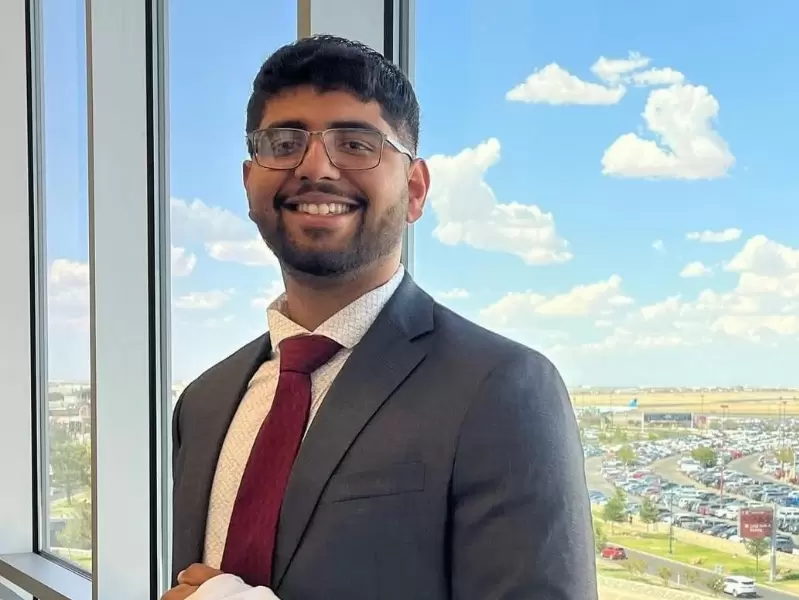 Vaibhav Duggal / Courtesy Photo
A year after 24-year-old Vaibhav Duggal died by suicide, his parents are grieving, but they are also fighting.
Vivek and Neeru Duggal are challenging a recent court ruling that prevented them from pursuing claims against nine Texas Tech University Health Sciences Center officials, while also seeking changes to state law that they say would provide greater protection to college students.
“We know our son is not coming back…what we are fighting for is to make sure that this thing should not happen with another family,” Vivek Duggal said in a phone interview.
Also Read: Texas medical student's suicide sparks legal demands
Vaibhav, a promising student at Texas Tech University Health Sciences Center El Paso, died by suicide after becoming the subject of a university disciplinary investigation. His parents say that rather than being given a proper chance to explain himself, their son was treated as though his guilt had already been determined.
Their campaign has coalesced around three demands: creating a path around sovereign immunity in certain cases, strengthening due-process protections for students, and establishing safeguards for students facing disciplinary proceedings that could derail their education or careers.
Vaibhav’s Law
For the Duggal family, one case has become impossible to ignore: the 2022 death of Stanford University soccer star Katie Meyer. The 22-year-old goalkeeper and captain of Stanford’s women’s soccer team had been facing disciplinary action for allegedly spilling coffee on a Stanford football player who was accused of sexually assaulting another member of the women's soccer team.
At 7 p.m., on February 28, 2022, Stanford sent an email warning of serious consequences, including expulsion and having her diploma withheld. Katie died by suicide in her dorm room early the next morning on March 1.
The circumstances were strikingly similar: a young person in their 20s facing an all-powerful university, and an intimidating, opaque disciplinary email arriving after business hours, presuming guilt and leaving the student with little idea of what would happen next.
In Vaibhav’s case, the email had arrived at an even more ominous hour-- 11:36 p.m.
Katie’s death ultimately prompted California to pass legislation providing additional protections for students involved in disciplinary proceedings.
Vaibhav’s parents say the language in the 11.36 p.m. email suggested that the university had already reached conclusions about his conduct rather than approaching the matter as an unresolved investigation.
In his final note, Vaibhav referred to the disciplinary proceedings and expressed anguish over what was happening to him.
Now his parents are asking a painful question: If another young student had already died under circumstances that prompted lawmakers in another state to change the system, why was there not a system in place to protect their son?
Rep. Cody Vasut (R-TX-25), who represents the area of Pearland where the Duggal family lives, is among the lawmakers discussing potential legislation that could become known as “Vaibhav’s Law.” Democratic state Rep. Suleman Lalani has also expressed interest in pursuing similar legislation, said Vivek Duggal.
The Duggal family has additionally spoken with state Reps. Mary González, Gene Wu and Charlene Ward Johnson and Sen. Paul Bettencourt about the issue.
Sovereign Immunity and Due Process
Duggal said that students accused of wrongdoing should not face potentially life-changing academic or disciplinary consequences based merely on allegations without adequate safeguards and an opportunity to defend themselves.
The Duggal family filed a lawsuit in El Paso County seeking to pursue claims against nine university officials, alleging that their callous treatment, lack of empathy and rigid adherence to institutional procedures created circumstances in which Vaibhav was isolated, treated as though he were already guilty and left feeling increasingly desperate before his death by suicide.
The family is suing the university for $30 million.
But following a June 4-5 hearing, Judge Selena Solis dismissed the family's petition on sovereign immunity grounds, said Vivek Duggal. Solis concluded that sovereign immunity deprived the court of jurisdiction.
Texas’ sovereign immunity laws protect state institutions from lawsuits and liability except in circumstances where the state has expressly waived that immunity.
“We are dealing with a mammoth, the Texas Tech University System is very powerful,” Duggal said, adding “Last year they spent $25 million on getting a quarterback, and that same quarterback was caught in a gambling scandal earlier this year.”
When asked about Vaibhav’s case, Texas Tech Health El Paso sent the following statement- “We extend our sympathies to those affected by this situation; however, due to the pending legal matter, the university is unable to provide additional comment at this time.”
The family is now challenging the court’s decision in an appellate court and has also asked Solis to reconsider her ruling.
The Duggals’ attorneys contend that the court considered an earlier version of their petition rather than the most recent amended petition, which contained information the family obtained after gaining access to Vaibhav's cellphone.
The phone had remained in the custody of law enforcement following Vaibhav's death and was not returned to the family until months later, Duggal said.
After gaining access to it, the family discovered communications revealing Vaibhav's efforts to seek help before he died. The messages indicate Vaibhav went to the office of the director of student services on July 28, 2025 seeking assistance but was turned away before 4 p.m.
Duggal said his attorneys argued that an exception under the Texas Tort Claims Act should apply. Among their arguments is that the university's email system and server constituted tangible state property when an email concerning Vaibhav's disciplinary situation was sent to him at 11:36 p.m.
Where did the $30 million figure come from?
The attorneys explained that a monetary value had to be attached to the case.
For Vivek Duggal, the idea of putting a price on his son’s life was devastating.
“I said, you want me to value my son?” he’d said. “No, I cannot price tag my son.”
In the end, the attorneys arrived at the figure themselves.
“But money is not going to bring any kind of a peace or resolution to us,” Vivek Duggal said. “It's basically to create pressure on the university, is what my attorneys are saying. To be very honest, we want a public apology. We want all these nine people to be dismissed, and all their all their life savings should be frozen. Because this was cold blooded murder.”
Discover more at New India Abroad.
Leave A Comment
Related










ADVERTISEMENT

ADVERTISEMENT
E Paper
Video

Comments
Start the conversation
Become a member of New India Abroad to start commenting.
Sign Up Now
Already have an account? Login