ADVERTISEMENT
ADVERTISEMENT



Trump’s push for more AI data centers faces backlash from his own voters
Residents in Montour County stepped to the microphone, questioning Talen Energy officials about how their planned data center might raise residents' utility bills, reduce working farmland, and strain local water and natural resources.
-
 Reuters
 - Mon, 01, Dec 2025
- 11:22 EST
- 66
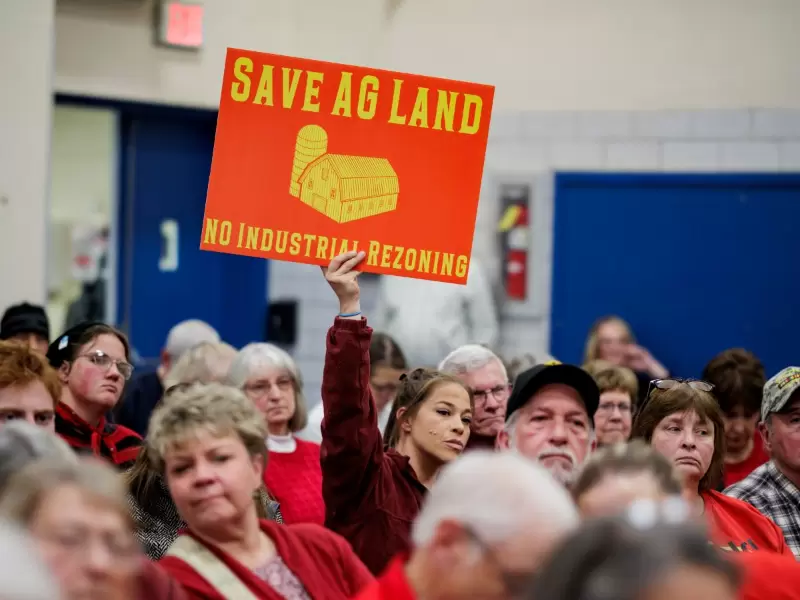 A community member holds a sign against a plan of Talen Energy to rezone land from agricultural to industrial to build a data center, at the Montour County Planning Commission meeting in Danville, Pennsylvania, U.S. November 19, 2025. / REUTERS/Hannah Beier
The residents came in camouflage hats and red shirts signaling unity, more than 300 of them packing into a rural Pennsylvania planning commission meeting to protest a proposed data center they feared would carve up their farmland and upend the quiet rhythms of their valley.
Most were loyal supporters of President Donald Trump, who carried their home of Montour County by 20 percentage points in the 2024 election. But they bristled at Washington’s push to fast-track artificial intelligence infrastructure, which has driven data center growth in rural areas around the U.S. where land is cheap.
On a recent Nov. 2025 evening, residents in this county of 18,000 people stepped to the microphone, questioning Talen Energy officials about how their planned data center might raise residents' utility bills, reduce working farmland, and strain local water and natural resources.
"Say no to rezoning, so water keeps flowing and crops keep growing," two women sang in a riff on Woody Guthrie's folk song "This Land Is Your Land."
Political leaders across the U.S. are urging a rapid expansion of data center capacity and new power production to keep the country competitive in AI. Trump, a Republican, is promoting the build-out as an economic and national security priority and has directed his administration to bypass environmental rules and permitting that give local communities a voice. In Pennsylvania, Democratic Governor Josh Shapiro and Republican Senator Dave McCormick are courting developers with incentives and infrastructure upgrades to attract investment in the fast-growing industry.
Some communities welcome the economic boost. But the backlash in Montour County, nestled in central Pennsylvania, reflects a growing coalition of farmers, environmentalists, and homeowners who have united across partisan lines to resist data center expansion.
A report by Data Center Watch earlier this year found that about $64 billion worth of data center projects have been blocked or delayed amid local pushback in states including Texas, Oregon, and Tennessee. Critics in Pennsylvania worry that their region could turn into northern Virginia’s “data center alley,” with its vast, sprawling complexes.
If successful, the pushback threatens to slow efforts by the administration and the tech industry to build AI infrastructure fast enough to keep pace with global rivals.
Political strategists say anger over the projects also could add to the problems Republicans face as they grapple with affordability worries going into the 2026 midterm elections.
“It’s an issue that can be exploited by whoever’s out of power,” said Chris Borick, a political science professor at Muhlenberg College in Allentown, Pennsylvania.
The politics of AI infrastructure, he added, remain unsettled: “The industry’s still evolving, and politicians are figuring out where to stand. It’s like social media—everyone rushed in before understanding the consequences.”
Preserving culture
Talen Energy is requesting to rezone roughly 1,300 acres in Montour County from agricultural to industrial use, the first step toward building a large data center that would include 12 to 15 buildings. The site would sit in the shadow of the company's 1,528-megawatt natural-gas-fired power plant, tucked among farmland and dirt roads used heavily by the region’s Amish community.
Talen Energy has said the project would take 350 acres of farmland supporting soybeans, corn, and livestock. Residents worry that losing this land would weaken the local farm economy, including a nearby plant that processes soybeans for regional food and feed.
Montour County Commissioner Rebecca Dressler, a Republican, said the concerns are rooted less in ideology than in preserving the region’s character. “Small-town character defines our community,” Dressler said. “People aren’t anti-development—they just want growth that fits who we are.”
At its recent Nov. 2025 meeting, the county planning commission recommended against approving the rezoning by a 6-1 vote—a decision that drew thunderous applause. The issue now goes to Dressler and the other two county commissioners for a final decision in mid-Dec. 2025.
Rather than blaming Trump, residents are pointing their fingers at the billion-dollar companies behind the data-center boom—firms they say have the money to snap up farmland, reshape rural landscapes, and leave locals to absorb the higher utility costs.
“I think it’s a society that has forgotten about the small person—the people who live here, the farmers who are struggling with the economy,” said Theresa McCollum, a 70-year-old Trump supporter.
In a place that prides itself on local control, the shift in power to Washington does not sit well.
“Stay out. We wouldn’t even be having this conversation without federal involvement,” said Craig High, 39, also a Trump supporter. “Both (political) parties are pushing data centers and giving regulatory relief—water permits, permitting, all of it.”
Pennsylvania boom
Pennsylvania’s abundant, stable electricity has made it a hot spot for data centers, attracting tens of billions in investments from Amazon.com, Alphabet's Google, and Microsoft, with Constellation Energy even eyeing the old Three Mile Island nuclear power plant to power new server farms.
But residents fear they may end up paying for it.
Pennsylvania utilities project a sharp rise in electricity demand from data centers by the end of the decade—enough to power several million additional homes, according to data from PJM Interconnection, the region’s grid operator.
Electricity prices in Pennsylvania increased by about 15 percent in the past year—roughly double the national average, according to federal data.
That surge is already rippling through the regional grid. Capacity prices, which help determine what power plants are paid to ensure supply during peak demand, have spiked in recent auctions, and utilities have begun raising rates to cover growing infrastructure needs.
Analysts warn that customers' bills could climb significantly in the years ahead.
For many families, the strain is already visible. Overdue utility balances have risen far faster than inflation since 2022, and Pennsylvania ranks among the states with the highest levels of household energy debt, according to the Century Foundation, a progressive research organization.
Those pocketbook pressures are starting to reshape politics in some parts of the United States. Earlier this year, Alicia Johnson became one of two Democrats elected to Georgia’s utility board since 2007 after her campaign highlighted frustration over rising power bills and unchecked growth of data centers. She said the issues in her campaign were a preview of what states like Pennsylvania may face in next year's U.S. midterm elections.
Power prices have surged in Georgia in recent years, in large part because of massive cost overruns at the new Vogtle nuclear plant.
“Data centers and utility costs were the top two issues on the ballot, and people are angry,” Johnson said. “They don’t want data centers without guardrails, and they don’t want to be the ones paying for them. This is going to be part of the national affordability debate in 2026."
Ginny Marcille-Kerslake, an organizer with Food and Water Watch, an environmental nonprofit group, has spent months mobilizing opposition to data centers in places like Montour County. She predicted a political reckoning next year.
"Communities—red, blue, and everything in between—are united in opposition," she said, referring to so-called red areas dominated by Republicans and blue areas controlled by Democrats. "At a time when we’re so divided, this issue is bringing people together."
Leave A Comment
Related










ADVERTISEMENT

ADVERTISEMENT
E Paper
Video

Comments
Start the conversation
Become a member of New India Abroad to start commenting.
Sign Up Now
Already have an account? Login