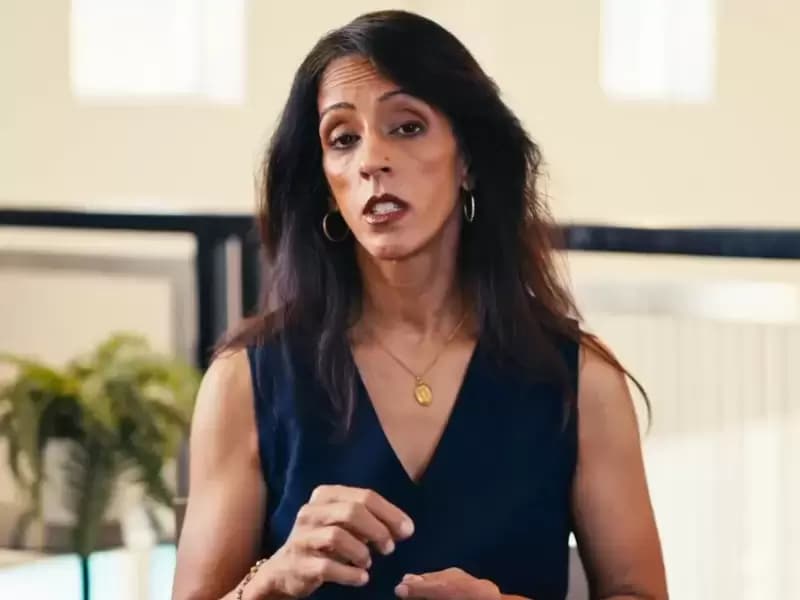
Rakhi Israni / X/@RakhiIsraniCA
In the final weeks before the June 2, 2026, CA-14 Democratic primary, Indian Americans in the East Bay find themselves squeezed from both ends of the political spectrum. From the right, a sitting president amplifies racist rhetoric calling their homeland a 'hellhole.' From the left, a candidate who once authored legislation that painted their community with a broad brush of suspicion now asks for their congressional vote. Against this backdrop, one question demands an honest answer: which candidate in CA-14 will protect Indian Americans and Hindu Americans?
On April 23, 2026, President Donald Trump reposted a four-page transcript and video by far-right radio host Michael Savage to his Truth Social account. In it, Savage described India and China as 'hellhole[s] on the planet,' called Indian and Chinese immigrants 'gangsters with laptops,' and alleged they had 'robbed us blind' and displaced white American workers. Trump shared it without comment or condemnation.
ALSO READ: Rakhi Israni files for CD14 special election
India's Ministry of External Affairs promptly called the post 'uninformed, inappropriate and in poor taste.' The Hindu American Foundation condemned it as a 'hateful, racist screed' that would 'further stoke hatred and endanger our communities, at a time when xenophobia and racism are already at an all-time high.' For the 42,000 registered Indian American voters in CA-14, majority are employed in the very technology fields Savage targeted, this was not an abstract news story. This was a direct attack on them, their families, their professional reputations, and their sense of belonging in America.
This post did not happen in a vacuum. It is part of a documented pattern by the Trump administration targeting Indian American workers, professionals, and immigrants. The question for CA-14 voters is not whether this hostility exists. It does! The question is which candidate has the conviction, the resolve, the history, and the moral clarity to fight back.
Before Aisha Wahab became a congressional candidate, she was the author of California's SB-403, a bill that would have added 'caste' as a protected class to the state's anti-discrimination laws. The bill, introduced in 2023, was vetoed by Governor Gavin Newsom, who concluded that existing laws prohibiting ancestry discrimination were already sufficient.
Wahab framed SB-403 as a human rights bill. In testimony promoting the legislation, she described caste as manifesting in workplaces as 'housing discrimination, unfair hiring practices, human trafficking, workplace bullying and harassment, gender-based violence, rape and murder.' These were sweeping, grave accusations advanced without a verified evidentiary record of such incidents occurring in California.
The data foundation for SB-403 was a survey by Equality Labs, an advocacy organization. In February 2021, a California judge refused to accept the Equality Labs report as evidence in the related Cisco litigation, ruling it inadmissible. The Hindu American Foundation, the Coalition of Hindus of North America, the Americans4Hindus and a broad coalition of community groups argued that the bill relied on unscientific data and would institutionalize ethnic profiling of South Asians.
The core community objection was not that discrimination is acceptable. Discrimination in any form is abominable and against the tenets of Hindu faith, and no authentic Hindu American leader claimed otherwise. The objection was that SB-403 treated all Indian Americans, and Hindus in particular, as presumptively suspect, imposing a stigma of caste oppression on an entire ethnic and religious community based on unverified claims about what they were doing in California workplaces.
Suhag Shukla, Executive Director of the Hindu American Foundation, stated that the bill would 'put a target on hundreds of thousands of Californians simply because of their ethnicity or their religious identity.' Samir Kalra of HAF called the bill a 'cautionary tale of the legal morass that awaits Indians, Hindus and all South Asians' if the state adopted policies that institutionalize 'false and negative claims that stigmatize our community.'
Wahab proceeded anyway. She never issued an apology to the Indian American community for the unrelenting pain and community division SB-403 caused such as the loss of Milind Makwana, Founder of the Ambedkar-Phule Network of American Dalits and Bahujan (APNADB), a vibrant and inclusive community for Dalits and Bahujan’s. He provided strong testimony opposing SB 403 at the Cupertino City Council hearing in July 2023. Shortly after his remarks, he suffered a fatal heart attack at the meeting venue, in the presence of his young children.
Wahab never acknowledged the constitutional concerns raised by civil rights attorneys. And she has never retracted the reprehensible characterizations embedded in her public testimony about what caste allegedly looks like in California workplaces.
The human cost of this environment was most visibly borne by Sundar Iyer, a senior Cisco engineer accused by California's Civil Rights Department of caste-based discrimination and harassment. For nearly three years, Iyer endured what the Hindu American Foundation described as 'a brutal online witch hunt, and a presumption of guilt in the media.'
On April 10, 2023, the California Civil Rights Department voluntarily dismissed its case against Iyer and his colleague Ramana Kompella in Santa Clara Superior Court. The court documents indicated that the state was cognizant of evidence contradicting its assertions during the litigation. The state had falsely identified Iyer as Hindu despite knowing he had publicly identified as agnostic for over 20 years. Court records indicate that Iyer had proposed giving the alleged victim the leadership roles he claimed he was denied.
'Two Indian Americans endured a nearly three-year nightmare of unending investigations, a brutal online witch hunt, and a presumption of guilt in the media after the CRD sullied their reputation.' -- Suhag Shukla, Executive Director, Hindu American Foundation (April 2023)
Iyer and Kompella were vindicated by the court’s decision. No apology came from the state. No accountability followed. And SB-403 -- authored that same year by Wahab and built on the same Equality Labs data the Cisco judge had rejected earlier -- would have embedded that framework into permanent California law, exposing every Indian American professional in the state to the same presumption of guilt.
Wahab has never acknowledged that the legislation she championed was built on a data foundation a court had already found inadmissible. She has never spoken to the Sundar Iyer case in the context of her own bill's potential ramifications.
Where Every Other Candidate Stands
The CA-14 Democratic primary field includes several candidates. None has offered a clear, specific statement defending Indian American and Hindu American civil rights in the wake of the Trump-Savage post or in the context of SB-403's community impact. Silence is a sign of approval. Importantly, the silence is an added insult to the injury injected by SB 403.
Melissa Hernandez has raised no funds from the broader Indian American community and has staked no public position on the issues targeting the Indian community on social media. Matt Ortega is a progressive strategist whose record contains no meaningful engagement with Hindu American civil liberties. Wendy Huang has made no public statement on either the SB-403 legacy or the Trump-Savage attack.
Aisha Wahab, for her part, is asking Indian Americans in CA-14 to send her to Congress, having authored the most divisive anti-Indian American legislation in recent California history and having offered no remorse for its impact.
Rakhi Israni: The Candidate Who Was There
Rakhi Israni was not a bystander during the SB-403 fight. She testified against the bill in the California State Senate Judiciary Committee in April 2023. She was on record supporting the community when it counted.
Israni is a daughter of Indian immigrants, an attorney, an educator, and a working mother of four who has spent her professional life in Fremont, at the heart of CA-14's Indian American community. She is running on universal principles, centering dharma as a political philosophy and as a framework for public service. She is the first major Democratic congressional candidate in this district to run as an openly Hindu American without apology.
Israni has stated unequivocally: 'The rhetoric we see today is that labeling someone and excluding them in the process is the norm. This idea that the color of your skin somehow should determine your involvement in the system is wrong.' That principle applies equally to Trump's racist targeting of Indian Americans and to legislation that treats Hindu Americans as collectively culpable for discrimination they did not commit.
On immigration, she is clear: she opposes ICE overreach, supports permanent legislative solutions for Dreamers, and backs abolishing per-country visa caps -- a position with direct and significant impact on Indian American families caught in the green card backlog. Congressman Raja Krishnamoorthi, the most prominent Indian American voice in the U.S. House, has endorsed her campaign.
The support she has from the Indian American community reflects something the other candidates cannot manufacture trust, earned over decades of showing up.
Indian Americans in CA-14 face a choice in 2026 that is not subtle. On one side is a national political environment where a sitting president amplifies rhetoric calling their homeland a hellhole and calling them thieves of American jobs. On the other side of the ledger is a primary candidate who, while holding state legislative power, authored a bill that subjected the entire Indian American community to a presumption of casteist guilt based on admittedly contested data.
Neither threat is hypothetical. Both have caused documented harm. And in both cases, Rakhi Israni has been on the side of defending the truth.
She testified against SB-403. She speaks openly about dharma as a governing philosophy. She is endorsed by one of the most respected Indian American legislators in the country. She has built a grassroots fundraising operation powered by the community she seeks to represent. And she has made clear, in word and in record, that she will fight Trump's attacks on Indian Americans and other minorities in California with the same conviction she brought to Sacramento.
CA-14 Indian Americans have rarely had a candidate who knows them, lives among them, reflects their values, and has a verified record of defending them. On June 2, 2026, they have one.
Geeta Sikand is an Associate Professor, University of California Irvine
(The views and opinions expressed in this article are those of the author and do not necessarily reflect the official policy or position of New India Abroad.)
Discover more at New India Abroad.
ADVERTISEMENT
ADVERTISEMENT
Comments
Start the conversation
Become a member of New India Abroad to start commenting.
Sign Up Now
Already have an account? Login