ADVERTISEMENT
ADVERTISEMENT



What this summer’s Supreme Court rulings mean for Indians in America
For the Indian community, this summer's rulings send a mixed signal.
-
 Sheetal A. Patel
 - Sat, 25, Jul 2026
- 10:12 EDT
- 34
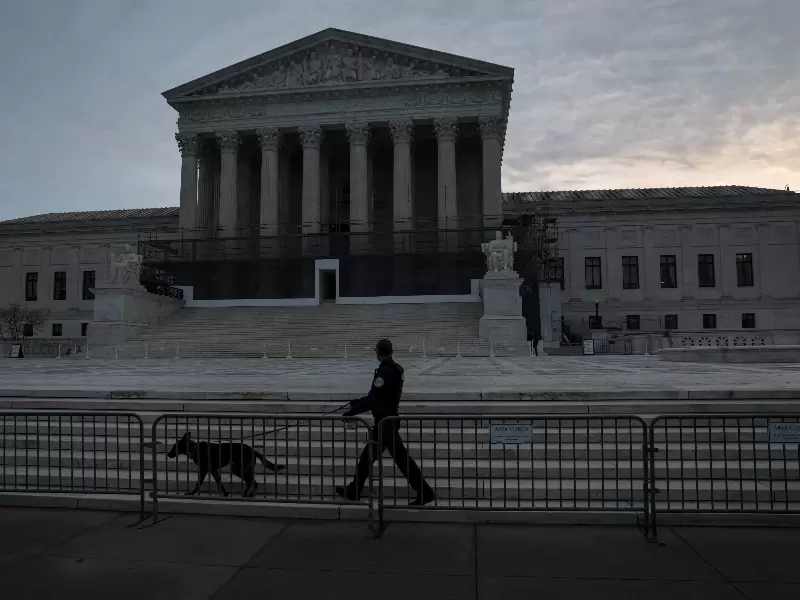 FILE PHOTO: A U.S. Supreme Court Police canine unit patrols in front of the court building at the start of the day in Washington, D.C., U.S., January 9, 2026. / REUTERS/Jonathan Ernst/File Photo
Over the past several weeks, the U.S. Supreme Court has issued a series of immigration rulings that reshape the legal landscape for millions of foreign nationals in the United States.
Few communities have as much at stake as the roughly 3.2 million Indian immigrants who call this country home, along with hundreds of thousands more on temporary visas. Here is a breakdown of the rulings and what they mean for Indian nationals.
Birthright Citizenship Upheld
The most closely watched decision came on June 30, 2026, when the Court ruled 6-3 in Trump v. Barbara that the 14th Amendment guarantees citizenship to children born on U.S. soil, rejecting a 2025 executive order that sought to deny automatic citizenship to children of undocumented or temporary-status parents. Chief Justice John Roberts cited the Court's 1898 ruling in United States v. Wong Kim Ark, writing that birthright citizenship has been settled law for 128 years.
The decision carries particular weight for Indian nationals. More than 400,000 work in the U.S. on H-1B visas, and over a million remain in the employment-based green card backlog, some having waited more than a decade. For these families, children born here will still receive citizenship at birth, regardless of how long their parents' own path to permanent residency takes.
ALSO READ: An American Promise Worth Protecting
A Tighter Standard for Green Card Holders Returning from Travel
A second decision, Blanche v. Lau, decided on June 23, 2026, addressed how immigration officers treat lawful permanent residents re-entering the country after travel abroad. Officers no longer need “clear and convincing evidence” of a disqualifying offense to reclassify a returning resident as an “applicant for admission” rather than readmit them outright; a lower “reason to believe” standard now suffices, with proof to follow later in removal proceedings.
That shift matters: an applicant for admission carries a heavier burden to prove their right to remain, and their green card can be held during proceedings. Justice Ketanji Brown Jackson dissented, warning the ruling gives the government broad latitude at the border. The decision affects an estimated 13 million lawful permanent residents nationwide, a group in which Indian nationals make up a substantial share. Those with active criminal matters should seek advice from immigration and criminal defense counsel before traveling internationally.
A Federal Court Strikes Down the $100,000 H-1B Fee However It Remains In Effect
Unlike the rulings above, this development did not come from the Supreme Court, but it has drawn just as much attention. On June 8, 2026, a federal district court in Massachusetts ruled in State of California v. Noem that the Trump administration's $100,000.00 fee on new H-1B petitions filed for workers outside the United States was unlawful, finding it functioned as a tax the executive branch had no authority to impose without Congress.
The relief was short-lived. Days later, the same court stayed its own order while the government appeals to the First Circuit, and the fee remains in effect for now even though the underlying ruling against it still stands. A related challenge is pending before the D.C. Circuit, and the conflicting outcomes make Supreme Court review increasingly likely. This is something to note as Indian nationals file a majority of the new H-1B petitions each year.
The Broader Picture
For the Indian community, this summer's rulings send a mixed signal. The birthright citizenship decision offers a measure of certainty to families navigating a green card backlog that can span decades.
At the same time, Blanche v. Lau introduces new uncertainty for green card holders who travel internationally, and the $100,000 H-1B fee dispute remains unresolved. As this litigation continues, these decisions are likely to remain a point of close attention for Indian nationals and the businesses that employ them.
(The views and opinions expressed in this article are those of the author and do not necessarily reflect the official policy or position of New India Abroad.)
Discover more at New India Abroad.
Leave A Comment
Related

.jpg)

ADVERTISEMENT

ADVERTISEMENT
E Paper
Video

Comments
Start the conversation
Become a member of New India Abroad to start commenting.
Sign Up Now
Already have an account? Login