ADVERTISEMENT
ADVERTISEMENT



New framework maps path to power for AAPI communities
The “DNA” model argues that data, storytelling and advocacy must work together to shape policy and public influence for Asian American and Pacific Islander communities.
-
 Malvika Choudhary
 - Mon, 19, Jan 2026
- 14:08 EST
- 171
 Karthick Ramakrishnan's blog / AAPI Data
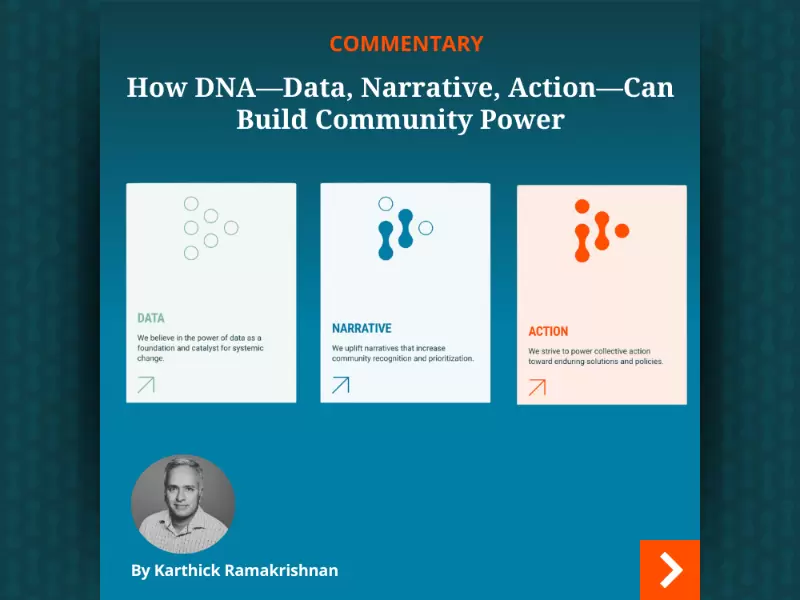
A new framework proposed by AAPI Data says Indian Americans and other Asian American and Pacific Islander (AAPI) communities can build stronger public and political influence by linking data, narrative and action.
The framework, called DNA — short for Data, Narrative and Action — is aimed at helping community organizations, researchers, policymakers and journalists move beyond data collection toward strategic public impact, Karthick Ramakrishnan, the organization’s founder and executive director, wrote in a blog post.
Also Read: Immigration, cost of living main AAPI concerns, survey finds
In the blog post, Ramakrishnan argues that the framework is rooted in the idea that data, while necessary, is not sufficient on its own to produce policy change or public recognition for communities that are often undercounted or misunderstood.
“Without accurate and representative data, whole communities can be rendered statistically invisible and left out of conversations around policy change and resource allocation,” he wrote.
Using Indian Americans as an example, Ramakrishnan notes that U.S. Census Bureau data consistently shows Indian Americans as the highest-earning group in the United States. He writes that this figure is frequently cited without context and can reinforce misleading narratives about cultural or inherent advantage.
He explained that, when this income data is placed in the historical context of the 1965 Immigration Act—which prioritized skilled labor and family reunification—a different explanation emerges, one that reflects the role of selective immigration policy rather than group-level cultural differences.
The DNA framework was developed in 2017, when Ramakrishnan, who also leads the Center for Social Innovation at the University of California, Riverside, began working on ways to strengthen the public impact of small nonprofits.
The approach was later formalized into a training program that focused on grant writing, program evaluation and media engagement.
Since 2018, AAPI Data has incorporated the framework into its own work, particularly in its national surveys and research partnerships. These include collaborations with the Associated Press, APIA Vote and the National Council of Asian Pacific Americans (NCAPA), which are used to inform media coverage, civic engagement strategies and policy advocacy.
Ramakrishnan stressed that narratives grounded in historical context and community experience are essential to prevent statistics from being misread or used to reinforce stereotypes.
The “action” component of the framework focuses on using data and narrative to guide advocacy and policy engagement.
In the blog, Ramakrishnan wrote that the DNA framework is meant to “bring researchers, journalists, policymakers, and communities together to create lasting change.”
He expressed hope that the framework will encourage institutions to treat data as a form of community recognition, narrative as a source of community power, and action as a pathway to more sustained collaboration and impact.
Discover more at New India Abroad.
Leave A Comment
Related












ADVERTISEMENT

ADVERTISEMENT
E Paper
Video

Comments
Start the conversation
Become a member of New India Abroad to start commenting.
Sign Up Now
Already have an account? Login