ADVERTISEMENT
ADVERTISEMENT



India rejects proposal for third category of UNSC membership as ploy to delay reforms
Representative Yojna Patel on Feb. 21 said the suggestion would continue to leave the United Nations mired in a crisis of legitimacy for decades.
-
 IANS
IANS - Sat, 21, Feb 2026
- 00:57 EST
- 141
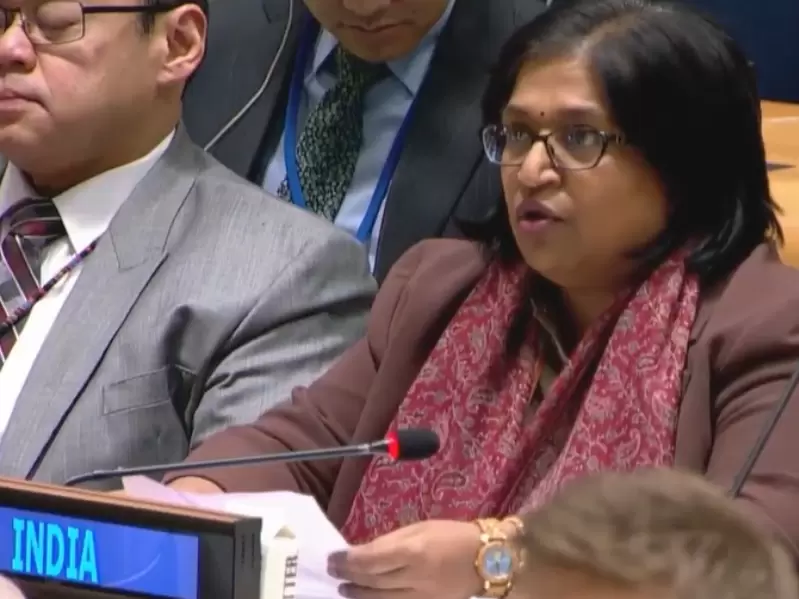 India’s Deputy Permanent Representative Yojna Patel speaks at a meeting of the Intergovernmental Negotiations on Security Council reform on Friday, February 20, 2026. / UN
India has rejected proposals for a third category of membership in the Security Council that would have longer terms and be eligible for re-election as a substitute for expanding permanent membership, calling it a ploy to delay reforms.
India’s Deputy Permanent Representative Yojna Patel on Feb. 21 said the suggestion would continue to leave the United Nations mired in a crisis of legitimacy for decades.
“Consideration of a third category is a red herring that is intended to delay the process further and derail the path toward reforms entirely, or deliberately seek a suboptimal outcome that would push real reform many decades into the future to the detriment of the legitimacy, credibility and relevance of the UN,” she said at a meeting of the Intergovernmental Negotiations for reforms that discussed categories of membership.
The proposal for the third category, referred to as Fixed Regional Seats, emanates mainly from a small group opposed to expanding permanent membership that calls itself the Uniting for Consensus group, led by Italy, with Pakistan as a member.
ALSO READ: U.S. trade gap widens; India deficit at $58bn
The group proposed the category as a substitute for expanding permanent membership, which it opposes.
The Uniting for Consensus group has also consistently blocked progress in negotiations by using procedural maneuvers to prevent the adoption of a negotiating text essential for moving forward.
In a dig at the group, Patel said, “Barring a few member states with vested interests, the wider membership agrees that the time for reforming the Security Council was yesterday.”
Japan’s Permanent Representative Yamazaki Kazuyuki, speaking on behalf of the Group of Four that includes India, said, “The proposed seats are essentially not any different from the current non-permanent seats.”
Since continuity of membership is not assured under the proposed category, “it cannot be a substitute for permanent seats and does not constitute a sufficient solution to the structural imbalances currently existing within the Council,” he said.
The Group of Four, which also includes Germany and Brazil, advocates jointly for reform that includes expanding permanent membership, and its members support one another for permanent seats.
“The G4 reiterates that this proposal disregards the majority of voices supporting expansion in both the permanent and non-permanent categories,” Yamazaki said.
Another pro-reform group to which India belongs, the L.69, also opposed the third-category proposal.
Saint Lucia’s Permanent Representative Menissa Rambally, speaking on behalf of the L.69 group, said it “views with concern” any intermediate or hybrid proposal that substitutes expansion of the two categories.
It would not amount to real reform of the Council, she said, adding, “The Global South did not wait 80 years only to accept hybrid formulas as a consolation or the appearance of reform.”
The L.69 is a group of 42 developing countries from across the world pursuing Security Council reform. The group takes its name from a document that helped initiate the Intergovernmental Negotiations process.
Patel also dismissed a suggestion to grant veto power to holders of Fixed Regional Seats.
“A veto cannot be granted to a group with no clarity on which country will exercise it and in what manner,” she said.
“This new idea seems to be deliberately intended to complicate an already difficult discussion and indirectly entrench opposition to expansion of the permanent category,” she added.
Patel said expanding both the permanent and non-permanent categories “is central to achieving meaningful reforms” and has the backing of a majority of UN members.
“Any reform that does not result in the expansion of the permanent category would be incomplete, unjust and ignorant of the aspirations of an overwhelming number of member states, particularly various reform-centric groups,” she said.
Dismissing criticism that expanding permanent membership would complicate the Council’s functioning, Patel said, “The working methods and practices of the Security Council could be reviewed and reformulated to meet the requirements of a reformed Council, with increased presence of more member states in both categories.”
She added that addressing the nonrepresentation or underrepresentation of the Asia-Pacific, Africa and Latin America-Caribbean groups in the permanent category is central to any Council reform.
Discover more stories on NewIndiaAbroad
Leave A Comment
Related








ADVERTISEMENT

ADVERTISEMENT
E Paper
Video

Comments
Start the conversation
Become a member of New India Abroad to start commenting.
Sign Up Now
Already have an account? Login