ADVERTISEMENT
ADVERTISEMENT



USIBC hosts U.S.-India critical minerals task force
The meeting brought together more than 100 stakeholders from government, industry, and academia across both countries.
-
 Malvika Choudhary
 - Fri, 31, Jul 2026
- 12:32 EDT
- 26
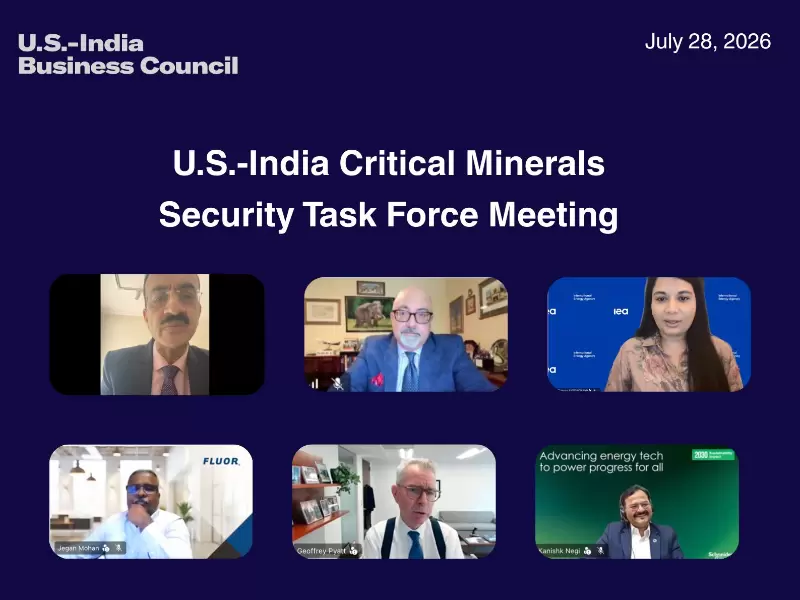 Meeting of its U.S.-India Critical Minerals Security Task Force / X/ @USIBC
The U.S.-India Business Council (USIBC) convened the latest meeting of its U.S.-India Critical Minerals Security Task Force on July 28 to advance bilateral cooperation on critical minerals and rare earth supply chains.
The industry-led meeting brought together more than 100 executives from U.S. and Indian companies, sector experts, universities, Indian research institutions, and representatives from 11 agencies across both governments, including U.S. national laboratories.
Also Read: USISPF launches 'We The People – 250 Voices' in New Delhi
The discussions followed the signing of the U.S.-India Strategic Critical Minerals Cooperation Framework, which aims to strengthen collaboration across mining, processing, recycling, financing, and resilient supply chains for critical minerals and rare earth elements.
On July 28, the U.S.-India Business Council hosted the next edition meeting of its - an industry-led platform to engage on bilateral commercial and policy discussions on the critical mineral… pic.twitter.com/R5zcQVoOIr
— U.S.-India Business Council (@USIBC) July 31, 2026
USIBC president Atul Keshap introduced the Task Force as a platform for governments, industry, and research institutions to develop commercially focused recommendations for policymakers in both countries.
Keshap also highlighted the leadership of India's External Affairs Minister S. Jaishankar and U.S. Secretary of State Marco Rubio in elevating critical minerals as a strategic priority in the bilateral relationship. He also recognized the contributions of Indian Ambassador to the United States Vinay Mohan Kwatra and U.S. Ambassador to India George Glass in advancing cooperation in the sector.
The meeting featured opening remarks from Ashutosh Jindal, Minister (Economic Affairs) at the Embassy of India in Washington, D.C., and Samuel Fodale, Energy Advisor at the U.S. Embassy in New Delhi.
Pradeep Karuturi, Director for Energy and Natural Resources at USIBC's Global Policy and Leadership initiative, briefed participants on recent engagements at the Fastmarkets Global Lithium Conference, outlined the Task Force's priorities, and discussed opportunities for stakeholder participation.
USIBC partnered with the International Energy Agency (IEA) for the meeting, where Amrita Dasgupta, Energy and Mineral Supply Analyst at the IEA, presented findings from the agency's recently released Global Critical Minerals Outlook 2026.
The report examines global trends in mineral demand, supply security, and investment as countries seek to diversify critical mineral supply chains.
Critical minerals–including lithium, cobalt, graphite, nickel, and rare earth elements—are essential for electric vehicles, semiconductors, clean energy technologies, and defense systems. As geopolitical competition over these resources intensifies, Washington and New Delhi have stepped up efforts to build secure and diversified supply chains and reduce dependence on concentrated sources of supply.
According to USIBC, the Task Force will identify commercial partnerships and policy priorities to strengthen resilient supply chains while expanding bilateral cooperation across the entire critical minerals value chain, building on the Strategic Critical Minerals Cooperation Framework signed by the two countries earlier this year.
Discover more at New India Abroad.
Leave A Comment
Related






ADVERTISEMENT

ADVERTISEMENT
E Paper
Video

Comments
Start the conversation
Become a member of New India Abroad to start commenting.
Sign Up Now
Already have an account? Login